



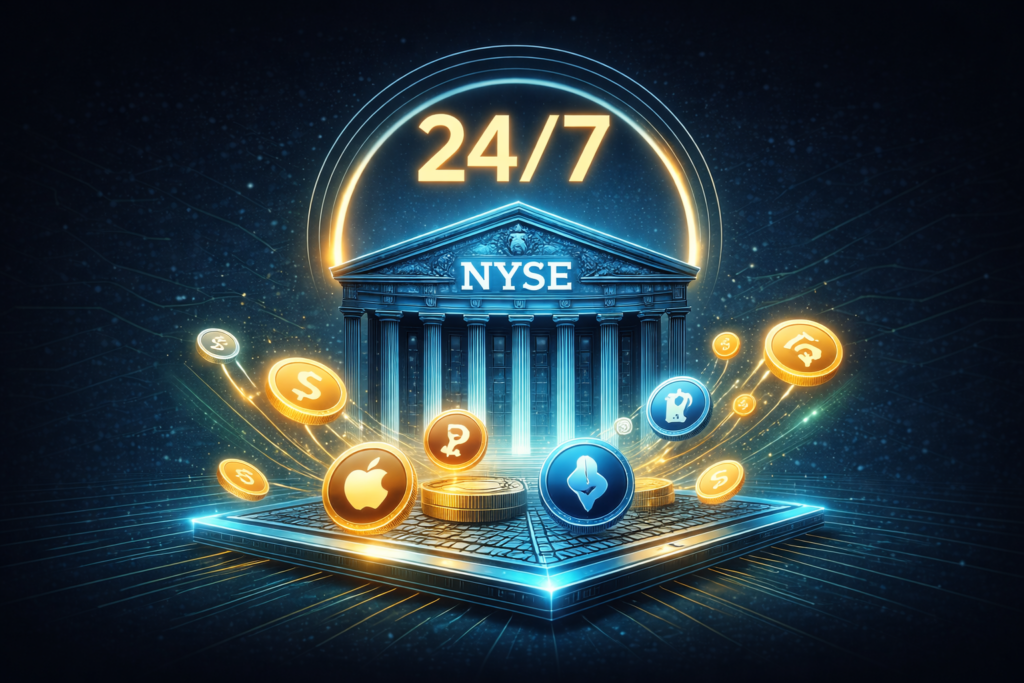
The planned platform will merge the trading infrastructure of the New York Stock Exchange with blockchain technology to enable 24/7 digital equity markets.
THE New York Stock Exchange today announced the creation of a new platform that will allow investors to trade tokenized stocks and ETFs 24 hours a day, seven days a week.
The system will allow investors to purchase fractional shares in dollars and settle transactions instantly using digital tokens and stablecoins, rather than relying on traditional bank transfers. The effort is part of the NYSE parent company’s broader digital strategy. Intercontinental Exchange (ICE)which is preparing its clearing infrastructure for 24/7 transactions and exploring token deposits with banks such as Bank of New York Mellon and Citi.
Lynn Martin, president of the NYSE Group, called the decision a historic step in modernizing the markets.
“For more than two centuries, the NYSE has transformed the way markets operate,” Martin said in a press release. “We are leading the industry towards fully on-chain solutions, built on unparalleled protections and high regulatory standards that allow us to combine trust with cutting-edge technology. By leveraging our expertise to reinvent market infrastructure, this is how we will meet and shape the demands of a digital future.”
The NYSE accepts tokenized stock trading 24/7
Unlike other exchanges experimenting with digital assets, including Nasdaq (which is seeking SEC approval to list and trade tokenized versions of existing securities), the NYSE is not just adding blockchain to its existing systems. The new platform is designed from the ground up as a parallel venue for tokenized transactions. This means that the NYSE will operate two separate markets: the traditional exchange with standard rules and clearing, and a digital market designed for blockchain-based trading.
Traditional NYSE trading will continue as usual, with regular trading hours from 9:30 a.m. to 4:00 p.m. ET and standard settlement the following day. On the other hand, the new tokenized platform will allow investors to trade at any time.
“We think this speaks to the emerging desire of the retail investor to be able to trade something at 5:04 p.m. on a Saturday and then use that money to buy something else at 5:05 p.m. on a Saturday,” said Michael Blaugrund, ICE’s vice president of strategic initiatives. Bloomberg. “It would facilitate this trading in a way that traditional equity infrastructure cannot do.”
The effort reflects the NYSE’s attempt to combine the speed of digital markets with the regulatory protections of traditional finance.
Why the NYSE tokenized platform is important for traders
For traders, the new platform could change how and when they invest in stocks. With tokenized stocks, investors can move quickly from one position to another without waiting for traditional clearing and settlement processes. This means that money from a sale could be ready to use instantly, allowing traders to react more quickly to market opportunities. It also opens the door for small investors to participate in high-priced stocks by purchasing fractional shares.
The platform would also introduce a new way of financing transactions. Rather than relying on bank wires or ACH transfers, investors could use approved dollar-backed stablecoins to transfer money to brokerage accounts and settle transactions on-chain. This would allow the proceeds of a sale to be obtained immediately in digital form, eliminating the multi-day delays common in the current system.
The 24/7 trading model could be particularly attractive to global investors across different time zones. The tokenized platform could allow anyone with access at any time through a qualified broker to trade, leveling the playing field and giving investors more control over their strategies.
The new NYSE platform could also accelerate innovation in financial markets. By showing that a fully regulated blockchain-based exchange is possible, the NYSE could inspire other exchanges and companies to explore tokenized assets and faster settlement systems. For traders, this could mean more options, new ways to invest and a gradual transition to a digital-first market infrastructure in the years to come.
Implications for stock-based prediction markets
The launch of a 24/7 tokenized stock market platform could transform prediction markets linked to stock market performance. Currently, many of these markets are pausing overnight or waiting for traditional settlement before payments can take place. With a digital platform that settles instantly, prediction market users could place trades, hedge positions or adjust strategies in real time, even outside of normal market hours. This could make stock-related prediction markets more liquid, more responsive and more attractive to retail and professional traders.
Regulatory approval of the NYSE tokenized platform could also pave the way for broader changes in how prediction markets are regulated. If the SEC gives the green light to a blockchain-based, all-digital venue like that of the NYSE, it could signal that regulated, crypto-native platforms can be compatible with U.S. financial rules. This could encourage the CFTC to reconsider the current limits of crypto-native prediction markets, allowing for even more innovation in the field.
In October 2025, ICE made a strategic investment of up to $2 billion in one of the world’s leading prediction market platforms, Polymarket, in a deal that valued the company at approximately $8 billion pre-investment and approximately $9 billion post-investment.
Crypto Industry Reaction to NYSE Announcement
The NYSE announcement garnered positive reactions from the crypto community, where many see it as a major validation of blockchain’s role in traditional finance.
Changpeng “CZ” Zhao, founder of Binance, one of the world’s largest cryptocurrency exchanges, called the NYSE plan “bullish for crypto and cryptocurrency exchanges,” highlighting how a heavyweight traditional exchange pivoting to tokenized trading could help cryptocurrency markets gain more widespread acceptance.
Reece Merrick, chief executive of Ripple, the company behind the XRP and blockchain payments network, also called the initiative “big” for the industry, reinforcing excitement among digital asset advocates about the potential reach of tokenized markets.
Campbell Harvey, professor of finance at Duke University, said Reuters that tokenization has real practical applications in financial markets and said that stocks are among the easiest and most promising areas to apply the technology.
“Tokenization is not a fad. It’s a problem-solving technology. And it opens up a long list of possibilities,” Harvey said. “Tokenized stocks are probably the lowest hanging fruit.”

Mike Breen
Mike Breen is a professional writer and editor covering a wide range of topics for over 30 years. He has been a freelance writer in the gaming industry since 2020, reporting on sports betting, online casinos and more for various Catena Media sites, and he began reporting on industry news from the 2025 prediction market for Prediction News. Prior to that, Mike was the founding editor of his hometown newspaper altweekly in Cincinnati, Ohio, where he extensively covered local arts, music and news. Mike’s published writings have received recognition and several awards from organizations such as the Society of Professional Journalists and the Association of Alternative Newsmedia. When Mike is not working, Mike enjoys playing and listening to music, attending comedy shows, watching movies, and spending time with his family and three cats.


