




from Japan Stable coin Rules
JPYC Co. launched what regulators and the company call the world’s first fully regulated and yen-indexed system. stable coin in October 2025, capping a decade of prudent financial architecture that Tokyo began putting in place long before most governments recognized the existence of digital currency.
This step did not happen by chance. Japan’s Financial Services Agency (FSA) spent years designing a framework that would make a collapse like Terra/Luna’s on its soil structurally impossible, and the rules it finalized through amendments to the Payment Services Act tell you exactly where the country’s priorities lie.
Japan sets a hard line on who can broadcast
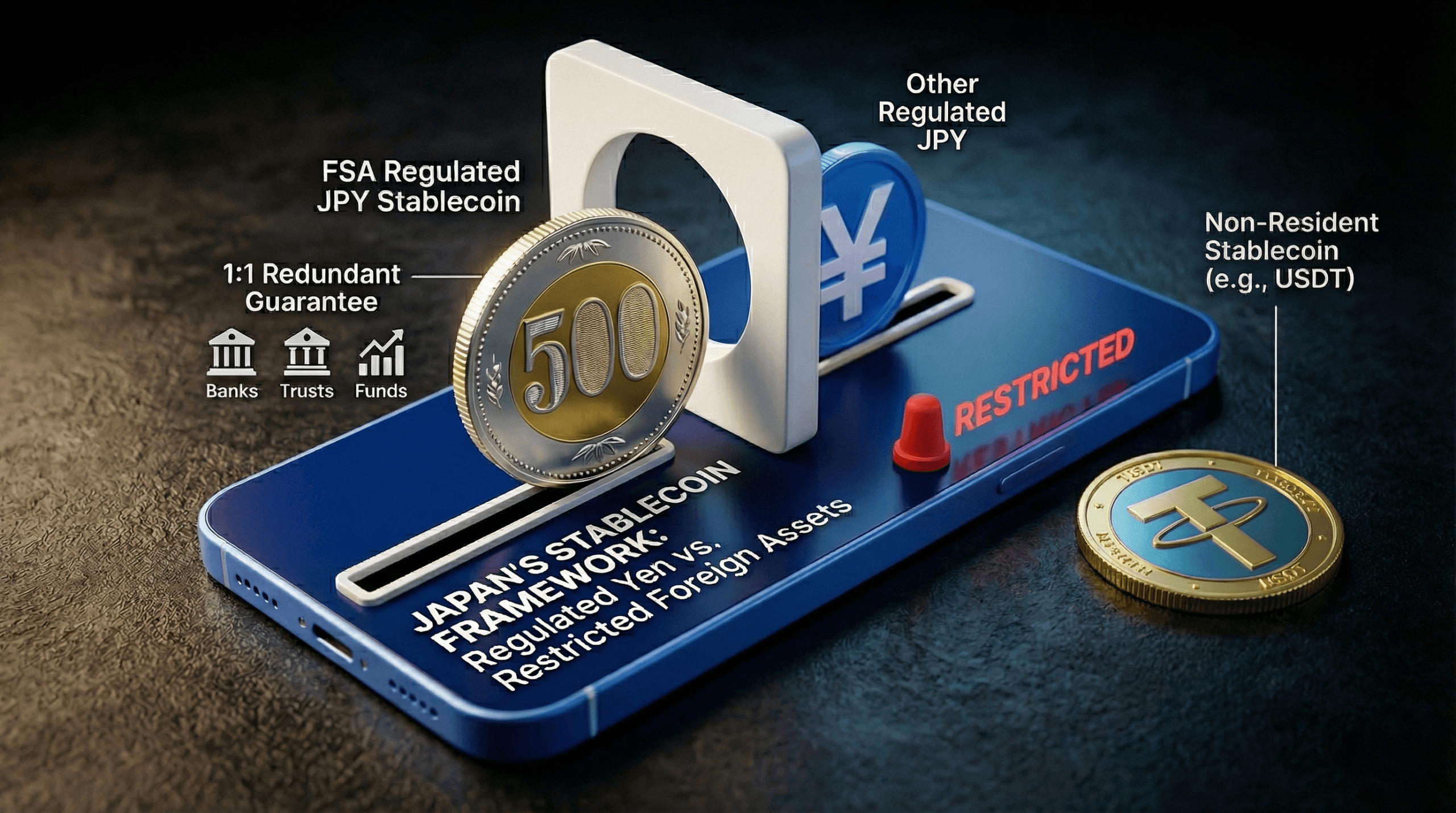
The changes to the PSA, which came into force in June 2023, and additional enhancements due to come into force by June 2026, set a hard line on who can issue what the FSA calls “digital type money.” stable coins.” Only three types of approved domestic entities are eligible: banks, money transfer service providers and trust companies. Each type of issuer has its own reserve structure. Banks issue stablecoins as deposits covered by Japan’s existing deposit insurance system. Remittance service providers back their tokens with cash deposits, bank guarantees or entrusted safe assets, including Japanese government bonds. Trust companies hold all trust assets as bank deposits, with a post-2025 provision allowing up to 50% low-risk short-term instruments.
JPYC became the first company to obtain a remittance service provider license under the new regime in August 2025. Its yen-pegged token operates on Avalanche, Ethereum and Polygon, features a 1:1 yen reserve and charges no transaction fees. Revenue comes from JGB interest earned on the reserve pool. The company has set a target of 10 trillion yen in circulation over three years, with a longer-term goal of 60 trillion yen within five years, focused on remittances, payments and cross-border transactions. Web3 colonies.
The FSA designed this framework with a specific memory in mind. The collapse of Terra/Luna in 2022, which wiped out tens of billions of value globally, solidified Japan’s current caution into explicit law. Regulators concluded that the main risk of stablecoins is a run, the same dynamic that destabilizes conventional banks, and they built par redemption as the foundation of the system. Each issuer is legally required to honor this guarantee. Tokens that cannot meet the standard are reclassified as cryptoassets and are subject to entirely different regulation.
Dollar Stablecoins Run into a wall
This architecture has a direct consequence for USDT and USDC. Denominated in dollars stable coins control approximately 97-99% of the planet stable coin market, but they have a fraction of that share in Japan. Foreign issuers like Tether and Circle cannot distribute securities to Japanese residents without meeting the same user protection and anti-money laundering standards required of domestic entities, a bar that has rarely been cleared.
Japanese stock exchanges have historically avoided listing the USD stable coins rather than navigating the compliance structure. USDT remains largely restricted on Japanese platforms in early 2026. USDC has a limited and regulated path through SBI VC Trade following Circle’s partnership with SBI Holdings, but access is capped and not widely available to retail users.
The preference for digital assets denominated in yen is not entirely regulatory. Japan’s cash-rich domestic economy generates less natural demand for the dollar liquidity tools, and the use of the yen in regional remittances and trade already offers a functional alternative for cross-border needs. The FSA framework reinforced existing market behavior rather than opposing it.
Banks are setting up
Japan’s three largest banks, MUFG, SMBC and Mizuho, develop a trust-based yen stable coins via the Progmat platform via joint proof-of-concept programs. SBI Holdings announced plans to launch a yen stable coin in the second quarter of 2026. The total JPY stable coin market capitalization stands at around $36.6 million at the start of 2026, which is modest relative to global volumes in US dollar terms, but growing in the institutional and cross-border payments segments where the Japanese framework actually works well.
Intermediaries face their own pile
Intermediaries operating in this space face their own compliance requirements. Buy, sell, hold or transfer type of digital currency stable coins requires registration as an electronic payment instrument exchange service provider. Registered businesses must hold at least 95% of clients’ crypto assets in cold storage, segregate user funds in trust structures, comply with FATF travel rule requirements, and enter into contractual liability-sharing agreements with issuers covering losses due to bankruptcy, hacking, or technical failures.
The PSA Amendment Act of 2025, enacted in June 2025, adds a lighter category of intermediaries for pure brokers, relaxes certain reserve rules for trust-type issuers and creates more flexibility for cross-border management. The FSA’s January 2026 consultations focused on the types of bonds that qualify as eligible reserves. The agency is also examining whether certain crypto assets should move from PSA oversight to the Financial Instruments and Foreign Exchange Act, a change that would not affect regulation. stable coin framework but could change investor protections for other digital assets.
How Japan Got Here
Japan’s early regulatory history helped establish the conditions that allowed the market to land today. The collapse of Mt Gox in 2014, then the world’s largest stock exchange, prompted the government to launch the first PSA. crypto changes by 2016. These rules required stock exchange registration, segregation of user assets, and AML compliance for crypto widely. Stablecoins received little attention in this early setting because the products barely existed. JPYC’s predecessor product, launched in 2021 as a prepaid payment instrument rather than a formal means stable coinand the Tochika regional token of Hokkoku Bank in Ishikawa Prefecture were the most visible early experiments before the current regime took shape.
The system Japan has built is deliberate about what it sacrifices. It moves slowly. This favors national issuers. It retains the greatest stable coins effectively sidelined. What it produces in exchange is a structure in which each yen-pegged token in circulation carries a buyback guarantee, an approved issuer, a separate reserve and FSA oversight. This trade-off will differ depending on whether you are a retail user in Tokyo, a megabank treasury office, or a currency exchange trying to quote USDC.
What comes next
Further bank launches are expected in 2026. JPYC expands interoperability through partnership with Circle and TIS integration for enterprise payments. The framework that limited stable coin activity for years in Japan is now the same framework allowing the first regulated national emissions. Whether this pace will satisfy the market is a separate question from whether the system is working as intended.
FAQs 🔎
- What stable coins are they legal in Japan? Unique type of digital currency pegged to the yen stable coins issued by FSA-licensed banks, money transfer service providers or trust companies are legal for circulation to Japanese residents.
- USDC or USDT available in Japan? USDT remains largely restricted on Japanese platforms, while USDC has limited regulated access through SBI VC Trade under a Circle partnership.
- What is JPYC? JPYC is the first fully regulated yen-pegged stablecoin, launched in October 2025 by JPYC Co. under Japan’s revised Payment Services Act.
- Why does Japan restrict foreign trade stable coins? Japan’s FSA requires all stablecoin issuers targeting residents to meet the same user protection, reserving, and anti-money laundering standards as licensed domestic entities, a threshold that most foreign issuers have not met.


