




Avihu Levy, StarkWare’s chief product officer, proposed a cryptosystem that he said would make Bitcoin transactions secure today for quantum computing – without requiring a soft fork, hard fork, or any change to the existing protocol.
Published on GitHub on Thursday, the Quantum Safe Bitcoin (QSB) proposal operates entirely within Bitcoin’s legacy scripting constraints and is designed to remain secure, Levy claims, even against an adversary running Shor’s algorithm on a large-scale quantum computer.
The problem is significant: each transaction would cost the sender between $75 and $150 in GPU computing, making the system impractical for routine use and limiting its suitability, at least initially, to high-value transfers.
Quantum-secure Bitcoin transactions without softforks pic.twitter.com/Ni7pA6dEsC
– Avihu Levy ✨🐺 (@avihu28) April 9, 2026
DISCOVER: Best Crypto to Buy Right Now – Updated Guide from CoinSpeaker
Hash-to-Sig Puzzle Mechanism: What the Proposed Bitcoin Quantum System Actually Does
Bitcoin’s current signature scheme – the Elliptic Curve Digital Signature Algorithm, or ECDSA – derives its security from the computational difficulty of the elliptic curve discrete logarithm problem. This hardness does not hold up against a sufficiently powerful quantum computer running Shor’s algorithm, capable of solving the problem in polynomial time.
As recent Google Quantum AI research has shown increasingly concretely, the hardware threshold for executing such an attack could be closer than previously modeled – with estimates suggesting that ECDLP-256 could be broken using around 500,000 physical qubits, a compression 20 times greater than previous projections.
Levy’s proposal completely bypasses ECDSA by replacing the proof-of-work signature-sized puzzle with what he calls a signature hash puzzle.
Rather than proving knowledge of a private key through elliptic curve calculations, the spender must find an entry whose hash result randomly resembles a valid ECDSA signature – a brute-force search task that offers no shortcut to quantum computing algorithms. In other words, the security model shifts from a mathematical structure that Shor’s algorithm can exploit to being resistant to pre-image hashing, which it cannot.
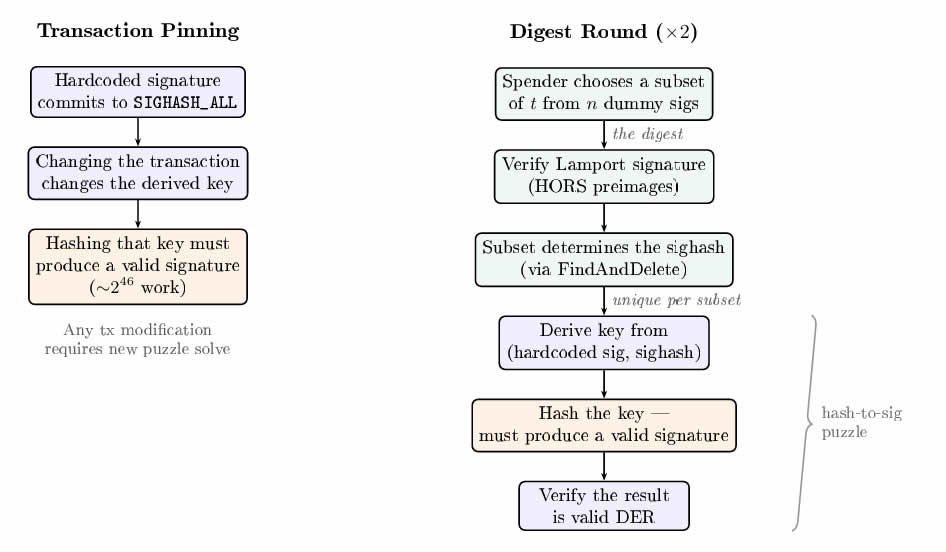
QSB requires significantly more computing power. Source: GitHub
The key implication: QSB does not fix ECDSA – it replaces the cryptographic assumption underlying the spend condition, while leaving Bitcoin’s transaction format, consensus rules, and scripting engine intact.
The QSB proposal: claims, methodology and what remains unverified
Levy’s proposal, which has not been peer-reviewed or officially published by an academic body at the time of writing, describes a transaction construct that encodes the signature hash puzzle into existing Bitcoin scripting primitives. No new opcode is required.
No coordination of minors is necessary. From a network perspective, a QSB transaction is indistinguishable from an existing transaction: it simply generates output using a scriptSig that satisfies an unusually constructed scriptPubKey.
The calculation burden lies entirely with the sender. Finding a hash pre-image that mimics a valid ECDSA signature requires significant brute-force GPU work – Levy estimates between $75 and $150 per transaction at current compute prices. This cost does not seem relevant, for example, for a transfer to cold storage on a treasury scale; it’s prohibitive for coffee. Levy acknowledges this directly, describing QSB as a stopgap for large BTC positions while the community deliberates on a longer-term protocol-level solution.
THIS IS HUGE. Bitcoin is quantum-secure TODAY.
Even though a quantum computer has emerged, one that breaks conventional Bitcion signatures, it provides a practical way to create secure Bitcoin transactions. WITHOUT CHANGE TO THE BITCOIN PROTOCOL!!!
—Eli Ben-Sasson | Starknet.io (@EliBenSasson) April 9, 2026
StarkWare CEO Eli Ben-Sasson characterized the proposal in harsh terms on X, stating that it “essentially makes Bitcoin quantum safe today.” This framing does important argumentative work – the system makes specific high-value cryptographic transactions resistant to quantum computing as part of its defined threat model, which does not equate to Bitcoin-the-network becoming quantum-secure in a global sense. The proposal has not been independently verified and no Bitcoin Improvement Proposals have been filed to formalize or standardize the approach.
EXPLORE: Best Coins to Watch – Updated Rankings from CoinSpeaker
following
Disclaimer: Coinspeaker is committed to providing unbiased and transparent reporting. This article is intended to provide accurate and current information, but should not be considered financial or investment advice. Because market conditions can change quickly, we encourage you to verify the information for yourself and consult a professional before making any decisions based on this content.

Daniel Frances is a technical writer and Web3 educator specializing in macroeconomics and DeFi mechanics. Hailing from crypto since 2017, Daniel leverages his experience in on-chain analytics to write evidence-based reports and in-depth guides. He holds certifications from the Blockchain Council and is dedicated to providing “insight gain” that overcomes market hype to find real utility for blockchain.


