



Everyone is talking about the Citrini Research report that sent the market crashing down yesterday. Buried within his 7,000 words of wisdom is a huge buy signal for Solana and Ethereum Layer 2.
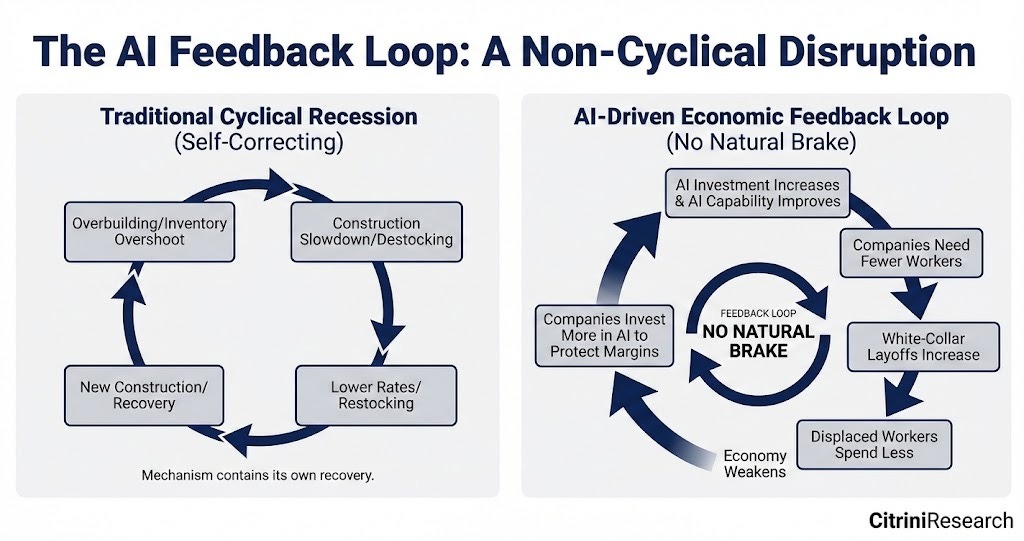
The report, titled The 2028 Global Intelligence Crisis, is a work of fiction that explores a future scenario in which AI disruption leads to what it describes as a “negative feedback loop with no natural brakes.”
In short, AI will displace white-collar workers at an unprecedented rate. This should have been obvious, but we had to wait until 2028 for the penny to drop…
“It should have been clear from the beginning that a single GPU cluster in North Dakota generating the output previously attributed to 10,000 white-collar workers in midtown Manhattan is more of an economic pandemic than an economic panacea. machines spend on discretionary goods (Hint: it’s zero.)
“AI capabilities improved, companies needed fewer workers, white-collar layoffs increased, displaced workers spent less, margin pressure pushed companies to invest more in AI, AI capabilities improved…”
Here’s what it looks like schematically:
Entering an era of abundant intelligence
There is no self-correction as one would expect in a typical cyclical recession.
It looks like this: construction (or other economic activity) slows, rates adjust downward, allowing companies to start increasing production again, until overproduction reappears, and so on.
In the AI doom loop, AI gets better, fewer workers are needed, fewer workers mean less spending, the economy weakens, companies invest in more AI to protect their margins, AI gets better again and the cycle repeats – there is no natural break.
We thought it was a sectoral story. I’m not into Software-as-a-Service (SaaS), so there’s no need to worry. But it’s much more than software. Much more. It was reassuring to think that AI would usher in an era of creative destruction, as past technological attacks on old ways of doing things have shown.
Yes, AI will destroy jobs, but, as in the past, new jobs and previously unimaginable industries will emerge to replace them.
The problem is that, in Citrini’s scenario, AI is a story of displacing human intelligence. All white-collar workers are in danger. This is the consequence of abundant intelligence.
The authors of the Cetrini report point out that advanced economies like the United States are based on services. The report breaks this down so everyone can understand:
“The US economy is a white-collar service economy. White-collar workers accounted for 50% of employment and generated about 75% of discretionary consumer spending. The businesses and jobs that AI was destroying were not tangential to the US economy, they were the US economy.”
Unfortunately for all of us – white-collar, blue-collar, whatever – machines don’t buy anything.
AI agents are destroying intermediation – goodbye credit cards, hello stablecoins
The report makes a strong case for how consumer agents will end the age of intermediation.
AI agents operate autonomously on behalf of their human owners, meaning they can easily find the best flight or hotel on the market because they never get tired, find nothing monotonous or boring, and never sleep.
BIG WARNING: AI COULD PUSH THE GLOBAL ECONOMY INTO A RECESSION THIS DECADE.
And this won’t happen by bursting the AI bubble, but rather by AI becoming bigger and better.
This is a scenario presented by Citrini in its report, and here’s why you should pay attention to it:
Currently, AI is… pic.twitter.com/FIu9PsZA2X
– Crypto Rover (@cryptorover) February 23, 2026
 BIG WARNING: AI COULD PUSH THE GLOBAL ECONOMY INTO A RECESSION THIS DECADE.
The days of companies that rely on our laziness or inertia are numbered. Add “dynamic coding” to the mix, and a new wave of startups can build delivery service apps in weeks to rival DoorDash and the like, or automate workflow in a tailored way that meets your business needs better than, say, Monday. Fees everywhere are reduced to almost zero.
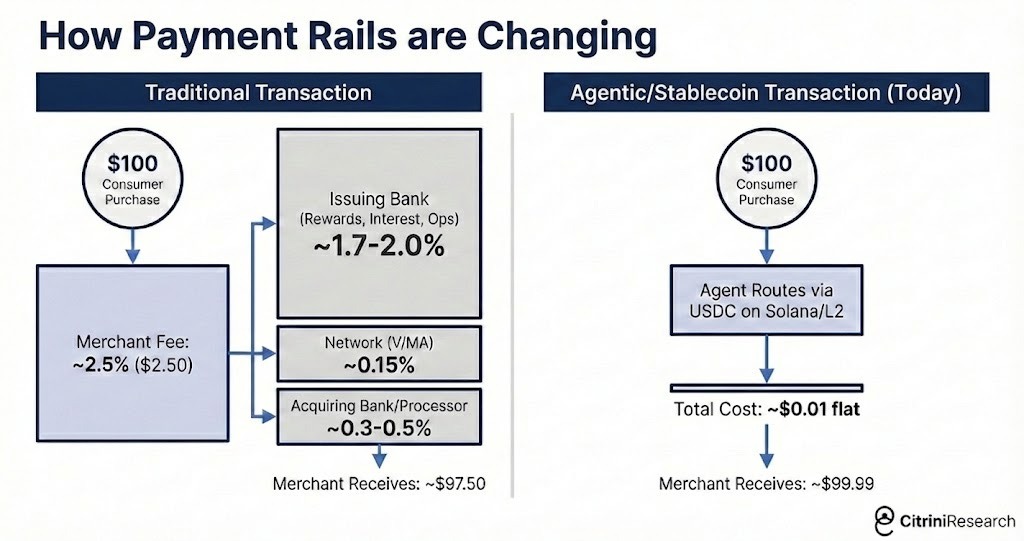
And then we come to our friends, the banks. Why pay fees to Mastercard and Amex when you can use a stablecoin running on a low-cost blockchain like Solana, or an Ethereum Layer 2 like Base, Arbitrum, Optimism or Polygon?
“Once the agents had control of the transaction, they looked for bigger paperclips.
“There was only so much that could be done when it came to price matching and bundling. The best way to save the user money (especially when agents started transacting with each other) was to eliminate fees. In machine-to-machine trading, the 2-3% card swap rate became an obvious target.
“Agents were looking for faster and cheaper options than cards. Most opted to use stablecoins through Solana or Ethereum L2, where settlement was near instantaneous and the transaction cost was measured in fractions of a cent.”
And what agentic AI will do for stablecoins could also be applied to cross-border payment protocols like Ripple’s XRP Ledger, although that is not mentioned in this report.
Coinbase has already begun experimenting with a protocol that allows AI agents to make on-chain payments.
The story of tokenization, disintermediation, and agentic AI to beat the bear market blues
Crypto was looking for a “new” narrative to lift the fog of the bear market. Well, it’s hiding in plain sight: tokenization, disintermediation, and agentic AI.
Will this solve the problem of an economy without enough workers earning wages and salaries to drive the consumption that businesses depend on?
Probably not, but as the report claims, we have time to find a solution to this problem. Taxing hyperscaler “robber barons” is being suggested, but this is unlikely to please the data center overlords.
In payments, as elsewhere, disruption is coming and everyone – investors, businesses and consumers – needs to start thinking about what it all means.
Consumer behavior is already changing. Chargebacks911, a global leader in dispute resolution and chargeback prevention, warns merchants and payment companies that agent commerce will reshape disputes as AI systems move from recommending purchases to fulfilling them. Chargebacks are payment reversals initiated by the cardholder’s bank.
For years, most chargebacks fell into three categories: fraud, merchant error, or buyer’s remorse. Agent-initiated transactions create a fourth scenario. The purchase is technically allowed, but the result does not meet the customer’s expectations.
“The payments industry has always treated the click as a signal of intent,” says Monica Eaton, founder and CEO of Chargebacks911.
“Agent commerce removes the click, so now we need a new way to prove intent when a human is not directly involved.”
Keep an eye on your bank account and welcome to the future.
Report co-author Alap Shah further explains the report’s ideas, such as AI-driven “shadow GDP,” where value accumulates in the balance sheets of hyperscalers but does not appear in the “human-centered consumer economy”:
The post Solana, Ethereum L2 (and XRP?) Just Got a Huge Buy Signal from Citrini Research appeared first on Cryptonews.


