





The debate on which should control – and pay – access to the bank data of American consumers has become acrimonious after the co -founder of Gemini, Tyler Winklevoss, said that Jpmorgan Chase & Co. “try to kill fintech and crypto companies”. In an extended X thread published on Sunday evening, Winklevoss accused that the largest bank in the nation wants to “remove your right to access your banking data for free via third party applications and to charge you exorbitant and fintech costs.”
He warned that the tolls offered “would go bankrupt the fintechs which help you to link your bank accounts to crypto companies like Gemini, Coinbase and Kraken so that you can easily finance your account with Fiat to buy bitcoin and crypto.”
JP Morgan vs. Crypto
Winklevoss Broadside won ten days after Bloomberg revealed for the first time that JPMorgan distributed price sheets to data aggregators describing the costs based on use for application programming calls (API) that move customer data to external applications. Reuters then confirmed the plan and published La Défense initial de la Banque: “We have invested important resources by creating a precious and secure system that protects customers. We have had productive conversations and work with the entire ecosystem to make sure that we make all the necessary investments in the infrastructure that ensures the security of our customers. ”
The timing is delicate. Last October, the Consumer Financial Protection Bureau (CFPB) finalized his personal rule of financial data rights under article 1033 of the Frank Dodd Act, forcing banks to hand over the verification and credit card of a customer – absolutely, while asks him for a third party to recover them.
A few hours after the rule publication, the Bank Policy Institute and the Kentucky Bankers Association continued the CFPB before the Federal Court, arguing that the regulators had exceeded their authority and endangering data security. The case is pending in Lexington, but under the Trump administration, the CFPB has taken the unusual measure to tell the judge that the rule he wrote “should be canceled”, a reversal which, according to criticism, embarked JPMorgan to go ahead with a payment model.
JPMORGAN Director General Jamie DIMON, insists that infrastructure cost recovery costs. “It costs a lot of money to set up APIs and things like that to manage the system,” he told analysts when calling last week’s results, adding that third parties “should pay to access the banking system and payment rails”, according to Payments Dive.
The confrontation overturned in crypto-political circles. Winklevoss argued that the banks’ trial “has undermined President Trump’s mandate to make America pro-innovation innovation and the world capital of cryptography”. Lawyer John E. Deaton echoed the feeling, recalling that he “put the majority of my wealth” in digital assets after Dimon called Bitcoin a fraud and label the chief of JPMorgan “Public Enemy # 1”.
Deaton also underlined the historical fines of JPMorgan compliance, saying that the bank “was sentenced to a fine of $ 40 billion through 281 violations since 2000.” The venture capital and presidential cryptography Czar David Sacks summed up the controversy in one word: “concerning”.
Behind the rhetoric, concrete issues for the exchanges of Crypto, which are based on Plaid, MX, Yodlee and similar bridges to check the customer accounts and shoot Fiat. If data aggregators absorb new costs, they should transmit at least part of the cost of high-frequency users, including exchanges that automate cash scales, making the integration of friction, as well as American regulators are progressing towards lighter securities guides for digital networks platforms.
At the time of the press, Bitcoin exchanged $ 118,620.
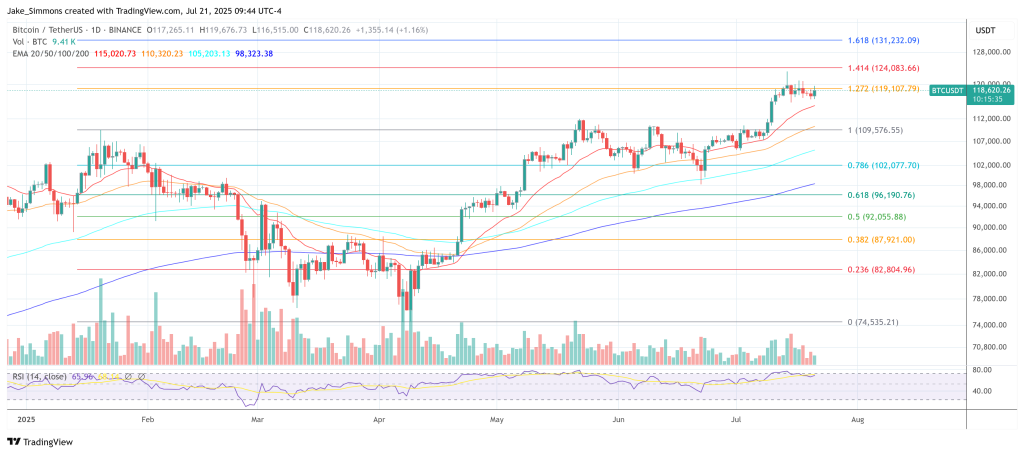
Star image created with dall.e, tradingView.com graphic
Editorial process Because the bitcoinist is centered on the supply of in -depth, precise and impartial content. We confirm strict supply standards, and each page undergoes a diligent review by our team of high -level technology experts and experienced editors. This process guarantees the integrity, relevance and value of our content for our readers.


