




Bitcoin is once again attempting to reclaim the $90,000 level, but price action remains capped below this key psychological threshold. Despite several bouts of short-lived relief, momentum has not kept pace, reinforcing growing concerns that the broader market structure is weakening.
As volatility persists and bullish attempts stop, a growing number of analysts are beginning to openly discuss the possibility that Bitcoin could enter a bear market phase. Confidence in derivatives and spot markets has become significantly more cautious as risk appetite continues to fade.
Related reading
In this context, a recent report from Darkfost draws attention to a familiar but controversial narrative: the rotation of capital from gold to Bitcoin. As gold hits a new all-time high above $4,420 per ounce, the idea that investors may soon shift their capital to Bitcoin is resurfacing in the market.
Historically, this narrative gained traction during periods when traditional safe-haven assets outperformed, fueling speculation that Bitcoin could become an alternative store of value.
However, Darkfost warns that this hypothesis is far from true. Although the rotation thesis has been widely repeated throughout this cycle, empirical evidence directly linking gold’s outperformance to sustained Bitcoin inflows remains weak.
Rather than signaling an imminent bullish turn, the current setup suggests that Bitcoin remains vulnerable, caught between macroeconomic talk and a deterioration in internal market structure.
Testing the gold-Bitcoin rotation thesis
Darkfost points out that the popular narrative that capital is moving from gold to Bitcoin lacks direct, verifiable evidence. To address this problem, he constructed a comparative framework to identify periods where such rotations might have taken place. He did this without assuming a causal relationship. The main problem, as he notes, is that on-chain and market data cannot conclusively prove that the capital flowing out of gold is the same capital flowing into Bitcoin.
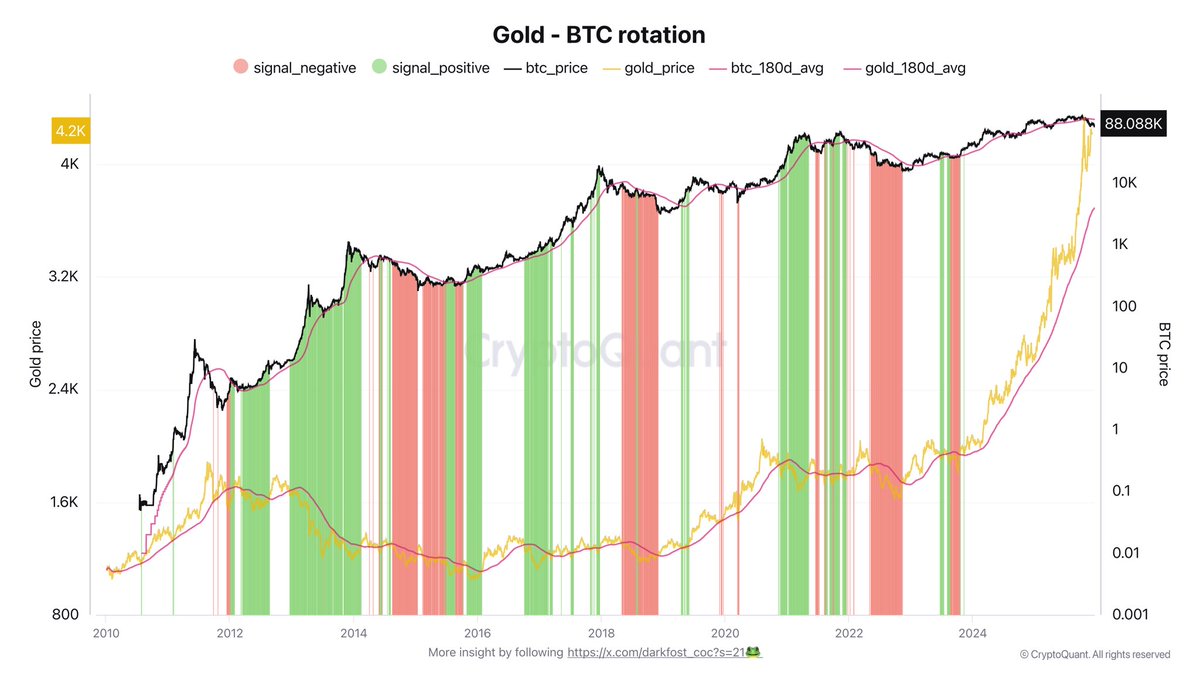
To approximate potential rotation phases, Darkfost applied a simple but disciplined signal structure. A positive signal appears when Bitcoin is trading above its 180-day moving average while gold is trading below its own 180-day moving average. In theory, this pattern suggests that relative strength is shifting toward Bitcoin. Conversely, a negative signal is triggered when Bitcoin and gold trade below their respective 180-day moving averages. Which indicates a broad environment of risk aversion rather than rotation.
This methodology allows for a historical comparison between cycles, highlighting times when relative performance has diverged. However, the results call into question the simplicity of the narrative. As the chart shows, these signals do not produce consistent or reliable results. In several cases, supposed rotation periods have failed to generate sustainable upside for Bitcoin. At other times, Bitcoin has rallied independently of gold’s trend.
The takeaway is clear: capital turnover between gold and Bitcoin is not an absolute or mechanical process. Market behavior seems much more nuanced. Driven by broader macroeconomic conditions, liquidity dynamics and investor positioning rather than simple asset-by-asset turnover.
Related reading
Prices struggle below key moving averages
Bitcoin is trying to stabilize after a strong correction phase, but the chart highlights that price action remains structurally fragile. BTC is currently trading just below the $90,000 level, an area that has moved from support to resistance in the short term following the recent breakdown. While the latest bounce shows short-term buying interest, it has yet to alter the broader bearish pattern that formed after the October highs.

From a trend perspective, Bitcoin is now trading below the 50-3D moving average (blue), which has started to decline, signaling weakening momentum. The failure to regain this level suggests that recent upward movements are corrective rather than impulsive.
Related reading
Below the current price, the 100-3D moving average (green) sits near the $85,000-$86,000 area and has served as interim support during the rebound. A sustained loss from this area would likely expose BTC to a deeper retracement towards the 200-3D moving average (red), which is currently rising near the $80,000 low zone.
The sale was accompanied by high volume. The rebound occurred on relatively lower participation, indicating a lack of conviction on the part of buyers. Structurally, Bitcoin is consolidating in a lower range. With lower highs and compressed volatility suggesting a pause rather than a trend reversal.
For bulls, it is essential to recover and hold above $90,000 and the falling 50-3D moving average to invalidate the bearish bias. Until then, price developments favor trading within a limited range, with the downside risk still present.
Featured image from ChatGPT, chart from TradingView.com


