




Join our Telegram channel to stay up to date with the latest news
The cryptocurrency market is going through a serious crisis of confidence, as Bitcoin (BTC) suffers its biggest decline since early 2025. Over the weekend, Bitcoin broke through several support levels, briefly falling below $78,000 and touching $74,600 before experiencing a weak rebound.
The move pushed Bitcoin to its lowest level since April 2025 and highlighted broader market fragility, driven by a hawkish Federal Reserve appointment and continued outflows from spot ETFs.
Selling pressure has swept away most major assets. Ethereum (ETH) is down about 10% on the day and is struggling to hold on to $2,166, while Solana (SOL) is down 12%, falling below the critical psychological level of $100.
Even traditionally safer large-cap tokens have not escaped damage as liquidations have spread across the AI and coin sectors.
Amid this widespread sell-off, privacy coins have become the most resilient narrative in the market. While themes like AI and gaming are posting double-digit losses, privacy-focused assets are falling much less, and in some cases even seeing gains.
This apparent flight to anonymity indicates that as global regulation and on-chain surveillance intensify, investors are transforming their capital into defensive, privacy-preserving assets during periods of heightened uncertainty.
The main privacy-focused projects currently include:
Monero (XRP)
Monero (XMR) is going through a period of high volatility after a dramatic start to the year. After hitting a new all-time high near $800 in mid-January, fueled by a major technical breakout and growing demand for privacy, the price has since corrected sharply and is now trading around $430.
This recent slowdown largely reflects broader market weakness, with Bitcoin slipping below $80,000 and the crypto fear index falling to 18, a level classified as Extreme Fear. From a technical perspective, XMR is testing a critical support zone between $388 and $415.
Development of Full-Chain Membership Proofs (FCMP++) and CARROT is progressing well, with a new version of alpha stressnet software released and developers planning stressnet beta and CARROT integration audits!
“Proof of full-chain membership proves return spent…
–Monero (XMR) (@monero) January 19, 2026
Analysts note that while the long-term structure remains bullish due to upcoming upgrades to protocols such as FCMP++ (Full Chain Membership Proofs) and the Cuprate Rust node, failure to maintain the $400 level could trigger additional liquidations.
Despite these short-term pressures, on-chain activity remains strong. Whale accumulation and consistent transaction volume continue to solidify Monero’s status as a privacy-focused digital money leader.
Chain link (LINK)
Chainlink (LINK) is facing intense selling pressure as the broader market turns cautious. The token has recently declined by around 22%, from a January high near $13 to its current price of around $9.57.
This sell-off pushed LINK into deeply oversold territory, with the relative strength index (RSI) falling to 23, a level last seen in late 2022.
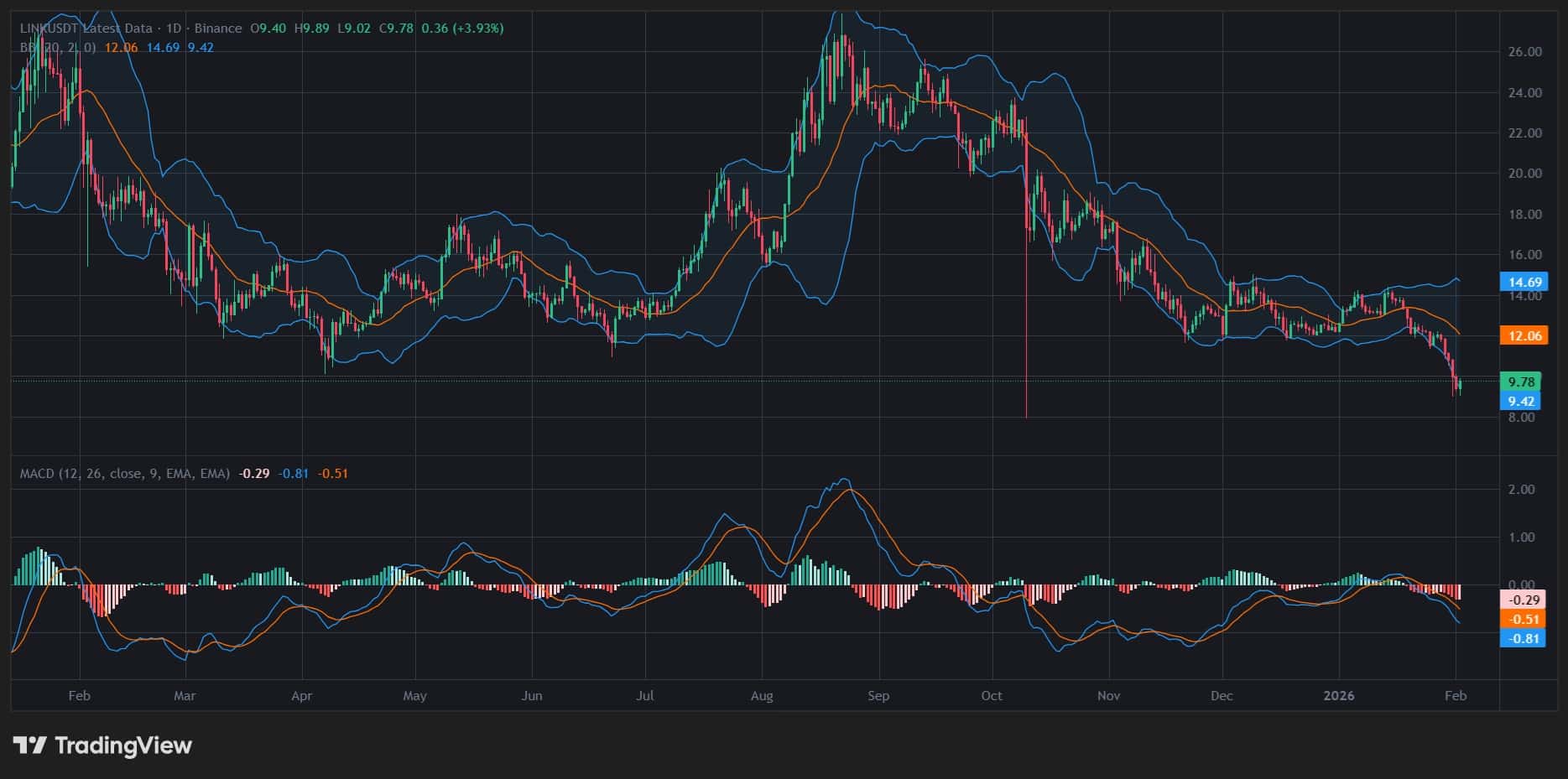
From a technical perspective, the price fell below the key psychological and structural support zone between $10.50 and $11.75 and has since converted this zone into strong resistance. Despite the bearish price action, fundamentals continue to provide a positive point.
Chainlink recently launched its “24/5 US Equity Streams” to enable real-time trading of DeFi stocks, and its official reserve recorded its largest purchase since late 2025, adding over 99,000 LINK.
Although near-term momentum remains firmly negative, analysts are monitoring a possible rebound towards the $12 level, provided LINK can successfully defend its next major support at $8.42.
Canton (CC)
Canton Network (CC) is charting its own path and showing strong resilience, gaining 4.7% intraday as the broader market, including Bitcoin and Ethereum, faces a significant slowdown. CC is currently trading between $0.17 and $0.18 and recently hit a new all-time high of $0.1813.
A powerful institutional adoption narrative is driving this evolution and allowing CC to dissociate itself from the volatility typical of cryptocurrencies.
JPM Coin expands to Guangzhou.@jpmorganDepository Token (JPMD) Set for Native Issuance on Guangzhou, Bringing Regulated Digital Money to Privacy-Friendly Rails👇
– Canton Network (@CantonNetwork) January 29, 2026
Major updates continue to fuel the rally, including Nasdaq joining the network as a Super Validator and JPMorgan expanding the integration of its JPM Coin settlement framework.
Technical indicators such as the MACD indicate a sustained uptrend, while CC continues to defend critical support at $0.155. As a result, the market is increasingly viewing CC as critical infrastructure for the regulated tokenization of real-world assets (RWA) rather than a purely speculative asset.
Zcash (ZEC)
Zcash (ZEC) is going through a period of high-stakes transition and price volatility as it trades around $305. In early January, governance conflicts led to the mass resignation of the Electric Coin Company (ECC) team, which initially led to an 18% price drop.
Sentiment is now stabilizing as former developers have launched a new company to continue developing the protocol, while the Zcash Foundation has doubled down on its 2026 roadmap. This roadmap includes a full migration to the Zebra consensus node and the integration of FROST to ensure institutional-grade privacy.
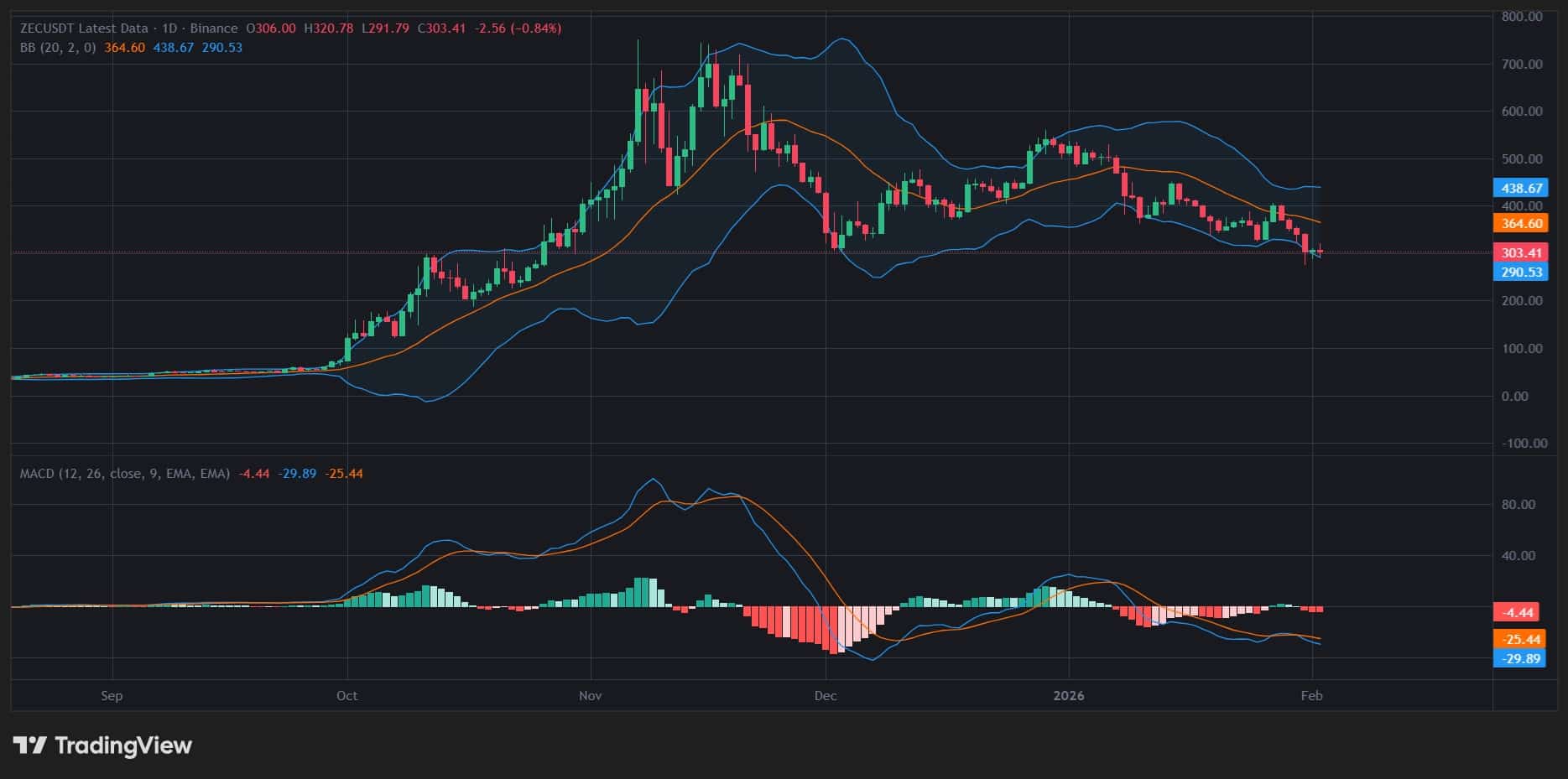
From a technical perspective, ZEC is testing a decisive support level near $310. Some analysts warn that failure to maintain this level could push prices toward $200, while others point to the SEC’s recent closure of its Zcash investigation without enforcement as a major long-term bullish signal for regulated privacy.
Litecoin (LTC)
Litecoin (LTC) presents a mixed technical profile as it trades between $63 and $70 amid broader market deleveraging. The price has suffered nearly 30% monthly declines, but technical analysts note that LTC has entered a deep oversold state. Its RSI hovers around 20, a level that historically precedes strong relief bounces.
On a fundamental level, the ecosystem is gaining attention ahead of the LitVM Testnet launch planned for Q1 2026. This milestone will introduce EVM-enabled Layer 2 smart contracts to the Litecoin network for the first time.
LTC is currently testing a critical support floor at $63.30. If buyers successfully defend this level, the growing “Litecoin Meta” narrative around its role as a programmable payment layer could lead to a recovery towards the $72-$75 resistance zone.
The Cryptonews YouTube channel provides regular updates and in-depth coverage of the privacy sector and other altcoin markets. The video presents the complete list of top privacy coins. The channel provides similar information daily, keeping viewers informed with the latest developments in crypto.
While privacy coins provide a refuge for established capital, investors looking for aggressive growth during the rebound are turning to Bitcoin Hyper (HYPER), which many recognize as the best small-cap crypto to buy in early 2026.
Privacy Coins Dominate the Market While Bitcoin Hyper Emerges as the Best Small-Cap Crypto
Time is running out for investors who want a piece of the Bitcoin Hyper (HYPER) ICO. Rumors suggest a February token launch after a very successful presale that has already raised around $31 million, with many considering HYPER as the best small-cap crypto to watch between now and 2026.
HYPER is the first native Bitcoin Layer-2 protocol. It aims to unlock billions of liquidity on the Bitcoin network by supporting a full ecosystem of DeFi, GameFi, AI agents, NFTs, and more.
Ethereum currently holds over $58.8 billion in TVL (Total Value Locked), primarily on platforms like Aave and Lido, highlighting the amount of liquidity HYPER could bring to Bitcoin.
The HYPER team uses the Solana Virtual Machine (SVM) to process transactions quickly and inexpensively and then settle them on the Bitcoin layer.
This setup could be a game changer for Bitcoin. HYPER holders could benefit the most, as the project could become a token with over $500 million in market cap by unlocking billions in liquidity.
Investors can still purchase at ICO prices before the pre-sale ends and HYPER becomes available on DEXs or major CEXs, potentially locking in early profits.
Related news

- Get educational courses and tutorials
- Free content and VIP group
- Jacob Crypto Bury Market Analysis Videos
- Taking Advantage of Trading Signals on Bybit
- Next 10x Altcoin gems
- Upcoming Presales and ICOs
Join our Telegram channel to stay up to date with the latest news


