




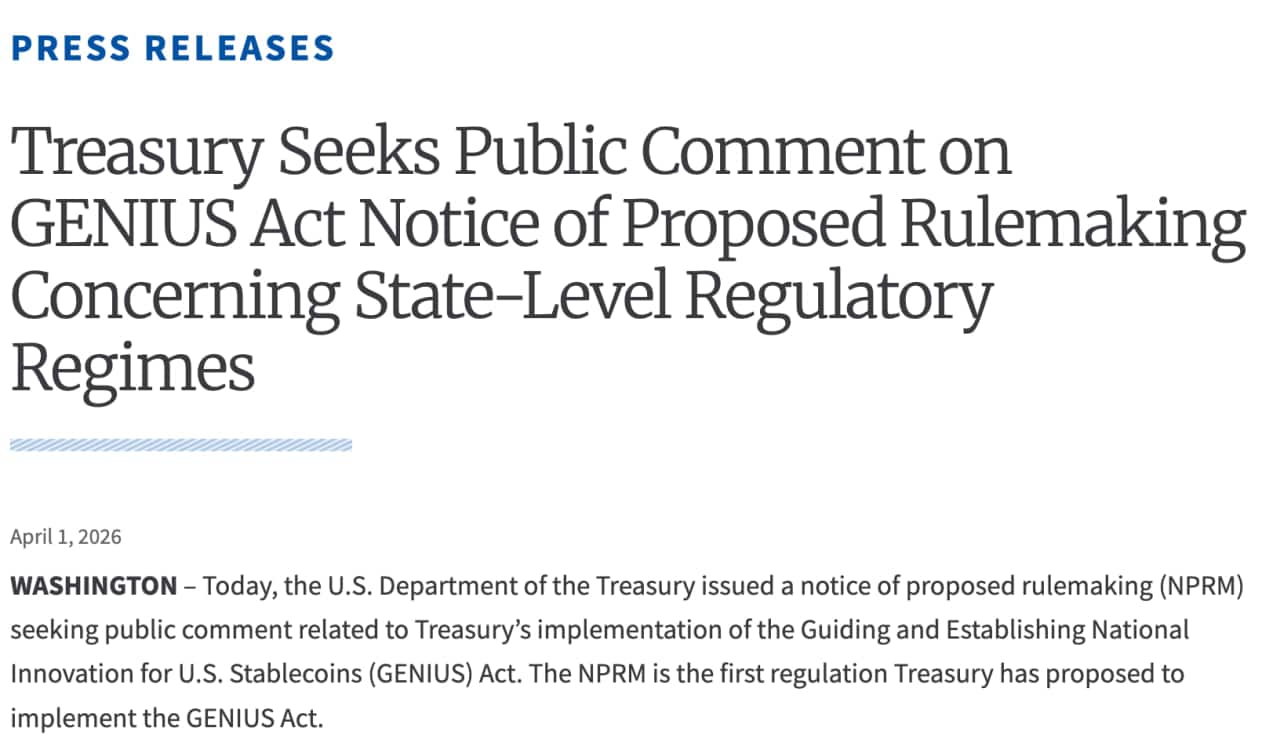
The U.S. Department of the Treasury issued a Notice of Proposed Rulemaking (NPRM) on April 1, 2026, formally seeking public comment on the requirements that state-level stablecoin regulatory regimes must meet under the Guiding and Establishing National Innovation for U.S. Stablecoins Act – commonly referred to as the GENIUS Act – which President Donald Trump signed into law in July 2025.
The NPRM establishes a 60-day comment window, with submissions expected around early June 2026 and accepted via the federal public record at Regulations.gov. The action comes as the overall market capitalization of dollar-pegged stablecoins approaches $300 billion, a threshold that gives the rulemaking immediate importance to market structure.
Source: Treasury.gov
The GENIUS Act allows states to authorize and supervise stablecoin issuers with less than $10 billion in consolidated assets, provided that these state frameworks do not deviate materially from federal standards – and it is precisely the definition of this deviation threshold that the NPRM now asks the public to help refine.
We suspect that Treasury’s decision to open a formal rulemaking process at this point, rather than issuing interim guidance or deferring to agency discretion, reflects a deliberate effort to establish federal supremacy over the dual-track oversight architecture before state legislatures can impose inconsistent standards. The NPRM is intended less to collect new information than to build a legally defensible case that preemptively resolves any future conflicts between state certifications and federal minimum requirements – a structural approach consistent with how Treasury has handled regulatory sequencing in other areas of payments law.
DISCOVER: Coin Supercycle: Top Performers This Week
Uniform Requirements, Discretionary Space and $10 Billion Trigger on US Treasury Stablecoin
The mechanism works as follows. The GENIUS Act creates two regulatory pathways: Issuers with less than $10 billion in consolidated stablecoin outstanding can be supervised by an approved state authority, while issuers above that threshold automatically fall under federal jurisdiction – most likely the Office of the Comptroller of the Currency – regardless of their state of incorporation or existing state license.
Treasury just released its Notice of Proposed Rulemaking (NPRM) implementing Section 4(c) of the GENIUS Act, the rules that will determine whether states can regulate their own stablecoin issuers or whether everyone must go federal. this defines the terms in which the dual… pic.twitter.com/UdtSTwtmop
– Alex Thorn (@intangiblecoins) April 1, 2026
The $10 billion figure functions as a strict legal trigger, not a call for supervisory discretion, meaning growth alone can move a company’s primary regulator without any enforcement action or application process.
Under the state component, the Treasury NPRM identifies a set of uniform, non-negotiable requirements from which no state framework can deviate. These include a mandatory 1:1 reserve guarantee of high-quality cash or cash equivalents, monthly public reporting obligations, full compliance with federal anti-money laundering and sanctions regimes administered by the Financial Crimes Enforcement Network and the Office of Foreign Assets Control, and an absolute ban on token rehypothecation – the practice of using a single reserve asset to simultaneously secure multiple redemption requests. On these four categories, state rules cannot be more permissive than the federal standard; they can only be more restrictive.
States retain discretion over liquidity requirements, capital buffers above the federal floor, risk management frameworks, prudential review procedures, enforcement mechanisms, and administrative due process rules.
The NPRM clarifies that any state election seeking to exceed federal standards in these discretionary areas is permitted – and in some interpretations, encouraged – provided that the net regulatory outcome for stablecoin holders is at least as protective as the federal benchmark. As the proposal directly states: “State-level regulatory regimes must lead to regulatory outcomes at least as stringent and protective as the federal regulatory framework. » A newly formed U.S. Treasury Stablecoin Certification Review Committee, involving the Federal Reserve, FDIC, NCUA, and OCC, will evaluate submitted state frameworks for substantial similarity before approving their operation under the dual-track system.
EXPLORE: Crypto Breakout Alerts This Week
following
Disclaimer: Coinspeaker is committed to providing unbiased and transparent reporting. This article is intended to provide accurate and current information, but should not be considered financial or investment advice. Because market conditions can change quickly, we encourage you to verify the information for yourself and consult a professional before making any decisions based on this content.

Daniel Frances is a technical writer and Web3 educator specializing in macroeconomics and DeFi mechanics. Hailing from crypto since 2017, Daniel leverages his experience in on-chain analytics to write evidence-based reports and in-depth guides. He holds certifications from the Blockchain Council and is dedicated to providing “insight gain” that overcomes market hype to find real utility for blockchain.


