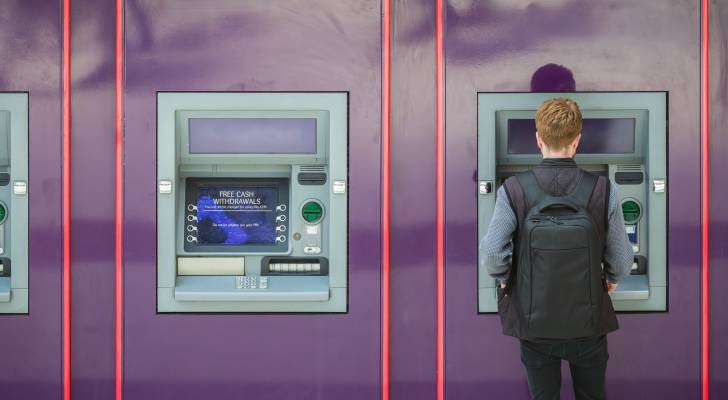
Man withdrawing money from an automatic teller machine (ATM)
This may seem surprising, but even in a country as financially advanced as Canada, hundreds of thousands of people still do not have access to basic banking services.
According to a 2022 study by the Financial Consumer Agency of Canada (FCAC) (1), approximately 600,000 Canadians are “unbanked,” meaning they do not have a chequing or savings account. Millions more are “underbanked,” relying on payday lenders, prepaid cards or money transfer services that charge high fees.
For newcomers, low-income workers, and rural or Indigenous communities, barriers can be both financial and geographic. But as digital finance evolves, the question arises more than ever: could a smartphone and digital wallet solve this problem?
At its core, blockchain-based finance (or DeFi, short for decentralized finance) eliminates the need for intermediaries like banks. Using smart contracts (self-executing code on public blockchains), users can send, borrow, lend, or earn interest without ever entering a branch.
Crypto banks built on blockchain “provide borderless wealth mobility, programmable finance, and seamless access to emerging products such as tokenized real estate and private credit,” says Mike Foy, CFO of Amino Bank (2). Unlike traditional banks, crypto banks operate around the clock – 24 hours a day, 7 days a week, 365 days a year – without waiting for business hours or the opening of borders.
This type of “always on” infrastructure could be transformative for people who struggle to access traditional banking services. A DeFi wallet doesn’t care about your credit history, immigration status, or zip code. All it takes is an internet connection.
Dr Niklas JRM Schmidt, contributor to The crypto-AI boom The report (3) describes it as “a new economic reality in which AI and digital systems can manage and move value independently.”
This same autonomy – without branches or back offices – could help to democratize access to financial tools long reserved for people inside the system.
The Canadian financial system is widely considered one of the most stable in the world. But stability can also breed exclusion.
In rural and remote areas, physical bank branches are disappearing faster than ever. Between 2019 and 2024, major banks closed more than 400 branches nationwide, leaving smaller towns and northern regions dependent on remote ATMs or digital-only access. For those with unreliable broadband, this represents no access.
Indigenous communities face even tougher obstacles. A 2023 Senate report on Indigenous economic participation found that many First Nations residents are “effectively cut off” from basic banking services due to a lack of branches, barriers to identity verification, and distrust of institutions (4). For these Canadians, crypto-based solutions – like digital wallets that can receive funds or store savings – can offer a gateway.
Dominic Volek of Henley & Partners describes this trend (5): “Cryptocurrency is democratizing capabilities once reserved for the ultra-rich. The same tools that multinational corporations used to move capital are now available to anyone with an Internet connection.”
For rural or marginalized users, this could mean the first real opportunity to store, send and grow their money, without needing to rely on the big five banks.
The potential is not theoretical: it is already appearing in a modest but powerful way. Here are examples of how cryptocurrency helps break down barriers:
Lower cost remittances: For newcomers to Canada sending money home, blockchain transfers can significantly reduce costs. Traditional money transfer services can charge fees of 7-10%, while crypto money transfers can complete transactions for less than 1% – and often in minutes. THE Crypto Wealth Report 2025 notes that more than $2 trillion in stable activity each month is already driven by AI and automated systems, many of which facilitate global peer-to-peer payments.
Microcredits via blockchain: Emerging fintech companies in Toronto and Vancouver are experimenting with blockchain microlending platforms that allow users to borrow small amounts against tokenized assets or proof of savings, without a credit check.
Crypto Savings and Investing Apps: Several Canadian startups now offer hybrid models, allowing users to earn interest on stablecoins pegged to the Canadian or US dollar. These mimic high-interest savings accounts but operate via blockchain protocols rather than banking products.
Although none of these systems are regulated to the same level as banks, they demonstrate the potential of crypto to serve segments neglected by the traditional system.
Yet realizing this potential will require more than code. Like the Cryptobanking 2025 The report highlights (6), that custody and regulatory safeguards are “essential, particularly for those seeking security through blockchain-based innovations.”
In Canada, this means improving both policies and infrastructure. The Bank of Canada has already begun research into a central bank digital currency (CBDC), exploring how a “digital loonie” could improve the inclusion and efficiency of payments. But progress has been slow, in part because of privacy and governance concerns.
Meanwhile, other countries are moving quickly. The UAE’s Virtual Assets Regulatory Authority (VARA) licensing regime, the European Crypto-Asset Markets Regulation (MiCA) and Switzerland’s Financial Markets Supervisory Authority (FINMA) framework are already integrating crypto into their traditional banking systems. Canada, in comparison, is still unclear whether certain DeFi activities – like staking rewards or yield farming – constitute income or capital gains.
As Dominic Weibel wrote in Crypto Wealth Report 2025 (7), “The new laws of wealth are written in a code. » Canada will soon have to decide whether it wants to participate in the drafting of these laws or simply apply them after the fact.
Read more: Here are 5 expenses that Canadians (almost) always pay too much for – and that they quickly regret. How many hurt you?
While DeFi offers freedom, it also carries serious dangers. Price volatility, fraud and lack of deposit insurance remain major concerns.
Crypto’s open access model makes it easy for scams to spread, and market fluctuations can wipe out economies overnight. As Volek warns in his report (8): poorly designed or overly punitive regulation could have the opposite effect, “accelerating the disintermediation that governments seek to prevent.”
The answer is not restriction, it is education. Financial literacy must evolve to include digital asset security, private key management, and the realities of risk exposure. Without it, the most vulnerable Canadians could become the easiest targets in an unregulated market.
For now, crypto remains a complement, not a replacement, to traditional banking services. But as blockchain systems mature, they could offer exactly what Canada’s big banks have struggled to offer: affordability, accessibility and autonomy.
If properly integrated and regulated, DeFi could one day offer a parallel financial system, in which access is not determined by income, location or institutional trust, but by digital literacy and connectivity.
As Volek (9) observes: “We are at an inflection point in global wealth management. Just as private banking once distinguished wealth from mass banking, cryptobanks are now defining the next frontier.”
For Canada’s underserved citizens, this border may not be a distant concept. It could be as close as the next app download.
Crypto may never replace banks, but it can fill the gaps they leave behind. If Canada can align its regulations and infrastructure with innovation, blockchain could finally make the banking sector what it should have been all along: borderless, affordable and inclusive.
We rely only on verified sources and credible third-party reports. For more details, see our editorial ethics and guidelines..
Department of Finance Canada (2); Henley & Partners: Crypto Banking: The New Ultra-High Net Worth Infrastructure (2, 6); Henley & Partners: Crypto Assets: A Very Brief Introduction (3, 7); Improve financial literacy in Indigenous communities (4); Henley & Partners: Digital offshore and the future of cross-border wealth (5, 8, 9)
This article provides information only and should not be considered advice. It is provided without warranty of any kind.