




Ethereum (ETH) is entering a new phase in which long-held assumptions about scaling are openly challenged. As Ethereum spot ETFs post their first net inflows after several days of outflows and on-chain data shows renewed activity on mainnet, Ethereum co-founder Vitalik Buterin urges the ecosystem to rethink the role of layer 2 networks.
Related reading
Vitalik’s message is straightforward: Ethereum’s base layer is evolving quickly enough that L2s are no longer essential as capacity providers, and their future value lies elsewhere.
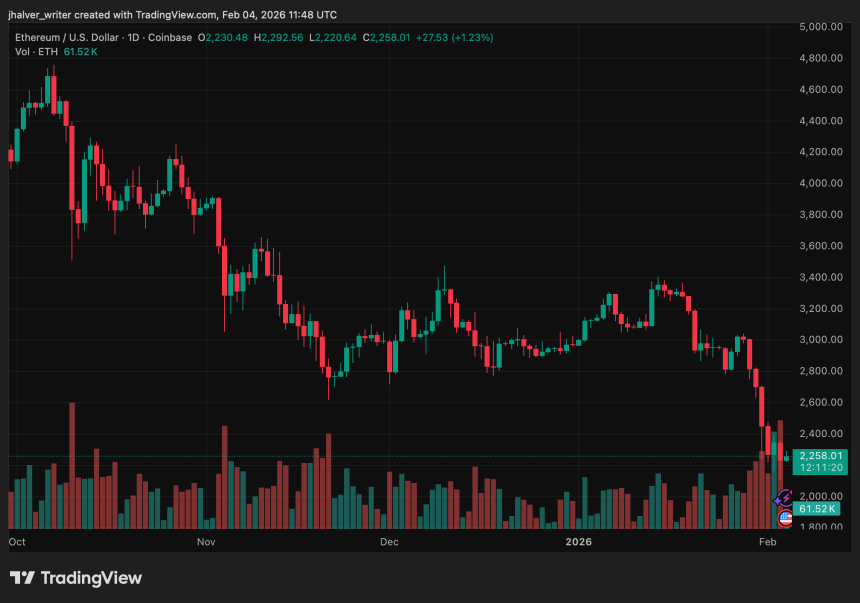
ETH's price trends to the downside on the daily chart. Source: ETHUSD on Tradingview
Ethereum mainnet scaling changes the L2 narrative
In recent statements, Buterin said that Ethereum’s original roadmap, focused on rollup, no longer reflected current conditions. Gas limit increases and protocol upgrades have increased Layer 1 throughput while reducing fees, making direct use of the mainnet more attractive.
Data shows that monthly active addresses on Ethereum L1 are growing sharply, even as overall L2 usage has declined. This change undermines the idea that L2s act as “shards of Ethereum” that inherit the full security and censorship resistance of the base layer.
Many L2s have struggled to achieve advanced levels of decentralization, often retaining centralized controls for operational or regulatory reasons. According to Buterin, a high-speed chain connected via a multisig bridge does not scale Ethereum itself because the trust assumptions differ.
As Ethereum scales directly, L2s are no longer required to provide core block space. According to Buterin, this change should free developers from the need to force L2s to a single definition.
A spectrum of L2 designs and native accumulations
Rather than abandoning L2s, Buterin reframes them as a spectrum. Some may be tightly secured by Ethereum, others may be partially connected, and some may be effectively independent systems that interact with Ethereum when needed. Transparency around guarantees of trust and security is at the heart of this approach.
On the protocol side, Buterin highlighted progress toward native rollups. A proposed rollup precompilation would allow Ethereum to verify EVM proofs without protocol-level knowledge.
Because it would be part of Ethereum itself, upgrades and bug fixes would be handled through normal network upgrades, reducing reliance on external governance structures and simplifying interoperability.
ETF Entries and Market Context
The strategic pivot comes as institutional signals improve. Ethereum spot ETFs saw a net inflow of around $14 million, led by BlackRock’s ETHA fund, marking a reversal after recent outflows.
Although near-term price action remains volatile, the return of ETF flows suggests continued interest in Ethereum as its base layer strengthens.
Related reading
For L2 manufacturers, the message is clear. It is no longer enough to compete solely on the basis of lower fees. Future relevance will depend on specialization, whether it is privacy-focused execution, application-specific chains, ultra-low latency systems, or non-financial use cases such as identity and AI.
Cover image of ChatGPT, ETHUSD chart on Tradingview


