Crypto-related stocks fall after bitcoin falls below $85,000
Synopsys jumps after Nvidia invests $2 billion
The crisis in the American manufacturing sector deepens in November
Indices down: Dow 0.90%, S&P 500 0.53%, Nasdaq 0.38%
NEW YORK, Dec 1 (Reuters) – U.S. stocks closed slightly lower on Monday, weighed down by rising Treasury yields and economic data showing tariffs remained a drag on the manufacturing sector, as investors looked to the Federal Reserve’s policy announcement next week.
The Institute for Supply Management survey showed U.S. manufacturing contracted for a ninth straight month in November, as factories faced falling orders and rising prices as the effect of tariffs persisted.
Register here.
ISM manufacturing PMI
Markets have largely priced in a rate cut from the Fed following its two-day policy meeting on December 10. They anticipate an 85.4% probability of a 25 basis point cut, according to CME’s FedWatch tool.open a new tab.
“Actually, the market is still obviously earnings-driven, we’ve been through earnings season, but now it’s the Fed,” said Joe Saluzzi, partner, co-founder and head of equity market structure research and co-head of equity trading at Themis Trading in Chatham, New Jersey.
“I see no reason why the upward trend should not continue, at least not as quickly, but perhaps more difficult until the end of the year.”
The Dow Jones Industrial Average (.DJI)open a new tab fell 427.09 points, or 0.90%, to 47,289.33, the S&P 500 (.SPX)open a new tab fell 36.46 points, or 0.53%, to 6,812.63 and the Nasdaq Composite (.IXIC)open a new tab lost 89.76 points, or 0.38%, to 23,275.92. While many policymakers have struck a cautious tone, dovish signals from a few key voting members in recent weeks, along with reports that White House economic adviser Kevin Hassett is a leading contender to succeed Fed Chairman Jerome Powell, have raised expectations for further monetary easing in the coming months.
Powell was scheduled to speak after the market closed, but was unlikely to address monetary policy due to the proximity of the central bank’s policy meeting.
“I guess they’ll be looking for clues as to anything he might say, but it seems like it’s a done deal,” Saluzzi said.
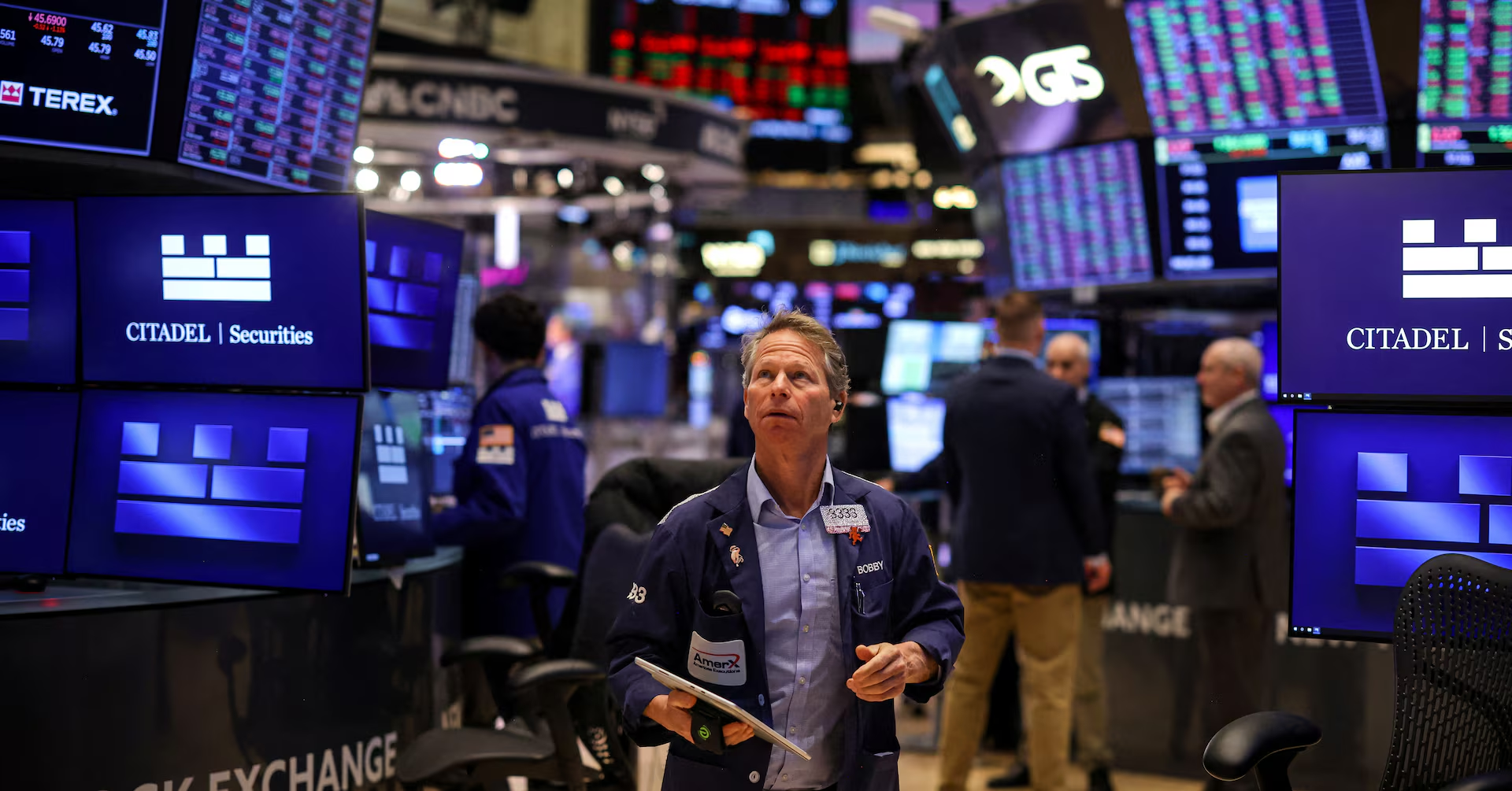
Traders work on the floor of the New York Stock Exchange (NYSE) in New York, U.S. December 1, 2025. REUTERS/Brendan McDermid Shopping License Rightsopen a new tab
Investors are also awaiting a delayed September report on the Personal Consumption Expenditures Price Index, the Fed’s preferred inflation gauge, due Friday.
Despite expectations of a decline, U.S. Treasury yields rose Monday on weakness in Japanese and European government bonds following comments from Bank of Japan Governor Kazuo Ueda, who signaled that conditions were aligning for a possible rate hike. Bond yields move inversely to prices.
Rising yields weighed on S&P 500 sectors like real estate (.SPLRCR)open a new tab and utilities (.SPLRCU)open a new tabwhich are considered by many investors to be bond proxies.
Coinbase (COIN.O)open a new tabwhich ended down 4.8%, and U.S.-listed shares of Bitfarms, down 5.7%, were among the crypto stocks that showed significant weakness, with bitcoin stumbling nearly 6% and at one point falling below $85,000. The crypto market has lost more than $1 trillion in value since reaching a record high of around $4.3 trillion, according to CoinGecko.
Strategy (MSTR.O)open a new tabthe world’s largest holder of cryptocurrency, finished down 3.3% after falling as much as 12%. It cut its profit forecast for 2025, citing Bitcoin weakness.
Big box stores were the center of attention on Cyber Monday, with shoppers expected to spend $14.2 billion online, according to Adobe Analytics. Walmart Stock (WMT.N)open a new tab and target (TGT.N)open a new tab grew by 0.9% and 0.8%, respectively. The S&P 500 Retail Index (.SPXRT)open a new tab increased slightly by 0.2%.
Synopsis (SNPS.O)open a new tab shares closed 4.9% higher after AI chip leader Nvidia (NVDA.O)open a new tab said it invested $2 billion in the semiconductor design software provider.
Declining issues outnumbered advancing issues by a ratio of 1.86 to 1 on the NYSE and 2.33 to 1 on the Nasdaq.
The S&P 500 recorded 17 new 52-week highs and one new low, while the Nasdaq Composite recorded 76 new highs and 78 new lows.
Volume on U.S. exchanges totaled 15.64 billion shares, compared to an average of 18.64 billion for the entire session over the past 20 trading days.
Reporting by Chuck Mikolajczak in New York; Additional reporting by Johann M Cherian and Pranav Kashyap in Bangalore; Editing by Shinjini Ganguli and Matthew Lewis
Our Standards: The Thomson Reuters Trust Principles.open a new tab