




Ethereum’s long-term vision increasingly moves beyond incremental upgrades toward a more fundamental transformation of its core architecture. Like the network continues to scale and support a growing ecosystem of decentralized applications, developers and researchers are exploring whether achieving ETH’s ultimate goals of scalability, security, and decentralization requires rebuilding elements of its base layer rather than simply refining existing systems.
Rebuilding core infrastructure for long-term growth
Ethereum’s evolution has gone beyond incremental upgrades; it is entering a phase of structural reconstruction. The head of research at EigenCloud, Soubhik Deb, mentioned on
Related reading
This is about reducing accumulated technical debt, moving toward rapid finality, and designing the protocol with future post-quantum resilience in mind. At the heart of this transformation is Lean Consensus, one of the most ambitious protocol workstreams for the network and crypto infrastructure as a whole.
In Soubhik Deb’s discussions with Drakefjustin, the goal was to understand what Lean ETH practically is in terms of real-time proof and increasing Layer 1 throughput, and what it unlocks for rollups. Other protocols are being introduced to strengthen the network ecosystem, including scaling.
Analyst Ladislas offered an overview of the relationship between FOCIL and Ethereum’s scaling roadmap, particularly in the medium term via zkEVM L1s. At present, it seems clear that the ETH community is demanding higher L1 throughput to meet global demand. However, the truth about trade-offs today is that censorship resistance and rapid inclusion depend heavily on the altruism of validators, more concretely, on the willingness of validators choosing to build blocks locally and thus forgoes more valuable blocks from third-party builders.
At the current scale, the altruism tax is still acceptable and manageable, but its recourse is fragile and suboptimal. What makes the situation even more problematic is that as throughput increases, it becomes progressively more expensive. The good news is that FOCIL will make inclusion a guarantee at the protocol level. Instead of treating resistance to censorship as a walk probability, it becomes an imposed rule of the system.
Related Reading: Ethereum Price Creates Strain Below Resistance and Risk of Breakout Increasing
However, with the decision to schedule FOCIL for protocol inclusion, the project is well positioned to reduce critical dependence on the social stratum. At the same time, this paves the way for a massive increase in L1 throughput.
Ethereum Liquidation Clusters Build on Both Sides of Price
Ethereum’s current liquidation heatmap reflects a tight market on both sides. According to For Ted, both long and short positions on ETH are aggressive, meaning all that aggressiveness will be removed.
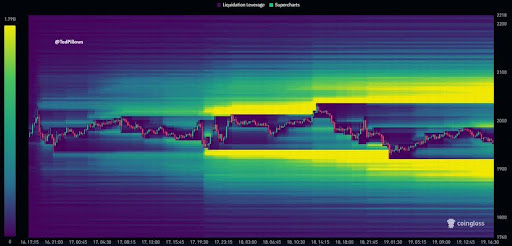
If geopolitical tensions, such as a possible escalation between the United States and Iran, escalate, downward pressure could trigger long-term selloffs, followed by a reversal that tightens short positions. However, positive developments such as the peace talks could trigger an increase burstclearing short positions before the price potentially moves back towards the target of late long positions.
Featured image of Adobe Stock, chart from Tradingview.com


