




Bitcoin rose sharply in early European trading on Monday, November 10, 2025, briefly reclaiming the $106,000 mark after a volatile weekend. The move comes as a mix of macro-liquidity signals and political headlines shake up risk appetite at the margins.
Why is the price of Bitcoin increasing today?
Beneath the surface, traders point to three interrelated factors: an abrupt shift in the Federal Reserve’s balance sheet guidance, growing chances that the Washington shutdown saga could be resolved imminently with a subsequent drawdown of the Treasury General Account (TGA), and a new wave of policy chatter – from 50-year mortgages to possible relief checks – that is reigniting the “liquidity pulse” debate.
The most concrete development is the Fed’s communication pivot on reserves and the balance sheet. New York Fed President John Williams signaled last week that with reserves dropping from “plenty” to merely “abundant,” the central bank may soon need to resume asset purchases — not to spur stimulus, but to keep the money market functioning smoothly as the Fed stops its quantitative tightening on Dec. 1 and begins fully reinvesting maturing Treasuries.
Related reading
“The Fed may soon need to expand its balance sheet to meet its liquidity needs,” Williams said, emphasizing that any purchases would be technical rather than a new quantitative easing program. QT will end on December 1 and officials are preparing for balance sheet growth needed to stabilize reserves.
Paradoxically, Washington policy constitutes the other tailwind. Prediction markets are now jeopardizing the chances that the record US government shutdown will be resolved by mid-November. Polymarket shows a chance of 87% for a resolution between November 12 and 15.
Why is this important for Bitcoin? Because at the end of a shutdown, Treasury spending typically resumes and, all else equal, TGA cash flows from the Fed into the banking system, thereby increasing bank reserves. This mechanical link – falling TGA, increasing reserves – has been well documented. An increase in reserves, especially when the Fed is no longer draining liquidity through QT, is the kind of macroeconomic backdrop that has historically coincided with stronger crypto supply.
Related reading
In this context, new political discourses are fueling the “liquidity imagination”. Over the weekend, President Trump and FHFA leaders floated the idea of allowing 50-year mortgages, a change that, if implemented by government-sponsored enterprises, would significantly reshape the length of housing financing in the United States and reduce monthly payments at the cost of higher lifetime interest.
On X, the liquidity discourse is distilled – out loud – into powerful memes and historical analogies. Capriole Investments founder Charles Edwards (@caprioleio) summed up the bullish case of the day: “Bull weekly close. 90% chance US shutdown ends this week (Polymarket). Fed cuts rates 1% over 18 months. Fed confirmed plans to expand balance sheet! Stocks in fear and greed in extreme fear! Put/Call ratio is bullish. Return Bitcoin upwards.”

James Lavish (@jameslavish) pushed the fiscal angle: “Trump is issuing $2,000 stimulus checks, the FHFA is considering 50-year mortgages, and the US government continues to run $2 trillion deficits. Please tell me again how the era of easy liquidity and asset inflation ends.”
Yann Allemann and Jan Happel, the co-founders of blockchain data and intelligence platform Glassnode (@Negentropic_) linked it to the TGA: “A government shutdown deal on the horizon. This will give Treasury the green light to start gutting the TGA. This is a major ingredient for the final step up.”
Joe Consorti (@JoeConsorti) added a reminder of the retail feed: “Welcome back, helicopter money… if you had invested your $1,200 stimulus check in Bitcoin, it would now be worth $18,607. Don’t waste that.”
At press time, Bitcoin was trading at $106,265.
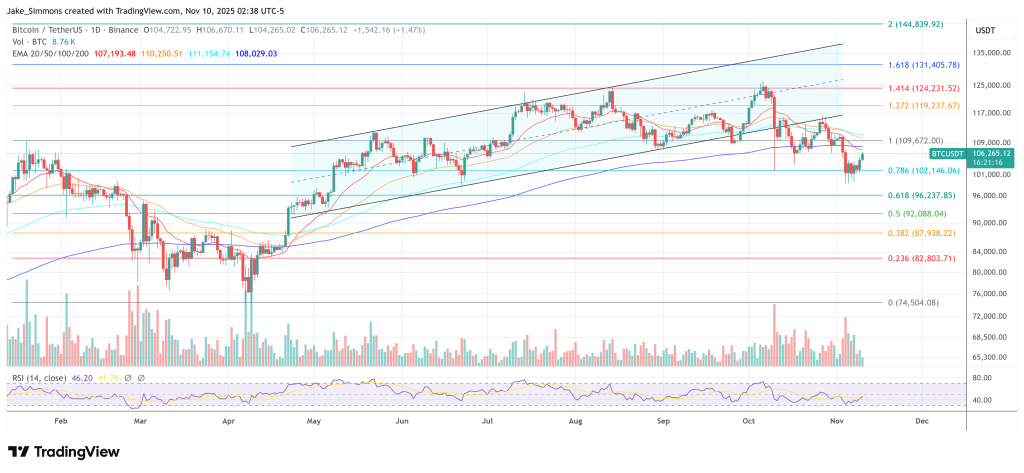
Featured image created with DALL.E, chart from TradingView.com


