



Key takeaways
-
JPMorgan has tokenized a money market fund and launched it on the Ethereum mainnet.
-
The fund holds U.S. Treasury bonds and Treasury-backed repos, with daily reinvestment of dividends.
-
Public Ethereum places MONY alongside stablecoins, tokenized treasures, and existing on-chain liquidity.
-
The focus now is on the use of collateral, secondary transfers and whether other big banks will follow.
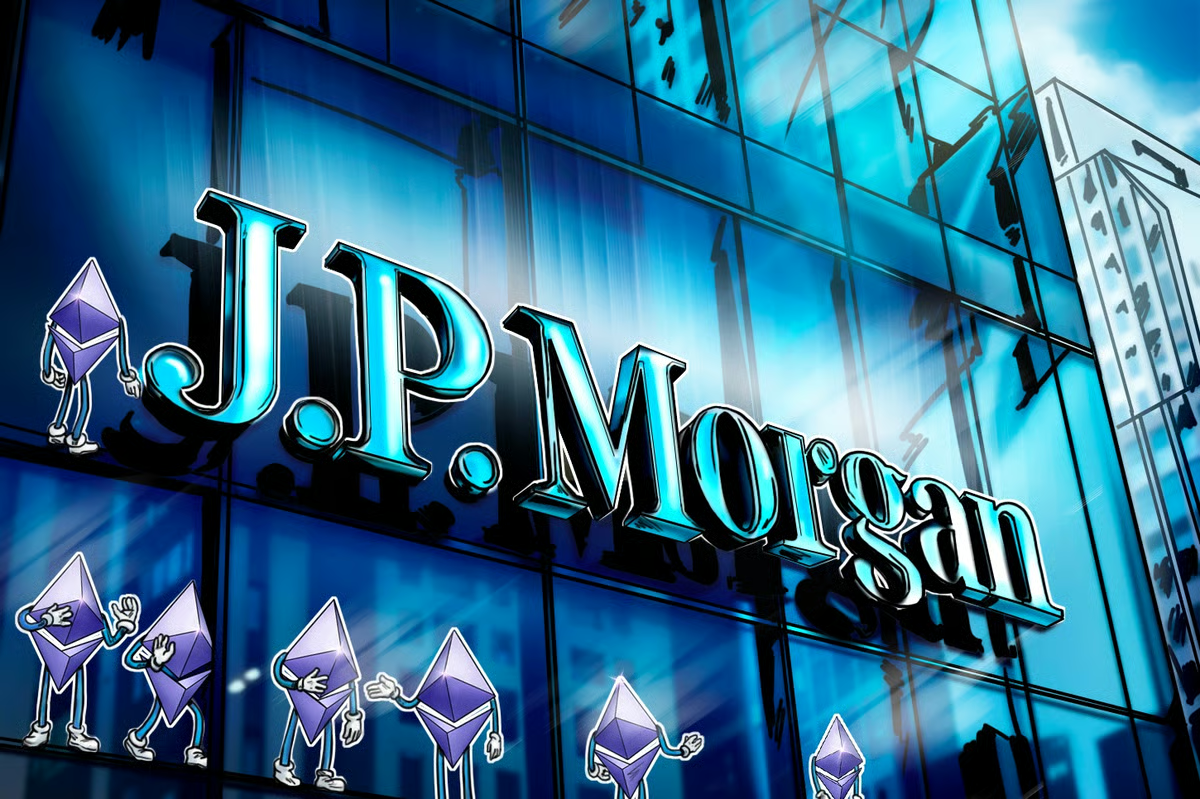
JPMorgan Asset Management has placed a very traditional product on the Ethereum blockchain: a tokenized money market fund called My OnChain Net Yield Fund (MONY).
It was launched on December 15, 2025 and runs on the bank’s Kinexys Digital Assets platform. Investors access the fund through Morgan Money, with stakes issued as blockchain tokens delivered directly to their on-chain addresses.
This is important because money market funds are a commonly used vehicle by institutions to store short-term cash. They are built for liquidity and a stable return and are generally backed by simple assets.
MONY fits this profile exactly. It invests in U.S. Treasury bonds and Treasury-backed repos, offers daily dividend reinvestment, and allows qualified investors to subscribe and redeem with cash or stablecoins. JPMorgan also said it would seed the fund internally before opening it more widely.
The decision to use Ethereum as a settlement layer makes the launch even more remarkable.
Did you know? A Treasury-guaranteed pension is essentially a short-term guaranteed loan. One party provides liquidity, the other provides U.S. Treasuries as collateral, and both agree to cancel the transaction later at a slightly higher price. The difference between the two prices represents interest.
So what exactly did JPMorgan launch?
MONY is a money market fund offered on-chain. Investors purchase interest in funds backed by a conservative liquidity portfolio of U.S. Treasury securities and repurchase agreements fully collateralized by Treasury bills, with ownership represented as a token sent to the investor’s Ethereum address.
Configuration is performed via two JPMorgan systems:
-
Morgan Money is the interface where qualified investors subscribe, redeem and manage their positions.
-
Kinexys Digital Assets is the tokenization layer that issues and administers the on-chain representation of these fund interests.
The idea is that tokenization can improve transparency, support peer-to-peer transfers, and open the door to using these positions as collateral in blockchain-based markets.
On the product side, MONY keeps the familiar mechanics, with daily dividend reinvestment and subscriptions and redemptions processed through Morgan Money using cash or stablecoins.
Why “Public Ethereum” is So Interesting
JPMorgan wants to connect to on-chain systems that counterparties already use, including stablecoins for settlement, custody and reporting flows, analytics, compliance tools and distribution channels.
Ethereum is also where crypto monetary activity is concentrated. RWA.xyz estimates stablecoins to be worth approximately $299 billion, forming the liquidity base with which tokenized funds repeatedly interact for settlement and cash management.

As for cash-like assets, tokenized Treasury bills total $8.96 billion. A money market product is adjacent here because it sits alongside the assets and behaviors that investors already use to park funds, move cash, and provide collateral.

Then there’s scope. The network chart from RWA.xyz shows that Ethereum holds approximately two-thirds of the total tokenized value of RWA.

For a regulated product which must circulate between approved counterparties, this concentration is important.
Did you know? “Public Ethereum” refers to the Ethereum mainnet, the open network that anyone can use. People often say “Ethereum” to mean the same thing, but adding “public” makes it clear that this is not a private, bank-managed, Ethereum-like network.
When cash yield goes on-chain
MONY’s portfolio remains conservative, holding U.S. Treasuries and Treasury-backed repos with daily dividend reinvestment, while ownership is represented as a token to an investor’s blockchain address. Once yield-producing species are on-chain, they can begin to integrate with other workflows.
1) 24/7 Treasury Operations
Positions can coexist with stablecoin balances and other tokenized assets, with subscriptions and redemptions routed through Morgan Money and the token layer managed by Kinexys Digital Assets. For institutions that already manage part of their cash and settlement flows on-chain, this creates a much tighter loop.
2) Mobility of guarantees
JPMorgan highlights the potential for broader use of collateral, as well as transparency and peer-to-peer transferability. It is in collateral where time and costs tend to accumulate due to eligibility checks, transfers, settlement times and transfer controls. A tokenized money market fund share provides an easier way for approved parties to transmit value, settle faster, and enforce who can hold it via on-chain rules.
3) The cash leg for tokenized markets
Tokenized securities, funds, and real-world assets (RWA) still need a place to park liquidity between transactions and settlements. A yield-generating monetary product on Ethereum fits naturally into this role as on-chain markets continue to grow.
The competitive landscape
MONY enters a lane already filled with serious players.
BlackRock’s BUIDL launched in 2024 as a tokenized fund on Ethereum, with recent updates building on features institutions actually use, including daily dividends, 24/7 peer-to-peer transfers, broader network coverage, and a move toward collateral integration.
Franklin Templeton put forward the same idea with its on-chain money market fund, where BENJI tokens represent shares of FOBXX.
Then there is the market infrastructure layer. BNY Mellon and Goldman Sachs have discussed approaches to tokenization of record aimed at facilitating the movement of existing money market fund shares into institutional workflows.
The market appears to be in the midst of a developmental phase, with tokenized cash products, improved transfer infrastructure, and clearer pathways to the use of collateral.
McKinsey’s base case estimates tokenized financial assets at around $2 trillion by 2030, excluding crypto and stablecoins.

Meanwhile, Calastone estimates more than $24 billion in tokenized assets under management as of June 2025, with money market and Treasury bond funds accounting for a significant portion.
Practicality and impact
MONY introduces a regulated cash product on public Ethereum, access to which remains tightly secure. It is being offered as a Rule 506(c) private placement to accredited investors, with distribution through Morgan Money. Eligibility checks are central to the product and the investor base remains narrowly defined.
This structure shapes how the token can move. A tokenized fund share can incorporate transfer rules, compliance barriers and operational controls that determine who is allowed to hold it, who can receive it and how redemption works in different scenarios. JPMorgan’s risk disclosures regarding the use of the product and blockchain indicate an institutional-level deployment designed around control and auditability.
The Ethereum mainnet is the launch location, and usage patterns may scale with the economy. Mainnet fees and operational overhead influence how often assets are moved and can drive decisions on scaling paths over time, including potential activity on Layer 2s as volumes increase.
It’s worth watching how this evolves as the real cadence of the product emerges.
Did you know? Rule 506(c) is a U.S. securities exemption that allow an issuer to publicly market a private offering, provided that all purchasers are accredited investors and the issuer verifies such status.
And now ?
Three signals will show how far this goes.
-
First, if MONY tokens begin to emerge as collateral usable in broader on-chain workflows, such as repo agreements, collateralized borrowing, hedging, and prime-brokerage-style rails, which aligns with JPMorgan’s focus on “broader use of collateral.”
-
Second, are other Global Systemically Important Banks (GSIBs) following JPMorgan on public chains? If peers replicate the choice of settlement layer, it will signal that public infrastructure is becoming a leading venue for tokenized cash products.
-
Third, is the settlement of stablecoins, including USDC (USDC) in the stated coverage, extending beyond subscriptions and redemptions towards secondary transfers and deeper integrations. This is where distribution starts to look like market infrastructure rather than an integrated fund product.
If MONY is accepted as collateral and begins to circulate via secondary transfers, not just subscriptions and redemptions, it becomes part of the settlement cycle rather than a money market fund locked in a box.
If other GSIBs launch similar cash products on the Ethereum mainnet, this would indicate a potential default location if the trend continues for tokenized cash.
This article does not contain investment advice or recommendations. Every investment and trading move involves risk, and readers should conduct their own research before making a decision. Although we strive to provide accurate and timely information, Cointelegraph does not guarantee the accuracy, completeness or reliability of the information contained in this article. This article may contain forward-looking statements that are subject to risks and uncertainties. Cointelegraph will not be liable for any loss or damage arising from your reliance on such information.


