




Cryptocurrency market liquidity has become patchy in 2025, according to market maker Wintermute. IInvestor capital concentrated around a small group of tokens, while much of the market struggled to gain traction.
As the crypto market moves away from previous cyclical patterns, the firm has identified three key developments that it believes could pave the way for a broader market recovery in 2026.
Sponsored
Crypto liquidity has become very heavy in 2025
In his review of the OTC digital asset market for 2025, Wintermute noted that the year tested many long-held assumptions of the cryptocurrency market. It also revealed a broader shift in the way liquidity works in the sector.
Typically, in crypto markets, capital flowed in a cyclical pattern, starting with Bitcoin as the primary liquidity entry point and then pivoting to Ethereum once Bitcoin’s momentum slowed.
He eventually moved to large-cap and then smaller-cap altcoins as risk appetite increased. However, this did not happen in 2025.
The market-making firm found that trading activity in 2025 was heavily concentrated on Bitcoin and Ethereum, alongside a small group of large-cap tokens. As a result, liquidity has become increasingly cumbersome, with capital pooling around major assets rather than being dispersed throughout the market.
“Capital is no longer widely distributed across the market. Instead, liquidity has become more concentrated and unevenly distributed, leading to greater divergence in returns and activity,” the report said.
Sponsored
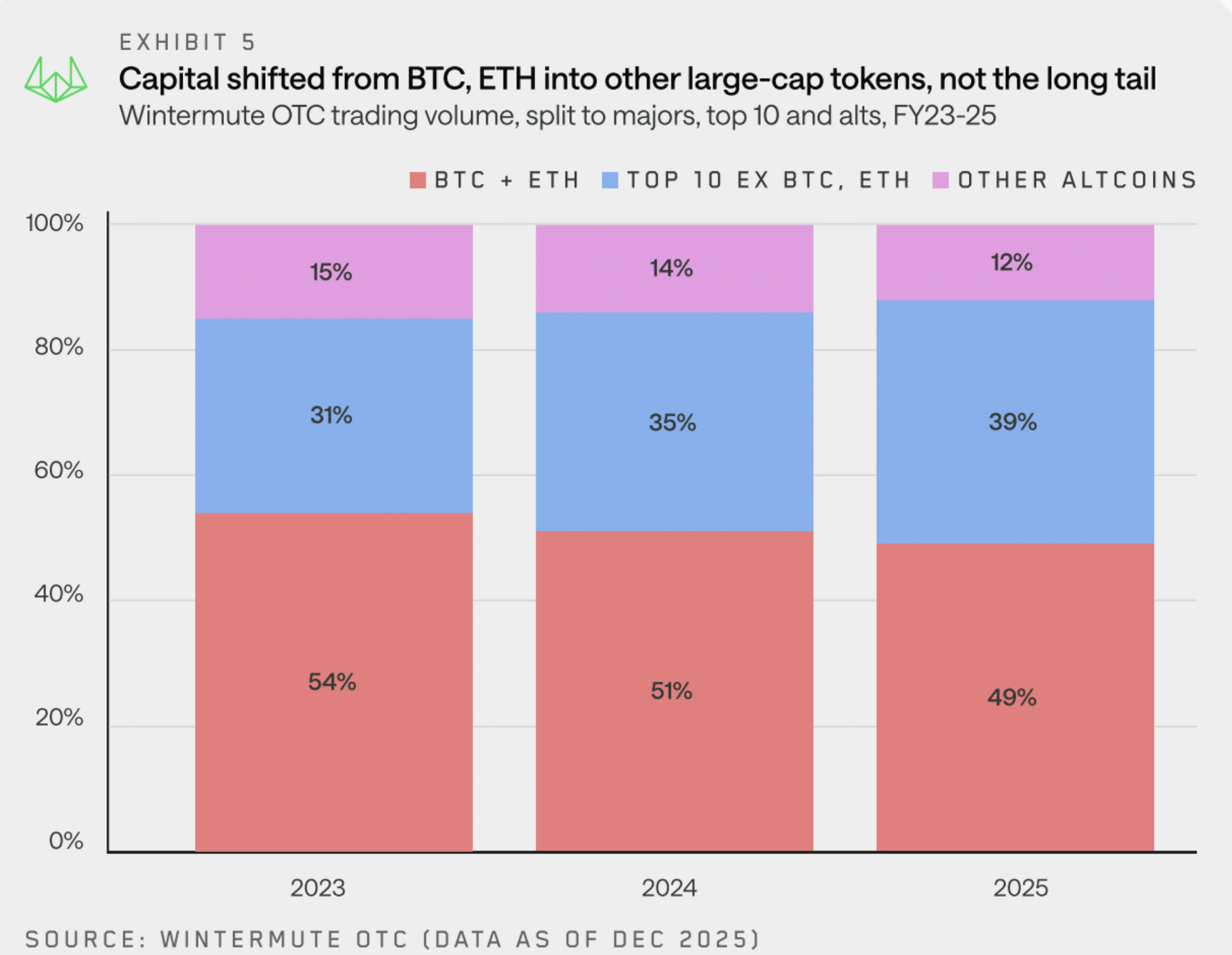
According to the report, this shift was driven by exchange-traded funds (ETFs) and digital asset treasuries (DATs). Until recently, stablecoins and direct investments were the main entry points for capital flowing into the crypto market.
“However, ETFs and DATs have structurally changed the way liquidity is channeled through the ecosystem,” Wintermute wrote. “As mentioned, their mandates are expanding and starting to allow exposure beyond BTC and ETH, largely into other large-cap tokens; however, this is happening gradually, so any benefit to the altcoin market will take time to materialize.”
The result was a contraction in market breadth and increasing divergence in yields. This suggested a more targeted deployment of capital rather than a large-scale market rotation. The trend is evident in the performance of the altcoin and memecoin sectors.
Sponsored
The report highlights that the duration of rallies in the altcoin market has been significantly reduced compared to previous years. Between 2022 and 2024, altcoin rallies typically lasted 45 to 60 days.
In contrast, 2025 saw a sharp decline in rally longevity, with median persistence falling to around 20 days. The decline occurred despite the constant emergence of new metas and themes, including coin launchpads, perpetual DEXs, and the x402 narrative.
“These narratives triggered brief bursts of activity, but failed to translate into sustained market-wide rallies. This reflects unstable macroeconomic conditions, market fatigue following last year’s overshoot, and insufficient altcoin liquidity to carry the narratives beyond their initial phase. This has led to altcoin rallies resembling tactical trades rather than high-conviction trends,” the report said.
Wintermute also drew attention to the performance of meme coins in 2025. The report found that the overall market capitalization of meme coins fell sharply after the first quarter. Additionally, it was unable to regain key support levels. Although brief spikes in activity occurred, they failed to reverse the broader downtrend.
Sponsored
The report cites short-lived bouts of volatility, such as the competition between coin launchpads Pump.fun and LetsBonk in July, as examples of localized trading interest that did not turn into a sustainable market recovery.
Wintermute presents three scenarios for a broader market recovery in 2026
Wintermute pointed out that a reversal of the 2025 dynamic would likely require at least one of three developments:
- Wider institutional exposure: Most new crypto liquidity enters the market via ETFs and digital asset treasuries, but it remains largely concentrated. A broader market recovery would require “the expansion of their investment universe.”
- Renewed solidity on major assets: A strong rally in Bitcoin or Ethereum could generate a wealth effect. However, the extent to which capital is directed towards the broader market remains uncertain.
- Return of attention from individual investors: A shift in mindset in the retail sector from stocks to crypto could lead to further inflows. Still, Wintermute considers this the least likely scenario.
According to the report, outcomes in 2026 will depend on whether any of these catalysts are powerful enough to expand liquidity beyond large assets.


