



Former Ripple CTO David “JoelKatz” Schwartz has pushed back against viral price calls for XRP, arguing that the current market price is already a referendum on the credibility of capital actually believing in a near-term path to $100. His comments also led to a broader discussion about the economics of XRPL and scaling tradeoffs that he believes are getting lost in the hype cycle.
Can XRP reach $100?
Schwartz was responding to an X user who urged him to tell “XRP supporters” that Schwartz declined to make an absolute claim, but framed the debate in probabilistic terms, emphasizing his own story of being surprised by the benefits of crypto.
Related reading
“I don’t feel comfortable saying something like that,” Schwartz wrote. “While I don’t think it’s likely, I didn’t think it was likely that XRP would ever hit $0.25. I started selling XRP at $0.10 because it seemed insane. I remember when bitcoin hitting $100 seemed like an impossible dream.”
Rather than debate the narratives, Schwartz offered a mathematical market thought experiment: If rational investors truly believed that there was a significant chance that XRP would reach $100 within a few years, the current price would not stay below double digits for long.
“If many rational people thought there was a 10% chance that XRP would hit $100 within a few years, they certainly wouldn’t sell much today for much less than $10,” he said. “Those with this belief would quickly buy most of XRP, as they would value it more than those who don’t believe in it, and soon the supply of XRP well below $10 would dry up.”
Schwartz then drew his conclusion from the discrepancy between the hypothesis and the tape. “The fact that the current price is well below $10 shows that there aren’t many people who actually think it has a 10% chance of hitting $100 in a few years with enough confidence to match their words with their actions,” he wrote, adding, “So anyone who says otherwise is not telling the truth.”
He pointed out that readers can “do the same calculations” with different odds, time frames and target prices. In a final note, Schwartz argued that his basic assumption is that crypto markets are “rational most of the time,” with major rallies typically catalyzed by “unpredictable external changes,” rather than widely telegraphed certainties.
Related reading
In a separate response, Schwartz himself revisited a famous old article on X in which he said that XRP “can’t be cheap.” When asked what he meant by that, he replied: “It means that a low price for XRP actually makes it more expensive to use for payments and trading. »
The implication is mechanical: if the price of XRP is lower, more units are needed to represent the same value in flight, which could impact how the asset is used in payment and exchange flows.
Scaling the XRP Ledger
Schwartz also addressed concerns about XRPL throughput after a user questioned whether “1,500 per second (theoretical) was enough,” inquiring about ways to increase on-chain transactions per second. Schwartz said higher TPS was possible, but cautioned that most approaches shifted costs onto node operators.
“There are ways, but I don’t think you really want to,” he wrote. “Almost any way you do it, it imposes costs on everyone running a node. They have to receive more transactions, process and store more transactions, and relay more transactions to others.”
He argued that decentralization pressure arises when node costs increase without corresponding profit, and suggested a different optimization goal: “That’s why I think it makes more sense to try to increase the value of each transaction rather than trying to increase the number of transactions you can support.” With XRPL fees “so low,” he added, many transactions are “very low in value,” leaving room to “get more valuable transactions on XRPL, or even crowd out worthless ones,” before throughput becomes the binding constraint.
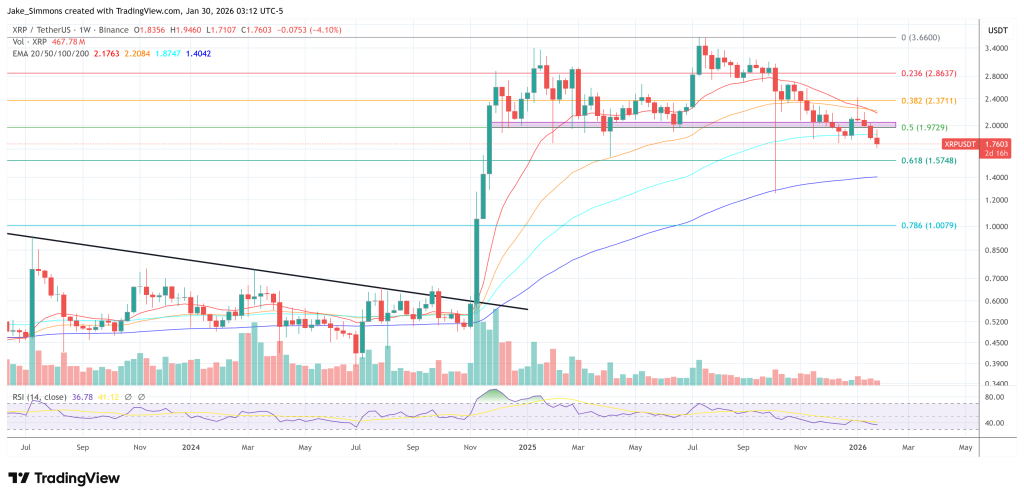
At press time, XRP was trading at $1.76.
Featured image created with DALL.E, chart from TradingView.com


