





XRP entered a critical phase after losing the $1.80 level and sliding towards the $1.60 zone, where the price is now trying to find short-term support. The move comes amid broader weakness in the crypto market, but XRP’s structure shows an additional layer of stress that goes beyond spot price action. According to a recent report from CryptoQuant, the derivatives side of the XRP market is experiencing a sharp contraction in leverage, signaling a significant change in trader behavior.
Data shows that open interest across all XRP derivatives platforms fell to around 902 million, marking its lowest level since 2024. This stands in stark contrast to the conditions seen in 2025, when open interest consistently hovered between 2.5 and 3.0 billion. The magnitude of this decline suggests that leverage is actively being unwound rather than simply rotating between exchanges, pointing to a broader adjustment in risk aversion.

Such contractions often reflect a market reducing its risks after prolonged volatility. With fewer leveraged positions in play, price movements tend to become slower but more deliberate, as speculative excesses are eliminated. As XRP tests the $1.60 zone, analysts are closely watching whether this leverage reset lays the groundwork for stabilization or signals an even deeper decline to come.
The report adds important color by detailing areas where leverage reduction is taking place. On Binance, open interest on XRP derivatives fell to around 458 million. Although this figure remains above the levels seen last December, it nevertheless represents a sharp contraction from the peaks seen earlier in the cycle.
Crucially, this decline on Binance mirrors what is happening on other major trading platforms, reinforcing the idea that the market is going through a broad deleveraging phase rather than a simple migration of positions between exchanges.
From a structural point of view, this is important. When open interest compresses simultaneously across all platforms, it generally reflects that traders are actively reducing risk and closing leveraged exposure. This type of environment often precedes periods of price consolidation, as the market digests previous volatility and searches for a new equilibrium. In past cycles, these phases have often led to the formation of basing structures, particularly as selling pressure fades and volatility compresses.
Looking ahead, analysts note that it will be critical to monitor any recovery in open interest. A rebound in debt that coincides with an improvement in price dynamics could provide an early signal that a new trend is developing.
For now, however, the drop in open interest rates to their lowest level since 2024 points to a clear cleansing of the market. While this reset may appear inconspicuous at first glance, it can provide a healthier foundation for future moves, provided that risk management remains at the forefront in the next phase of the XRP market’s evolution.
XRP Price Shows Weakness
XRP price action continues to reflect structural weakness as the asset trades significantly below its key moving averages and tests the $1.60 area for support. The chart shows a clear transition from an earlier uptrend to a sustained downtrend, marked by lower highs and lower lows from the October high near the $3.50-$3.60 region. Momentum has steadily deteriorated, with each bounce failing below short- and medium-term falling moving averages, signaling persistent seller control.
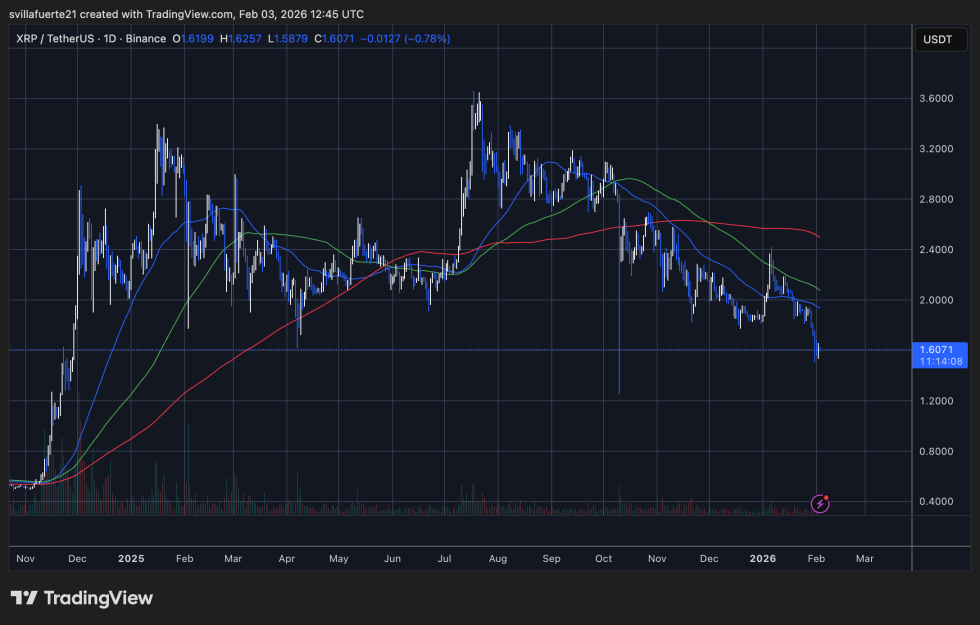
The loss from the $1.80 level is technically significant. This area previously served as a consolidation base and demand zone, but the net distribution suggests that buyers have retreated rather than aggressively defend prices. XRP is now trading below the 50-day and 100-day moving averages, while the 200-day moving average above continues to decline, reinforcing a medium-term bearish structure.
Volume remains relatively subdued compared to previous distribution phases, consistent with derivatives data showing leverage contraction rather than panic-driven liquidation. This supports the idea that the current movement is more of a controlled unfolding than an event of capitulation.
As long as the price remains between $1.55 and $1.60, XRP may attempt to stabilize and form a base. However, failure to hold this zone would expose the market to a deeper retracement to prior demand zones near $1.30 to $1.40.
Featured image from ChatGPT, chart from TradingView.com
Editorial process as Bitcoinist focuses on providing thoroughly researched, accurate and unbiased content. We follow strict sourcing standards and every page undergoes careful review by our team of top technology experts and seasoned editors. This process ensures the integrity, relevance and value of our content to our readers.


