




Brad Garlinghouse, chief executive of Ripple and one of the most prominent voices in institutional crypto, appeared on Fox Business this week to accuse Jamie Dimon, chairman and CEO of JPMorgan Chase, of deliberately misrepresenting the Clarity Act, the Digital Asset Market Clarity Act of 2025 (HR 3633), to protect a payments franchise that generates approximately $20 billion in annual revenue with estimated profits exceeding $5 billion.
The specific fault line is a unique clause in the pending legislation that would allow crypto exchanges to offer a stable coin yield to users, a provision that Dimon has publicly opposed and which the banking lobby has made its main legislative goal.
This is not simply a dispute over regulatory philosophy or compliance architecture. This is a structural struggle over who will control the next generation of dollar-denominated digital payment instruments, and whether these instruments will function as pure transaction rails, which the banking industry prefers, or as yield-generating products that will compete directly with bank deposits for household money.
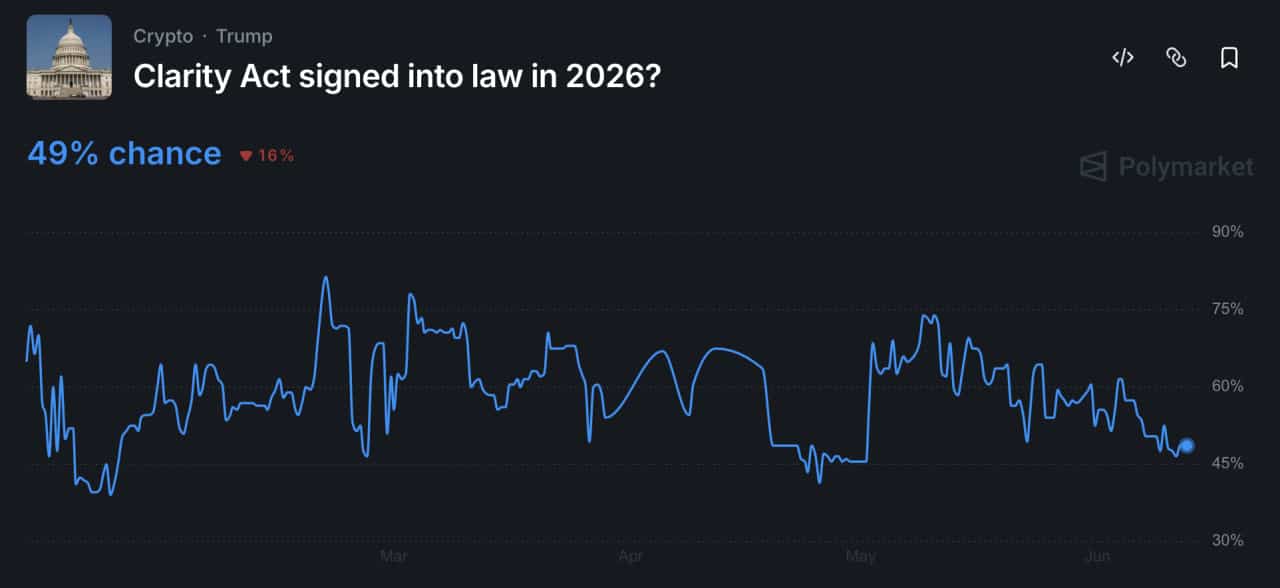
Source: Polymarché
Prediction market users on Polymarket currently give a 49% chance that the Clarity Act will be signed into law this year, down about 18 percentage points from the previous week, a compression that reflects the true uncertainty produced by this specific intersectoral divide.
EXPLORE: The next crypto will explode in the second quarter
Dimon’s Opposition: JPMorgan’s $20 Billion Payment Franchise, His Specific Public Arguments Against the Clause, and the Structural Logic Behind Banks’ Resistance to the Clarity ACT
Jamie Dimon’s opposition to the Clarity Act’s stable yield provision has been publicly stated several times, most recently in an interview with Fox Business host Maria Bartiromo, the same format and interviewer through which Dimon previously targeted Brian Armstrong, co-founder and chief executive of Coinbase, over Armstrong’s advocacy for the bill.
During that appearance in early May, Dimon called Armstrong “the only one” pushing for the inclusion of stable yields, claimed that Coinbase was spending “hundreds of millions of dollars in Washington” on the effort, and concluded that Armstrong was, in Dimon’s words, “full of shit.” Dimon’s most recent comments, to which Garlinghouse was responding directly, asserted that the Clarity Act reduces compliance safeguards and creates conditions in which illicit activities become easier to carry out.
JPMorgan CEO Jamie Dimon: “We will fight the CLARITY Act. If we lose, we lose and we live. But we will fight.”
“No one is going to bow down to Brian Armstrong or Coinbase… He’s full of bullshit” pic.twitter.com/okbuiu2Q0s
— Altcoin Daily (@AltcoinDaily) May 29, 2026
The epistemic status of the precise figure of $20 billion merits caution. JPMorgan does not break out its payments revenue as a standalone public reporting line in a way that would allow accurate verification, but the order of magnitude of the estimate is consistent with the company’s disclosed wholesale and consumer payments activity and is treated by analysts covering the sector as a reasonable approximation of the franchise at risk.
The structural logic of banking resistance is not difficult to reconstruct from publicly available documents. The American Bankers Association and the Bank Policy Institute issued a joint statement formally opposing the yield provisions earlier this year, arguing that yield-producing stablecoins would function as substitutes for deposits, removing household savings from the banking system and reducing the capacity for credit intermediation that regulators and community banks have cited as a systemic concern.
We suspect that Dimon’s expressed objections, framed as compliance concerns and risks of facilitation by bad actors, do not accurately reflect the primary business motivation behind JPMorgan’s opposition, and that the franchise protection argument made by Garlinghouse is the most analytically honest account of what is at stake for the bank.
A report from the White House Council of Economic Advisers released in April 2026 found that completely eliminating stablecoin yield would increase bank lending by only $2.1 billion, a 0.02% increase in overall credit supply, while imposing an estimated net welfare cost of $800 million on consumers, a ratio that does not support the systemic risk framework that Dimon has publicly deployed.
The same analysis found that big banks would capture 76% of any additional lending made possible by a yield ban, with community banks capturing the remaining 24%, a distribution that matches precisely those who benefit most from the regulatory outcome Dimon advocates.
DISCOVER: Best Meme Coins to Buy in 2026
following
Disclaimer: Coinspeaker is committed to providing unbiased and transparent reporting. This article is intended to provide accurate and current information, but should not be considered financial or investment advice. Because market conditions can change quickly, we encourage you to verify the information for yourself and consult a professional before making any decisions based on this content.

Daniel Frances is a technical writer and Web3 educator specializing in macroeconomics and DeFi mechanics. Hailing from crypto since 2017, Daniel leverages his experience in on-chain analytics to write evidence-based reports and in-depth guides. He holds certifications from the Blockchain Council and is dedicated to providing “insight gain” that overcomes market hype to find real utility for blockchain.


