




Ethereum has been consolidating below $2,400 for weeks, building a base that the market is watching with growing anticipation. The technical structure suggests that a breakout is in the works rather than delayed – and new data from Arkham Intelligence has just added a layer of institutional context that reframes what the current consolidation may actually represent.
Three newly created wallets, identified by Arkham as likely linked to Bitmine, just received 100,000 ETH from BitGo, or approximately $233.7 million in a single transfer. The wallets are new. The childcare provider is institutional. The timing is deliberate.

This type of chain movement does not happen by chance. BitGo is one of the industry’s largest institutional custodians of digital assets, and transfers of this magnitude from institutional custody to newly created wallets generally reflect coordinated acquisition rather than routine portfolio management. The 100,000 ETH figure alone represents a significant portion of Ethereum’s liquid supply – and adding to Bitmine’s already large position, it suggests that the company’s accumulation strategy is not slowing down.
For a market consolidating just below a key resistance level, the arrival of $233 million of new institutional capital into newly created portfolios is precisely the kind of signal that changes the structural situation. The question is what Bitmine plans to do with it next.
The World’s Largest Ethereum Treasure Keeps Growing
As of April 19, 2026, Bitmine held 4,976,485 ETH, approximately 4.12% of the total circulating supply of Ethereum, making it the largest Ethereum corporate treasury in the world. With 3,334,637 ETH staked through its MAVAN validator network, generating approximately $221 million in annualized staking revenue, the company has built something that goes far beyond a speculative position. It’s an infrastructure.
What makes Bitmine’s accumulation particularly notable is the timing of its occurrence. The company remains one of the few major digital asset treasuries still actively buying amid crypto’s recent volatility, with most of its peers having slowed or halted their purchases altogether. Bitmine has accelerated its acquisition pace for four consecutive weeks, rising from a previous weekly average to over 100,000 ETH in the most recent period – its largest single-week haul in 2026.
The conviction behind this rhythm is explicit. Chairman Tom Lee has publicly argued that the current crypto downturn is coming to an end, pointing to historical patterns in which crypto bear markets have coincided with stock declines of at least 20% – a threshold the current cycle has not reached.
At the current rate, Bitmine could reach its stated goal of controlling 5% of Ethereum’s total supply by mid-summer 2026. With each week of purchase, the available float shrinks a little more.
Ethereum Price Structure Reclaims Key Range
Ethereum is attempting to stabilize above the $2,300 level after a volatile multi-month structure that was defined by strong expansions followed by equally aggressive retracements. The weekly chart shows ETH recovering from February’s capitulation low near $1,800, where high-volume selling marked a local exhaustion point. Since then, prices have formed a series of lower lows, suggesting early accumulation rather than the continuation of a broader downtrend.
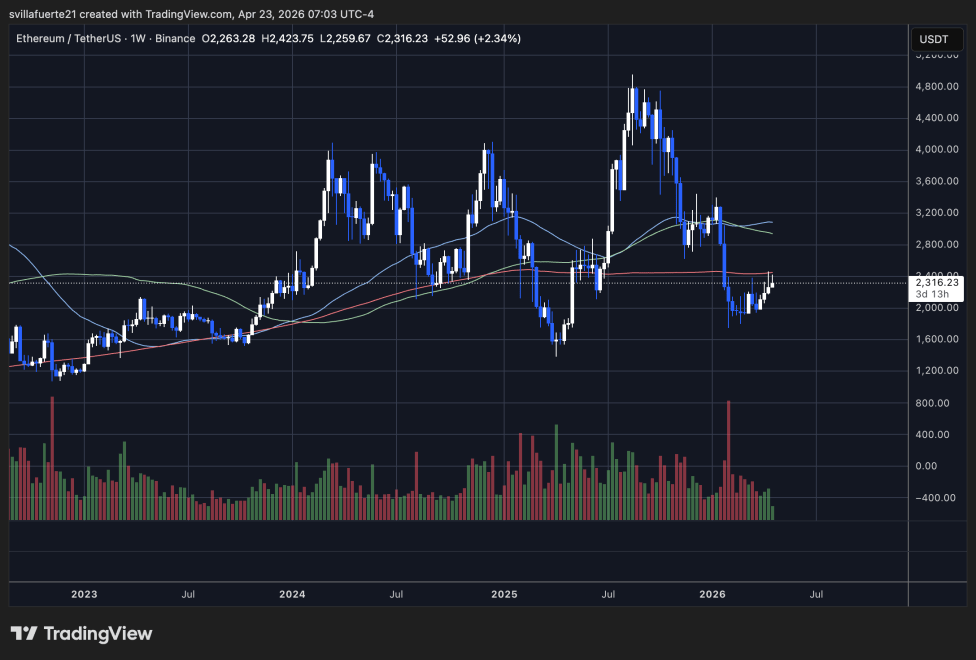
However, the recovery remains technically incomplete. ETH is currently testing the confluence of the 100-week and 200-week moving averages, both acting as dynamic resistance in the $2,300-$2,600 range. Historically, this area has been decisive. Previous attempts to recover it have failed, leading to renewed downward pressure.
Volume adds nuance. The spike seen during the February sell-off contrasts with a relative decline in volumes during the recovery, indicating that the current move does not have the same level of conviction. This raises a valid question: is this a structural reversal, or simply a turnaround in a broader context?
If ETH consolidates above $2,300 and absorbs supply, the next logical target is around $2,800. Failure to maintain this level would likely reintroduce downside risk towards the $2,000 region.
Featured image from ChatGPT, chart from TradingView.com
Editorial process as Bitcoinist focuses on providing thoroughly researched, accurate and unbiased content. We follow strict sourcing standards and every page undergoes careful review by our team of top technology experts and seasoned editors. This process ensures the integrity, relevance and value of our content to our readers.


