





Ethereum is holding strong as the broader market consolidates, with the price sitting just above $2,332 after modest gains of 1.66% over the past 24 hours and 3.35% over the past week. The moves aren’t spectacular, but the structure building beneath them could be bigger than the price action suggests. An analysis by GugaOnChain identifies a shift in institutional behavior that alters how the current consolidation should be interpreted.
The analysis tracks three distinct address categories on Binance – accumulation addresses, stable whale addresses, and user deposit addresses – and the current alignment between them is exceptionally constructive. Accumulated addresses now number 2,434, having surpassed the whales’ stable addresses at 2,410.
This crossover is important because it signals a behavioral migration: institutional participants who previously held stablecoins in a holding position are now actively executing them – buying ETH and placing it in cold storage rather than keeping capital aside.
The depot side of the equation completes the picture. Binance user deposit addresses – the metric that reflects the number of addresses sending ETH to the exchange with the intention of selling – stand at just 2,314, the lowest of the three figures. For every address for sale, many other institutions are actively accumulating or positioned with capital ready to absorb any offer that comes in.
Two buyers for every seller – and time is already running out
The ratio at the center of the GugaOnChain analysis is the number that reframes everything else. The combined buying pressure – active accumulation and stable-ready institutional capital – currently exceeds potential selling pressure by a ratio of 2.1 to 1. In practical terms, for every address sending ETH to Binance to sell, two institutional addresses are actively buying or positioned to buy at the time the bid appears.
The analysis describes the current $2,332 level as a floor of armored glass – a price zone where the structural weight of institutional demand has become dense enough to absorb selling without giving ground.

The prospective assessment formulated by the report is precise and confident. With a Convergence Index above 2.0, GugaOnChain assigns a 92% probability to a breakout scenario – citing historical precedent that when deposit addresses fall below accumulation addresses at this ratio, price expansion has consistently followed within 72 to 120 hours. The institutional market, as presented in the report, is actively draining available ETH liquidity from Binance. When this process reaches its natural conclusion, the supply available to resist rising prices simply runs out.
The risk scenario that would invalidate the device is just as specific. A spike in Binance user deposit addresses above 2,600 – surpassing the Whales stable line – would signal massive profit-taking and trigger a reversal alert. This threshold has not been reached.
What the data describes, in its entirety, is a supply shock already in motion. The accumulation is real, the stable corner positioning is real, and the selling pressure is outnumbered. The 72-120 hour window that the analysis refers to has already begun.
The market is consolidating. But underneath, the balance of intentions is shifting.
Ethereum tests long-term support as market rebuilds its structure
Ethereum is trading near the $2,300 level on the weekly time frame, an area that now sits at the intersection of several structural signals. After the sharp rejection of the cycle high of $4,800, ETH entered a sustained downtrend that culminated in a capitulation towards the $1,600-$1,800 range earlier this year. Since then, prices have seen a recovery, but the broader structure remains in transition rather than fully bullish.
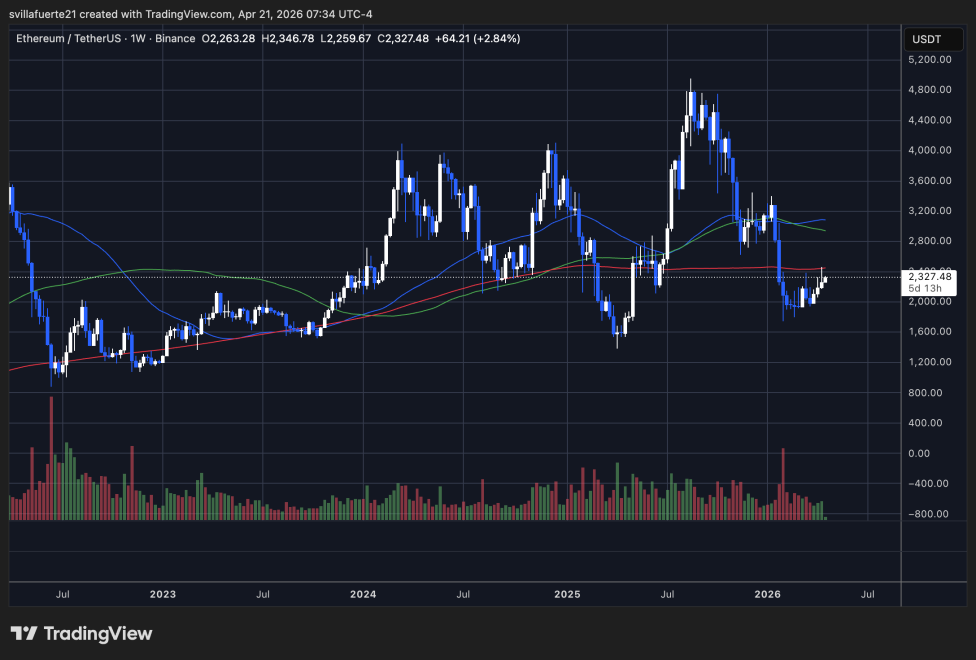
The most relevant development is that Ethereum is reclaiming the 200-week moving average, which had briefly acted as resistance during the rally. Holding above this level suggests that long-term support is being re-established, even if the short-term moving averages remain compressed and directionless. The 50- and 100-week averages are stabilizing, reflecting a market that is no longer moving decisively but rather building a base.
Price action reinforces this interpretation. The recent low, higher than the February low, indicates that sellers are losing control at the margin, but the inability to break above the $2,600-$3,000 area shows that demand has not yet reached expansion phase levels.
Volume normalized after the capitulation peak, indicating a reduction in forced selling. For Ethereum, the current structure is less about momentum and more about stabilizing in anticipation of a possible larger move.
Featured image from ChatGPT, chart from TradingView.com
Editorial process as Bitcoinist focuses on providing thoroughly researched, accurate and unbiased content. We follow strict sourcing standards and every page undergoes careful review by our team of top technology experts and seasoned editors. This process ensures the integrity, relevance and value of our content to our readers.


