



Polymarket has filed for Futures Commission Merchant (FCM) registration with the National Futures Association (NFA) through an affiliated entity called Coming Home GBA, according to Bloomberg.
The July 3, 2026 NFA filing signals the world’s largest prediction marketplace’s intention to offer regulated margin trading to U.S. users – allowing traders to take leveraged positions in event-driven contracts through a fully licensed intermediary.
The central tension this story reveals is that a platform fined for operating an illegal derivatives market in 2022 is now seeking the highest level of derivatives intermediary registration in the United States while simultaneously operating under a separate CFTC marketing investigation.
Polymarket applies for license to legally offer margin trading in the United States
According to Bloomberg, Polymarket, the world’s largest prediction market platform, is seeking approval from U.S. regulators to offer margin trading, allowing users to open positions without publishing the total amount of… pic.twitter.com/Ah6CL2ZVWj
– Wu Blockchain (@WuBlockchain) July 10, 2026
What an FCM license actually does
An FCM, Futures Commission Merchant, is a company registered with both the Commodity Futures Trading Commission (CFTC) and the NFA, which can solicit orders for futures and derivatives contracts and extend credit to customers for leveraged trades.
FCM holds customer collateral in accordance with the futures industry’s custody and segregation rules, enforces margin calls, manages KYC (know your customer) verification, and files regulatory reports with the CFTC.
This is a significantly different arrangement from how most cryptocurrency trading platforms operate today. In a typical on-chain prediction market, a user connects an autonomous custodial wallet, deposits funds, and trades without a regulated intermediary touching the transaction.
The FCM model inserts a licensed broker between the user and the exchange, a structure that unlocks access for institutional clients but adds friction for retail users accustomed to DeFi’s permissionless rails.
For Polymarket in particular, FCM registration would allow it to offer leveraged trading in the United States through a compliant broker channel, rather than the on-chain self-custody model that caught the CFTC’s attention four years ago.
DISCOVER: The best Meme Coin ICOs to invest in 2026
From a $1.4 million fine to a full exchange: the regulatory arc
Polymarket has spent years teaching everyone "put your money where your mouth is." Someone just did it – and sued him for $500,000.
The lawsuit focuses on a gap: the market title said one thing, the resolution rules said another. $6.5 million in losses among 1,868 traders came from this same… pic.twitter.com/fQfhOfPjn1
— GlitchLord (@Ph4nt0m_wb3) July 10, 2026
Polymarket’s regulatory journey has been significant. In January 2022, the CFTC fined Polymarket $1.4 million for operating an unregistered event contracts marketplace.
Rather than withdraw, Polymarket acquired CFTC-licensed QCX LLC and QC Clearing LLC for approximately $112 million, benefiting from a regulated exchange infrastructure.
On November 25, 2025, the CFTC recognized Polymarket as a Designated Contract Market (DCM), allowing it to onboard brokerages and route to U.S. customers. The filing of Coming Home GBA on July 3, 2026 marks Polymarket’s next step in this process.
However, the CFTC continues to investigate Polymarket’s marketing practices, particularly regarding content creators earning large sums of money without actual investments, which institutional investors will need to take into account.
EXCLUSIVE: Earn $10 USDC via Binance Signup
What Polymarket margin trading would mean for crypto traders

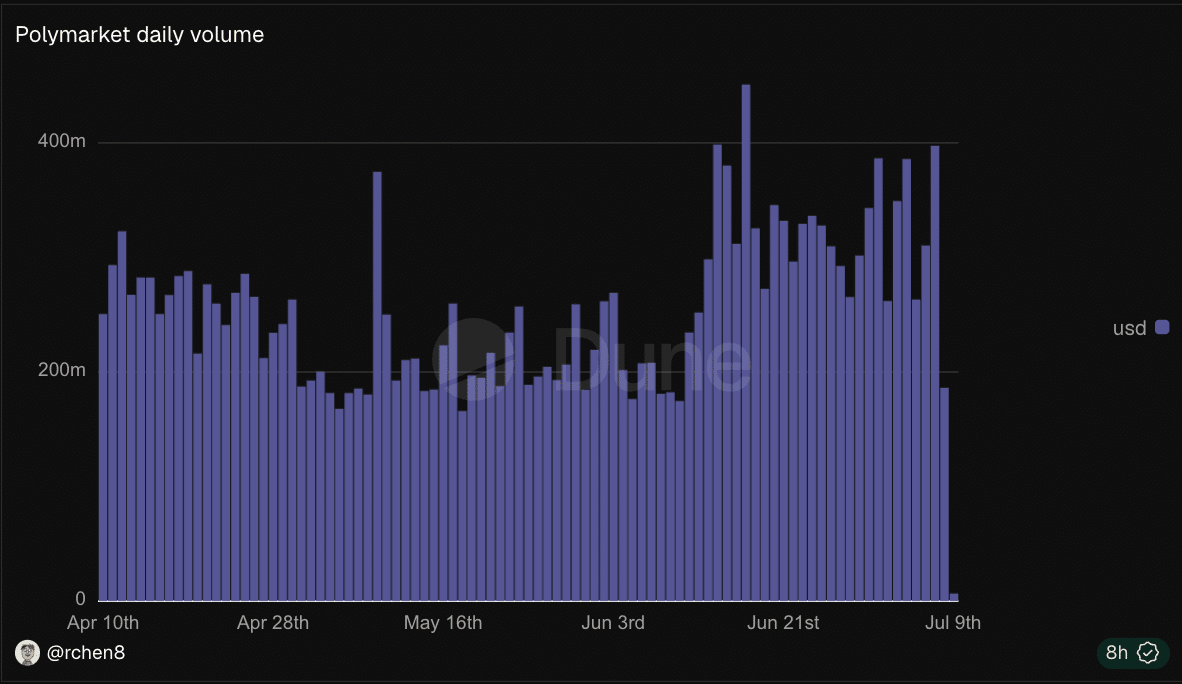
(SOURCE: Dunes)
Polymarket’s weekly trading volume exceeded $4 billion in June 2026, setting a record and demonstrating its scale ahead of the launch of its margin product in the United States.
The FCM depository aims to transform this volume into a more sophisticated and institutionally accessible offering by introducing leverage and a regulated brokerage infrastructure.
For retail traders familiar with regulated derivatives, the move to an FCM-intermediated polymarket is clear: accounts held with registered brokers, margin requirements imposed, and CFTC reporting.
However, for users accustomed to decentralized prediction markets, this change introduces more compliance and friction, but also access to leverage not available through self-custody to US users.
Polymarket’s DCM and potential FCM status provides a compliance advantage that offshore or decentralized platforms struggle to match for U.S. institutions.
Although competitors like Hyperliquid dominate on-chain perpetuals, they operate outside the US regulatory framework. A CFTC-licensed polymarketplace with FCM-backed margin trading could fill a critical gap.
However, the NFA and CFTC have not yet approved the Coming Home GBA application. The approval time and number of FCM partners will determine the competitiveness of the product.
Although Polymarket has filed and established its infrastructure, the timing and ongoing CFTC investigation pose potential risks. Traders should view this as an evolving situation rather than a finalized deal.
EXPLORE: Best Crypto Presales with Asymmetric Upside Potential in Today’s Market
Margin Trading Coming to Polymarket: Will Polymarket Suck Up All the Hyperliquid Cash? appeared first on 99Bitcoins.


