



In today’s XRP news, withdrawal transactions on Binance accounted for 53.8% of total XRP transaction activity over a rolling seven-day period ending June 23, 2026, the highest figure since June 2024, according to CryptoQuant, the on-chain analytics platform.
This seven-day streak in which XRP withdrawals outpaced deposits occurred against a backdrop where XRP was trading near $1.10, close to recent lows, and in a news cycle dominated by MoneyGram choosing Stellar for its new stablecoin.
The two scenarios collide in the XRP community discussion, but they tell different stories. One is a behavioral signal in the exchange feed data. The other is a narrative wound whose roots go back years, not days.
@MoneyGram has been quietly building on blockchain for over five years. Now, with its own stablecoin (MGUSD), a Kraken partnership, a validator seat on the Tempo network, and over $2 billion in stablecoin settlements already underway, the pace is picking up.
CEO @anthonysoohoo joins… pic.twitter.com/DAlAFoClmP
— Converge (@ConvergeDefiant) June 23, 2026
XRP News: What Binance Withdrawal Data Really Says
The CryptoQuant metric that tracks exchange flows on Binance measures the frequency of withdrawals relative to deposits, rather than the raw dollar value of the XRP being moved. An increase in withdrawal transactions indicates more individual withdrawals than deposits, which often reflects XRP holders moving into cold storage or ETF custody rather than a single exit event.
Deposits on Binance fell to 46.1% of total XRP activity, the lowest level since 2024, creating a divergence of 7.7 percentage points. Between June 3 and 14, approximately 722 million XRP left exchanges, including approximately 425 million from Binance.
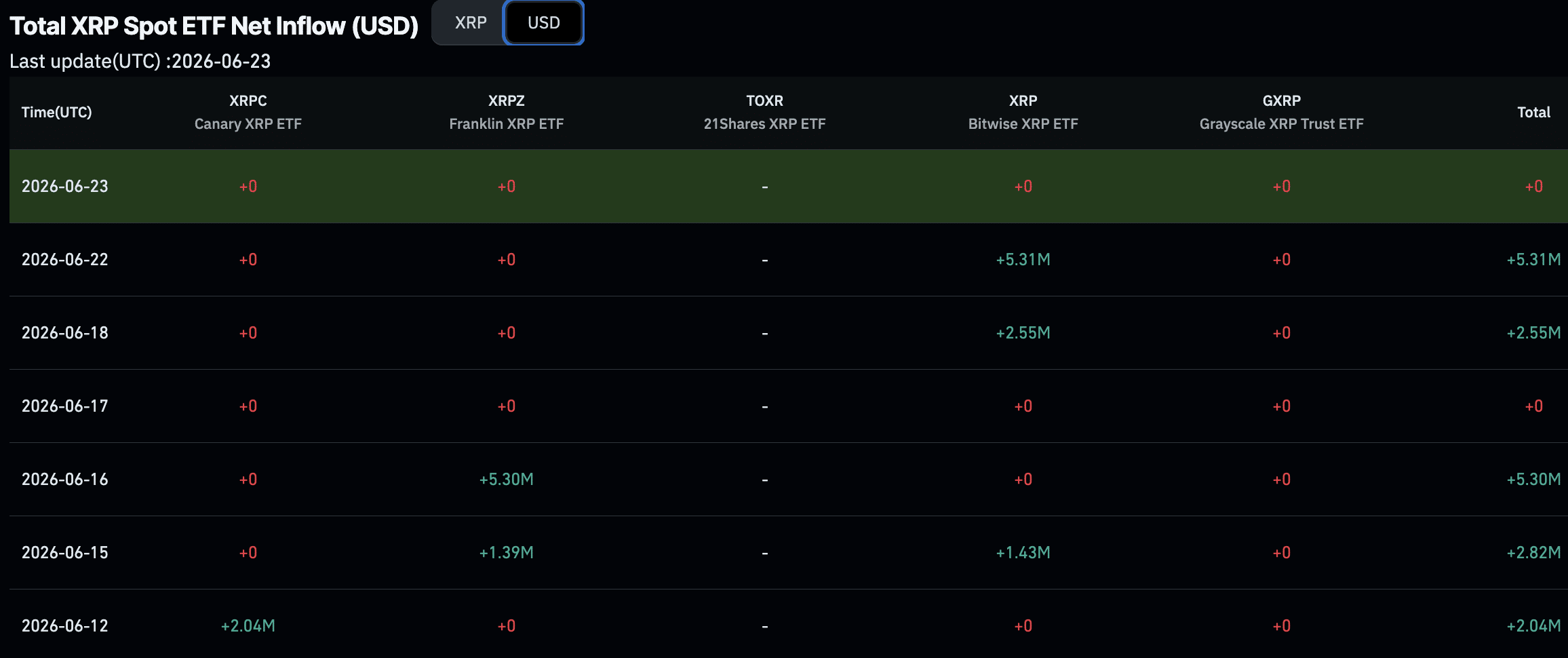
CryptoQuant data from early 2026 combined ongoing FX outflows with net inflows from XRP ETFs, which had absorbed approximately $1.4 billion as of March 2026, indicating institutional accumulation.
CryptoQuant analysts indicated that the pullback dominance reading should not be taken as a direct signal to buy or sell. The data suggests a gradual suppression of supply rather than panic selling, indicating a quiet squeeze in supply rather than sharp market movements. For detailed mechanics on ETF inflows and their impact on XRP market structure, additional analysis is available.

(SOURCE: CoinGlass)
DISCOVER: The best Meme Coin ICOs to invest in 2026
MoneyGram chose Stellar, but the Ripple breakup happened in 2021
MoneyGram launched MGUSD, a dollar-pegged stablecoin, on the Stellar blockchain in June 2026. Using Stripe’s Bridge platform for issuance, M0 smart contracts for the token layer, and Fireblocks for portfolio management.
The non-custodial wallet is integrated into the MoneyGram app. This allows users to easily transfer dollars to Stellar and convert them to local currency in approximately 500,000 physical locations.
Contrary to reports, this move does not represent a move from Ripple to Stellar. MoneyGram and Ripple partnered between 2019 and 2021, with Ripple investing around $50 million and using its on-demand liquidity service.
However, as Ripple’s legal problems intensified, MoneyGram stopped using this service, and by 2026, XRP had not been part of its transactions for years.
MoneyGram’s launch of MGUSD on Stellar builds on its existing service, MoneyGram Access, which facilitated money transfers to USDC on Stellar. This is an expansion of the company’s infrastructure, not a new direction.
The relationship is symbolic, given that Stellar co-founder Jed McCaleb previously co-founded Ripple, and both networks have long targeted the same cross-border settlement space. Ultimately, this impacts the narrative rather than any current revenue stream.
The best modern money moments from the last two weeks covered on Stabledash Live in 5 minutes:
> Confidentiality from @SimkinStepan comes to @solana via @altitude
> @scottnbeck converted a 40-year-old bank to the OCC national charter
> @MoneyGram built $MGUSD on @m0 for an independent chain… pic.twitter.com/5vzAIz5d91— Stabledash (@stabledash) June 22, 2026
EXCLUSIVE: Join 99Bitcoin’s 1,000 USDT Airdrop on ByBit
The biggest threat is the Stablecoin model itself
XRP is not affected by the launch of MGUSD on Stellar, as it has not already seen any flows from MoneyGram. The real threat to Ripple is MoneyGram issuing its own dollar-backed stablecoin.
This allows it to capture reserves that earn a return, incentivizing payment companies to favor its dollar rail assets over bridge assets. Ripple is not idle, as it develops its own stablecoin in dollars, RLUSD, and forms partnerships, such as the one with Flutterwave for Africa.
The US regulatory framework has made launching compliant stablecoins a viable option for payment companies. Although XLM benefits from the visibility of MGUSD, the real advantage lies in the stablecoin structure rather than a specific bridge token.
For XRP holders, the focus should be on accumulation trends, as the impact of proprietary stablecoins on the broader narrative of bridging tokens and new institutional partnerships remains to be seen.
EXPLORE: Best Crypto Presales with Asymmetric Upside Potential in Today’s Market
The post Binance


