




Bitcoin fell back below $80,000 today (May 8) as new US military strikes in the Strait of Hormuz depleted risk appetite in markets, pushing BTC to $79,250, a -2.8% drop in 24 hours. The pullback ends a multi-day green streak that took the asset to $82,700 earlier this week. Whether this six-week winning streak survives into the weekend depends on a single question: Will Iran respond or negotiate?
The immediate trigger was a new round of US strikes in the Strait of Hormuz, which shook stock markets overall and prompted traders to reduce their exposure to speculative assets. BTC briefly touched $82,000 on the back of $2.44 billion in ETF inflows in April, the highest monthly figure since October 2025.
This momentum has now stalled. Previous episodes of this conflict have shown Bitcoin reacting sharply to the deterioration of the ceasefire, and Friday’s price action fits that pattern uncomfortably.
The broader crypto market fell 1.2%, with a total market capitalization of $2.73 trillion, with risk-averse sentiment extending across all altcoins. The macroeconomic situation remains binary: a credible peace signal could jump-start the recovery, while further escalation threatens a deeper technical breakdown.
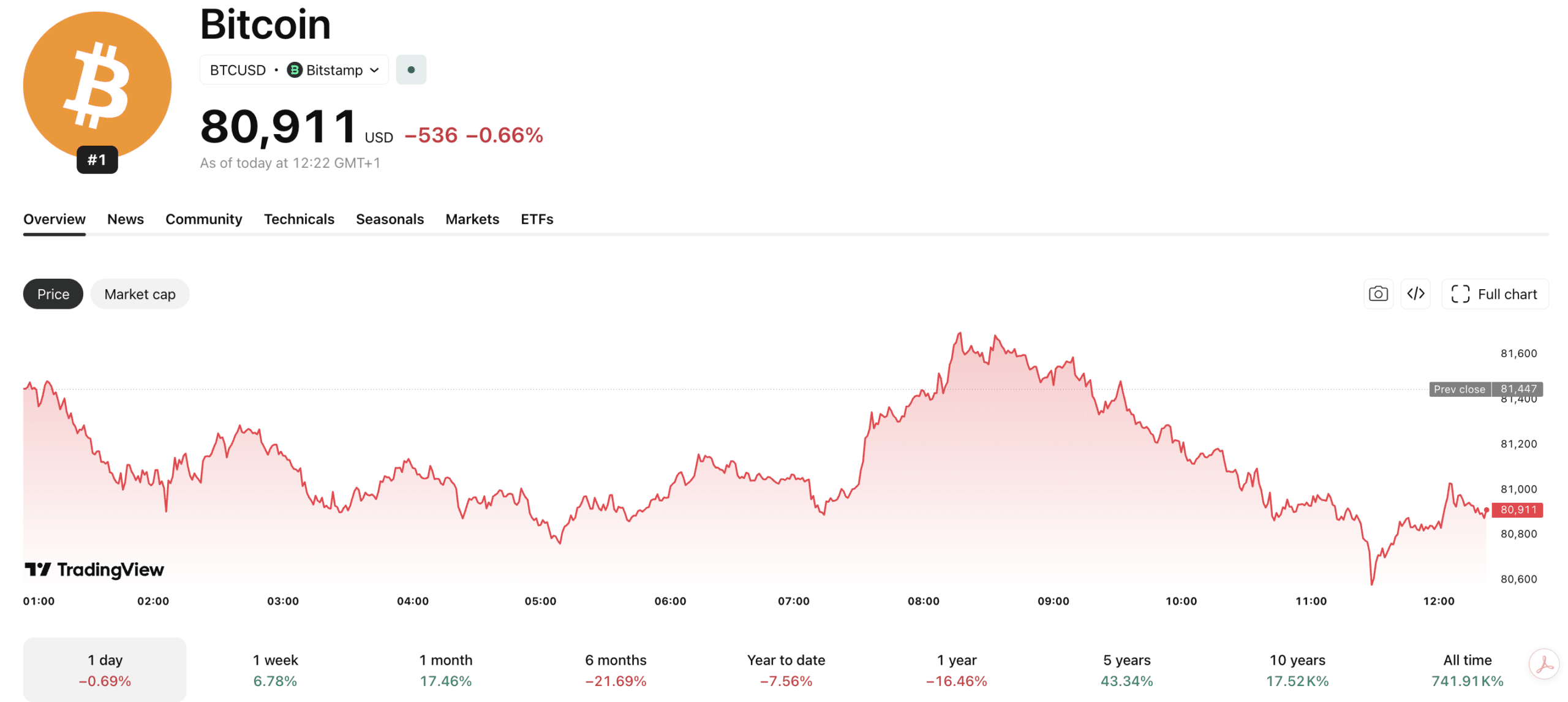
(SOURCE: TradingView)
Can BTC USD Price Hold $78,900 and Reclaim $83,000 This Week?
At $79,381.69, Bitcoin is putting pressure on a group of technical bottoms that analysts had flagged well before Friday’s decline. The immediate line in the sand is at the 50% Fibonacci retracement level of $78,920; a breach at this level would expose the 100-day EMA to near $75,886, a level untested since the earlier phase of the Iran conflict. BTC’s reaction to the ceasefire news earlier in the cycle showed how quickly the $72,000 range came into play once macro support evaporated.
On the positive side, Mexico analysts identify the 200-day moving average at $83,000 as pivotal resistance: a sharp close above this level would open the way to $89,000 – $94,000 and potentially $100,000 if ETF demand remains constant until mid-May. The RSI sits at 65.60, technically still bullish but cooling after the short squeeze peak fades.
Three scenarios deserve attention:
Case of the bull: Iran reports real progress in ceasefire over the weekend, BTC reclaims $81,000 on Monday and ETF flows resume, $85,000 by mid-May seems plausible on this reading.
Reference case: The stalemate persists, BTC consolidates between $78,900 and $81,000 as markets wait for the next catalyst.
Bear case: The climb deepens, $78,920 fails, and a retest of the $75,886 EMA becomes the most likely outcome. The six-week winning streak is technically intact, but it clings to geopolitics rather than fundamentals.
DISCOVER: Best Crypto to Buy Right Now – Updated Guide from CoinSpeaker
Bitcoin Hyper Targets Early Moves Upside as Bitcoin Tests Key Levels
For investors watching Bitcoin stagnate at resistance due to macroeconomic risk, the calculations on a further one-time rise with a market cap of $1.6 trillion appear increasingly compressed. The asymmetric return window is earlier in the stack.
This is the thesis behind Bitcoin Hyper ($HYPER), a Bitcoin Layer 2 project currently in presale that has raised over $32.6 million at the current token price of $0.0136797.
The main goal of the ambitious project is to be the first Bitcoin Layer 2 to integrate the Solana Virtual Machine (SVM), theoretically offering faster smart contract execution than Solana itself while relying on Bitcoin’s security layer.
A decentralized canonical bridge manages BTC transfers, and the architecture targets the three structural weaknesses that have historically limited Bitcoin’s programmability: slow throughput, high fees, and the absence of native smart contracts.
The Iranian conflict has already demonstrated how quickly Bitcoin’s on-chain infrastructure can be strained, a layer of scalability has real context of utility here, not just marketing copy. Staking is live with a high APY offering.
Visit the Bitcoin Hyper presale website here.
EXPLORE: Best Ethereum Wallets for 2026 – Updated Guide from CoinSpeaker
following
Disclaimer: Coinspeaker is committed to providing unbiased and transparent reporting. This article is intended to provide accurate and current information, but should not be considered financial or investment advice. Because market conditions can change quickly, we encourage you to verify the information for yourself and consult a professional before making any decisions based on this content.

Daniel Frances is a technical writer and Web3 educator specializing in macroeconomics and DeFi mechanics. Hailing from crypto since 2017, Daniel leverages his experience in on-chain analytics to write evidence-based reports and in-depth guides. He holds certifications from the Blockchain Council and is dedicated to providing “insight gain” that overcomes market hype to find real utility for blockchain.


