



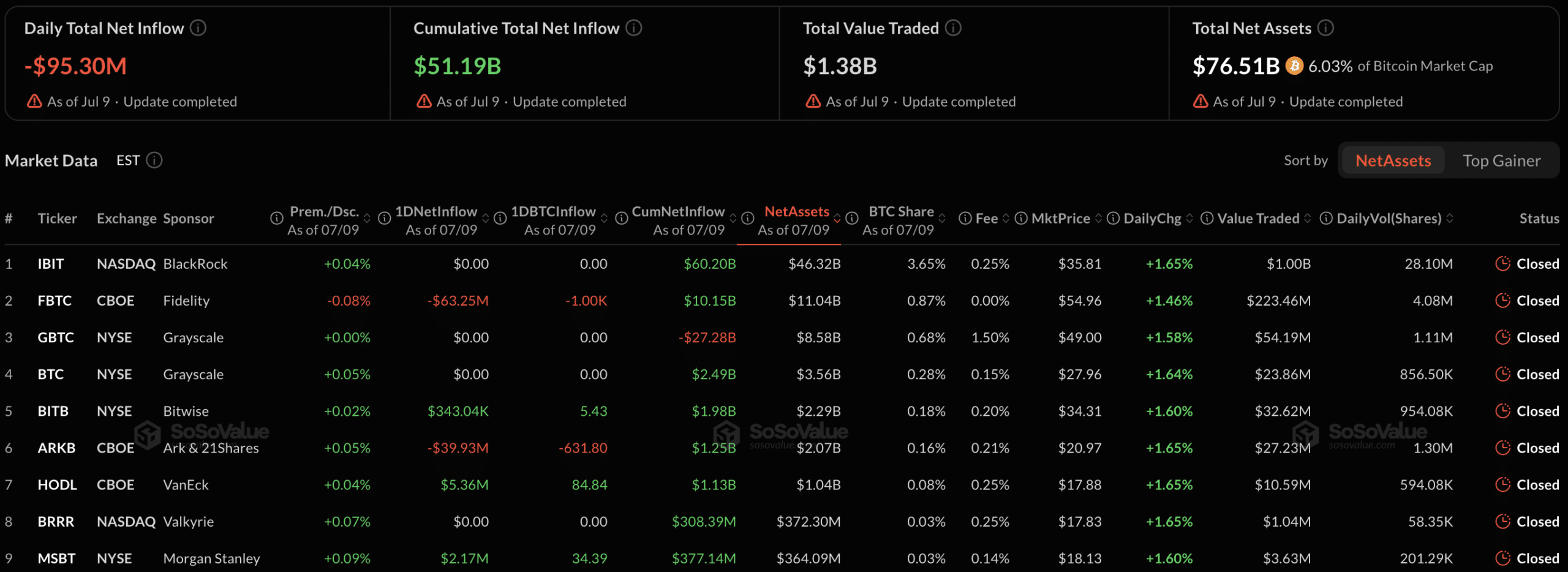
In today’s Bitcoin ETF news, nearly $5 billion left U.S.-listed spot Bitcoin ETF products in the second quarter of 2026, a record quarterly loss, while the $2 trillion private credit market absorbed $15.6 billion in redemption requests that exceeded standard quarterly caps.
The numbers look different on the surface, but they tell the same story: Investors in structurally unrelated asset classes are seeking the exit at the same time, and this convergence is the signal worth watching.
BlackRock moves Bitcoin again… @BlackRock executes a transfer of $951.5 BTC to @Coinbase Prime.
The move, valued at approximately $59 million, represents a strategic shift in liquidity as the world’s largest asset manager rebalances its cash ETF holdings.
Source: Onchain… pic.twitter.com/wIxukwCW6q
– BSCN (@BSCNews) July 9, 2026
The central tension this article reveals is that a liquid exchange-traded product and an illiquid, protected lending vehicle are not expected to crack simultaneously. When they do occur, the cause is almost always macroeconomic and not asset specific.
This in-depth analysis of Bitcoin ETF numbers comes as BTC USD jumped +1.5% overnight, trading above $64,000 and expected to be retested at $65,000. Daily trading volume also reached $28.1 billion, up from $22 billion yesterday.
Bitcoin ETF News: Q2 2026 in numbers – A record quarter for ETF redemptions

(SoSoValue)
BlackRock’s IBIT, the largest spot Bitcoin ETF by assets, bore the brunt of the second-quarter selloff. According to SoSoValue data, $4 billion left U.S.-listed Bitcoin ETFs in June alone, with IBIT accounting for about 73% of those outflows.
The pace of withdrawals accelerated sharply in the second quarter, making it the worst quarter for ETF flows since the products launched in January 2024. Omkar Godbole of CoinDesk reported that the main driver of outflows was capital turnover.
He says investors are turning away from Bitcoin to fund positions in AI trading and high-profile stock events, including SpaceX’s blockbuster IPO.
This framework is important: these were not panic buys driven by bad news specific to Bitcoin, but a deliberate reallocation toward competing opportunities with clearer near-term catalysts.
DISCOVER: The best Meme Coin ICOs to invest in 2026
Private credit: where $15.6 billion reached a threshold of 5%
Bitcoin ETF outflows appear manageable compared to the private credit market, where redemption requests jumped to $15.6 billion in the second quarter of 2026, surpassing the 5% quarterly cap in 10 of the 16 BDCs monitored.
BDCs, which lend to mid-market businesses, have semi-liquid structures with built-in repayment gates because the underlying loans cannot be sold quickly without losses. In the second quarter, redemption requests averaged 10.3%, more than double the cap, with many carryovers from the first quarter.
New inflows into these funds fell by about 56%, leading to net outflows of about 3% of assets. Fitch warned that unmet redemption requests would lead to elevated redemptions in the coming quarters, creating increased structural risk.
EXCLUSIVE: Join 99Bitcoin’s 1,000 USDT Airdrop on ByBit
Same pressure, different structures and why convergence matters
Bitcoin ETFs and private credit BDCs occupy opposite ends of the liquidity spectrum. An ETF trades on a stock exchange throughout the day; you can exit in seconds.
A BDC is a long-term secure vehicle in which your capital is effectively locked in until the quarterly window opens, and even then only partially. These products are not linked by counterparty relationships, shared guarantees or common reporting chains.
What they share is a base of investors who are making the same decision at the same time: reduce exposure to risky assets and raise liquidity. When structurally unrelated vehicles experience simultaneous liquidity runs, the correct interpretation is a macro-level change in risk appetite, not an individual product failure.
The Bitcoin ETF exit pattern is well documented as a repeat of previous stress episodes. Industry estimates suggest that U.S. spot Bitcoin ETFs experienced an extended outflow period from late 2025 to early 2026.
IBIT’s outflows and broader macroeconomic risk factors coincided with BTC falling below $60,000, which previously served as medium-term support.
EXPLORE: Best Crypto Presales with Asymmetric Upside Potential in Today’s Market
The post Bitcoin ETF and Private Credit Redemptions Converge in Q2 2026 Warning appeared first on 99Bitcoins.


