



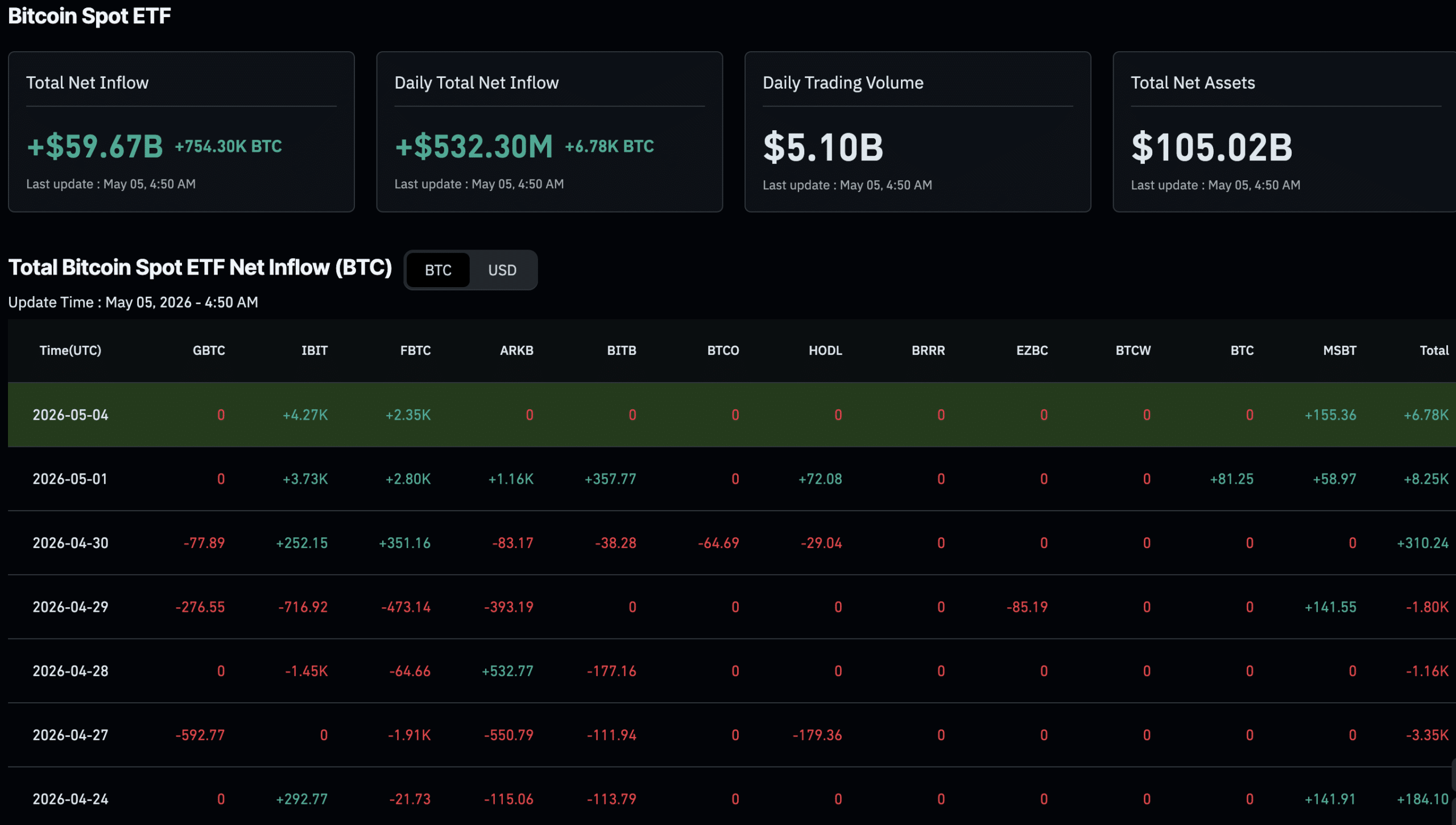
In the latest Bitcoin ETF news, spot ETF flows have now accumulated $59.6 billion in cumulative net inflows since their January 2024 launch, and the two largest players, BlackRock’s iShares Bitcoin Trust (IBIT) and Fidelity’s FBTC, are still buying. Bitcoin reclaimed $80,000 for the first time since late January, with institutional capital driving the move rather than retail momentum.
Data tells a specific story. April 2026 brought in the largest monthly inflow of the year – between $1.97 billion and $2.44 billion, and May opened with $629 million in a single session on May 1, followed by $378 million on May 4. It is a structured allocation.
This ETF data dump comes as Bitcoin USD surpassed $80,000 for the second time in a week, this time with real momentum behind it. BTC is up +1.5% on the day and sits at $80,800, with $81,500 as the next level to pull back.
The question on most investors’ lips now is: “Is this sustainable, or is Wall Street about to take profits?”
Bitcoin ETF News: What the $59.6 Billion Milestone Really Means
Cumulative entries and weekly entries are different things, and this difference is important. Think of it like a bathtub: Weekly flows tell you how fast the water is flowing in or out at the moment, while cumulative inflows tell you how full the bathtub actually is. At $59.6 billion, the bathtub is almost full, just $2.47 billion shy of the all-time cumulative high of $61.19 billion reached in October 2025, the same month Bitcoin hit $126,000.
The path here was not straight. The product category absorbed $6.38 billion in capital outflows between November 2025 and February 2026, a painful reset that brought cumulative inflows well back from their peak.
The two-month recovery in March and April reduced about half of that deficit, adding $3.29 billion in net inflows. Foreign exchange reserves are now at a 7-year low, meaning less Bitcoin is available for active trading.
In other Bitcoin ETF news, Bloomberg analyst Eric Balchunas pointed out something worth paying attention to: IBIT is the only fund among the top 20 ETF inflows globally that still has a negative return year-to-date. Investors are putting money into a product that hasn’t made them money yet this year.
$IBIT Coming in at No. 11 in April, it generates $2.3 billion, the most interesting figure given that it’s the only ETF on the list with a negative return year-to-date. Typically you only see this with Vanguard ETFs (their investments buy rain or shine). A good sign for the long-term viability of the category. Also note $DRAM at #12, never seen before… pic.twitter.com/gb5hCuHFOS
– Eric Balchunas (@EricBalchunas) May 4, 2026
DISCOVER: 99Bitcoin Readers – Earn $10 USDC when you sign up for Binance
Why Wall Street is not selling: in-depth analysis of institutional behavior
IBIT currently holds between 809,870 and 812,000 BTC, representing approximately 62% of the total Bitcoin ETF assets and almost 7% of the circulating supply. This Bitcoin is held in institutional custody, supporting ETF shares for pension funds and corporate treasuries.
The supply dynamics are striking; With the Bitcoin network mining around 450 BTC per day after 2024, spot ETFs absorbed 19,000 BTC in just five days in late April, equivalent to over 40 days of mining production. Additionally, Strategy added approximately $3.9 billion in Bitcoin purchases that month, absorbing five months of new supply.
Whales added around 270,000 BTC last month. Notably, the Czech central bank governor said at the Bitcoin 2026 conference that a 1% BTC allocation can improve returns without significantly increasing portfolio risk, indicating that institutional interest is growing.
Additionally, Morgan Stanley’s Bitcoin Trust, launched in April 2026, attracted $163 million with no recorded outflows, putting competitive pressure on the market. Major companies like Goldman Sachs and JPMorgan Chase are also indicating the potential launch of Bitcoin ETFs in the near future.
(SOURCE: CoinGlass)
What this means for retail: the concept of the institutional floor
The concept of the institutional floor is simple in theory: when large regulated entities hold a significant amount of Bitcoin through ETF structures, they create a price support mechanism that retail-driven cycles never had. Think of it as a landlord who owns hundreds of apartments and has no pressure to sell – as opposed to a speculative buyer who needs to get out quickly. The owner stabilizes the market; pinball amplifies swings.
During the 2021 cycle, it was retailer confidence that drove the moves. Bitcoin soared to $69,000 on social media momentum, then crashed more than 80% when that momentum reversed. This cycle, institutional Bitcoin holders with long time horizons are setting the tone – and these holders don’t panic on a bad weekend.
The uncomfortable truth for retail investors watching Bitcoin flash $80,000: the institutional floor is real, but it’s not guaranteed. It only exists as long as cash inflows into ETFs remain net positive. The product category absorbed $6.38 billion in capital outflows between November and February, evidence that institutions can and do reduce their exposure when conditions change.
EXPLORE: Best Crypto Presales with Staking Rewards
Follow 99Bitcoins on XYouTube and Telegram for more crypto news and analysis.
The article Bitcoin ETF News: Flows Exceed $58 Billion and Why Wall Street Isn’t Selling appeared first on 99Bitcoins.


