





Bitcoin is struggling to regain the $88,000 level as market uncertainty persists and precious metals continue to rally aggressively. Gold’s strength has reignited a familiar narrative: capital is leaving Bitcoin to finance the shift to traditional safe havens. However, a recent report from CryptoQuant calls this assumption into question, suggesting that current market dynamics are being misinterpreted.
On-chain data indicates that Bitcoin sales are not directly funding the rise in gold and other metals. Instead, liquidity appears to be grinding to a halt rather than fleeing the crypto market altogether. This behavior is reflected in the Stablecoin Supply Ratio (SSR), a metric designed to measure the purchasing power of stablecoins relative to the market capitalization of Bitcoin. The SSR provides insight into whether capital is already deployed into BTC or sitting on the sidelines, awaiting clearer conditions.
A lower SSR implies higher latent purchasing power, meaning stablecoins hold significant capacity to re-enter the market. Conversely, a higher SSR indicates that liquidity has been largely devoted to Bitcoin. Current readings suggest that capital remains in stablecoins, indicating caution rather than true risk aversion.
In this context, Bitcoin’s weakness below $88,000 reflects hesitation, not abandonment. While metals benefit from defensive positioning, on-chain signals indicate that liquidity awaits a new catalyst in crypto, rather than moving decisively away from it.
The report adds important context by describing key stable supply ratio (SSR) levels and how they frame Bitcoin’s current market structure. Historically, the SSR has oscillated within well-defined ranges. Readings above 15-16 indicate that the purchasing power of stablecoins is low, meaning liquidity has been largely deployed in Bitcoin.
Values between 10 and 15 represent a neutral zone, commonly associated with consolidation phases. When the SSR falls below 10-11, latent purchasing power is high, a condition which has often preceded bullish phases. It is important to note that these thresholds provide structural context rather than precise temporal cues.
Currently, SSR stands at 12.57, down sharply from recent highs in the 18-19 range. This decline signals a transition from fully deployed liquidity to capital left behind. Despite the price weakness, Bitcoin remains structurally stable, suggesting that capital is not leaving the crypto market but waiting for clearer conditions before re-entering it.

It is important to note that the current rise in gold should not be interpreted as a direct consequence of the Bitcoin sell-off. Large allocators typically operate in diversified, multi-asset frameworks, simultaneously maintaining exposure to stocks, precious metals, digital assets and stablecoins. The lower SSR confirms that capital is not moving from Bitcoin to gold, but reallocating risk while remaining in the crypto ecosystem.
Bitcoin continues to trade under pressure, with the price falling back towards the $87,500-$88,000 area after another failed attempt to regain momentum above the short-term moving averages. On the daily chart, BTC remains significantly below the 50-day and 100-day averages, both of which are now falling and acting as dynamic resistance. The 200-day moving average, still above $100,000, reinforces the idea that the broader cycle has shifted from expansion to consolidation or correction.
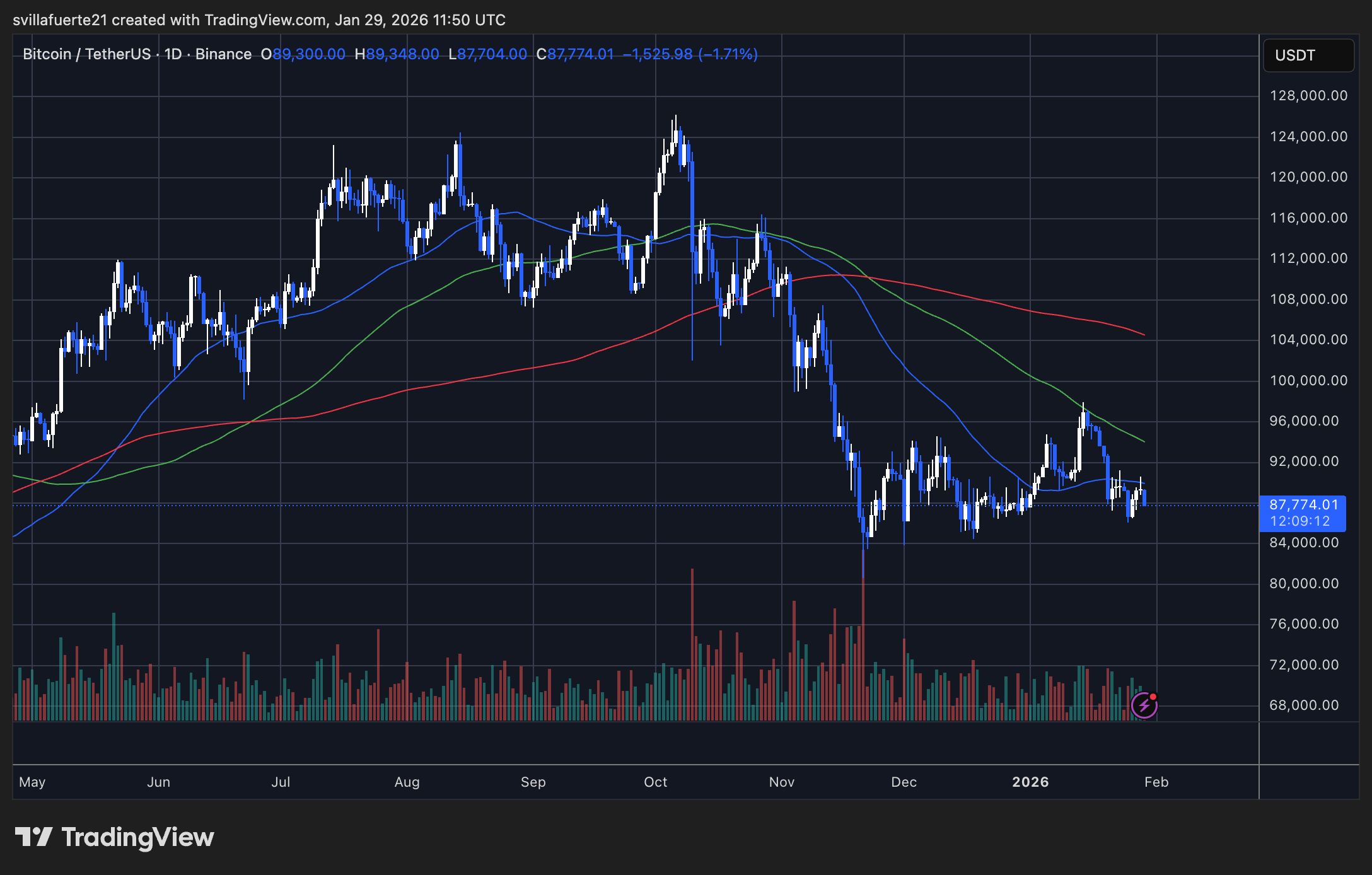
Structurally, the market is stuck in a wide range after the strong breakout in November. Since then, price action has been characterized by lower highs and choppy bounces, suggesting reactive buying rather than sustained demand. The recent rebound towards the mid-$90,000s was rejected precisely at the descending moving average cluster, confirming that sellers continue to defend rallies.
The behavior of the volume supports this interpretation. The largest spikes remain associated with sell-offs, while recovery attempts occur at relatively low volumes, reflecting limited buyer conviction. This imbalance keeps downside risk active, even if prices hold above December lows.
In the near term, the $86,000-$87,000 area remains a key demand area. A clean break would expose lower structural supports, while maintaining this level would keep Bitcoin trapped in a prolonged consolidation. Until BTC returns to its short- and medium-term averages, the chart favors caution over trend reversal.
Featured image from ChatGPT, chart from TradingView.com
Editorial process as Bitcoinist focuses on providing thoroughly researched, accurate and unbiased content. We follow strict sourcing standards and every page undergoes careful review by our team of top technology experts and seasoned editors. This process ensures the integrity, relevance and value of our content to our readers.


