




Something is happening to Bitcoin today, as news reports that the most convinced BTC holders have sold around $2.4 billion in the last two days alone. This is defined by on-chain analysis as those holding for at least 155 days, with 26% of all bitcoins sold in the last 30 days coming from investors who acquired coins over $90,000.
The moves coincide with a 12% price decline over the week since October’s all-time high above $126,000, while cash ETF net assets collapsed to $82.83 billion from $107.8 billion.
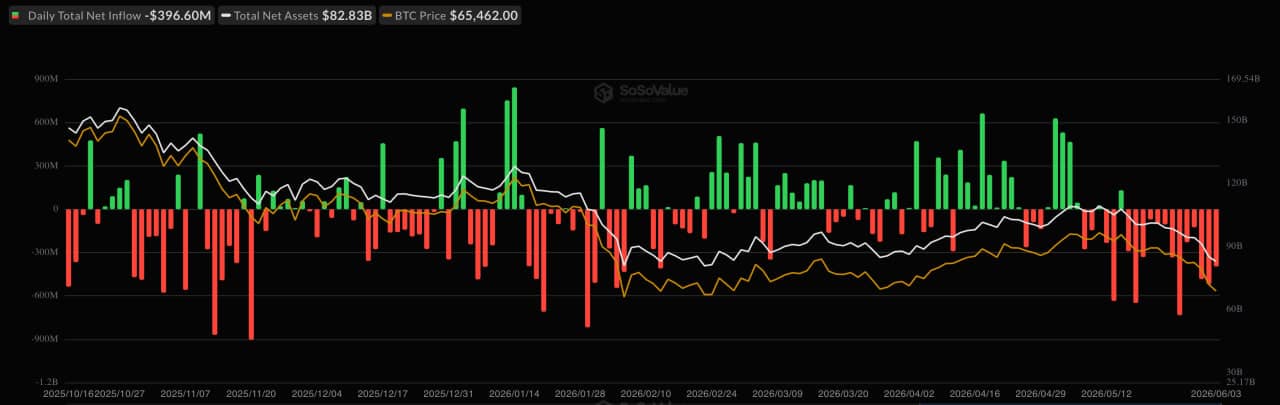
Source: SoSoValue
Compounding the pressure, weak U.S. jobs data, including a February revision showing a loss of about 92,000 positions, triggered institutional risk management programs that accelerated the sell-off of high-beta assets, with Bitcoin absorbing outsized capital outflows relative to stocks.
The analytical question is no longer whether long-term holders capitulate; it is a question of whether the behavior of this cohort at local lows constitutes a final cycle consistent with the formation of an all-time low, or reflects a structural deterioration in conviction that extends the bearish phase well beyond what previous cycle analogues suggest.
EXPLORE: The next crypto will explode in the second quarter
Bitcoin News Today: LTH-SOPR and Supply-in-Loss, What On-Chain Data Really Shows
The main on-chain signal pointed out by Compass Point analyst Ed Engel is behavioral: long-term holders were largely inactive from February to April, then turned into net sellers in recent weeks as Bitcoin approached the lows of the new cycle.
Engel noted that this change carries “significant implications for BTC supply/demand balances,” a transmission mechanism that is simple in its structure but important in its timing, given that this cohort has absorbed each previous drawdown without capitulating.
The LTH Spent Output Profit Ratio (LTH-SOPR), which measures whether long-term holders are making gains or losses on coins spent, has moved into sub-1.0 territory, confirming that a significant portion of this cohort is now selling at a loss.
A high supply of long-term holders hides a bigger problem.
The buyers who drove this cycle are no longer accumulating.
Whale tolls are shrinking and dolphin growth continues to deteriorate. pic.twitter.com/mbFYYX8bKe
– CryptoQuant.com (@cryptoquant_com) June 1, 2026
Research synthesizing data from Glassnode estimates that approximately 39-43% of the total bitcoin supply is currently underwater, approaching the 50-55% area that historically marked final cycle lows during the January 2015, December 2018, and November 2022 lows.
Current estimates place a profit of 11.1 million BTC against a loss of 8.9 million BTC, a gap that in previous cycles completely closed at the structural low before accumulation began.
Fidelity’s cycle analysis notes that the current decline from the October peak stands at about 52%, significantly less than the 77-85% declines seen in previous bear markets, but several high-value on-chain metrics, including MVRV Z-score and Loss Long-Term Holder Supply, simultaneously show flashing readings that have historically only appeared at major lows.
A composite metric, identified in a BeInCrypto roundup of on-chain data, tracks a roughly negative 1.5 standard deviation from its average near the $62,000 level, an area associated with exhaustion points from the previous cycle. Engel summed up the trend directly: “Capitulation of major buyers is a very common theme in late-cycle bear markets. This makes us more confident that the BTC bear market is in its final stages.”
DISCOVER: Best Meme Coins to Buy in 2026
following
Disclaimer: Coinspeaker is committed to providing unbiased and transparent reporting. This article is intended to provide accurate and current information, but should not be considered financial or investment advice. Because market conditions can change quickly, we encourage you to verify the information for yourself and consult a professional before making any decisions based on this content.

Daniel Frances is a technical writer and Web3 educator specializing in macroeconomics and DeFi mechanics. Hailing from crypto since 2017, Daniel leverages his experience in on-chain analytics to write evidence-based reports and in-depth guides. He holds certifications from the Blockchain Council and is dedicated to providing “insight gain” that overcomes market hype to find real utility for blockchain.


