



Bitcoin is attempting to build a near-term recovery after weeks of sustained selling pressure. Although buyers have defended a key support area, the broader trend remains fragile as price continues to trade below major technical resistance levels that must first be breached to hope for a true recovery.
Bitcoin price analysis: the daily chart
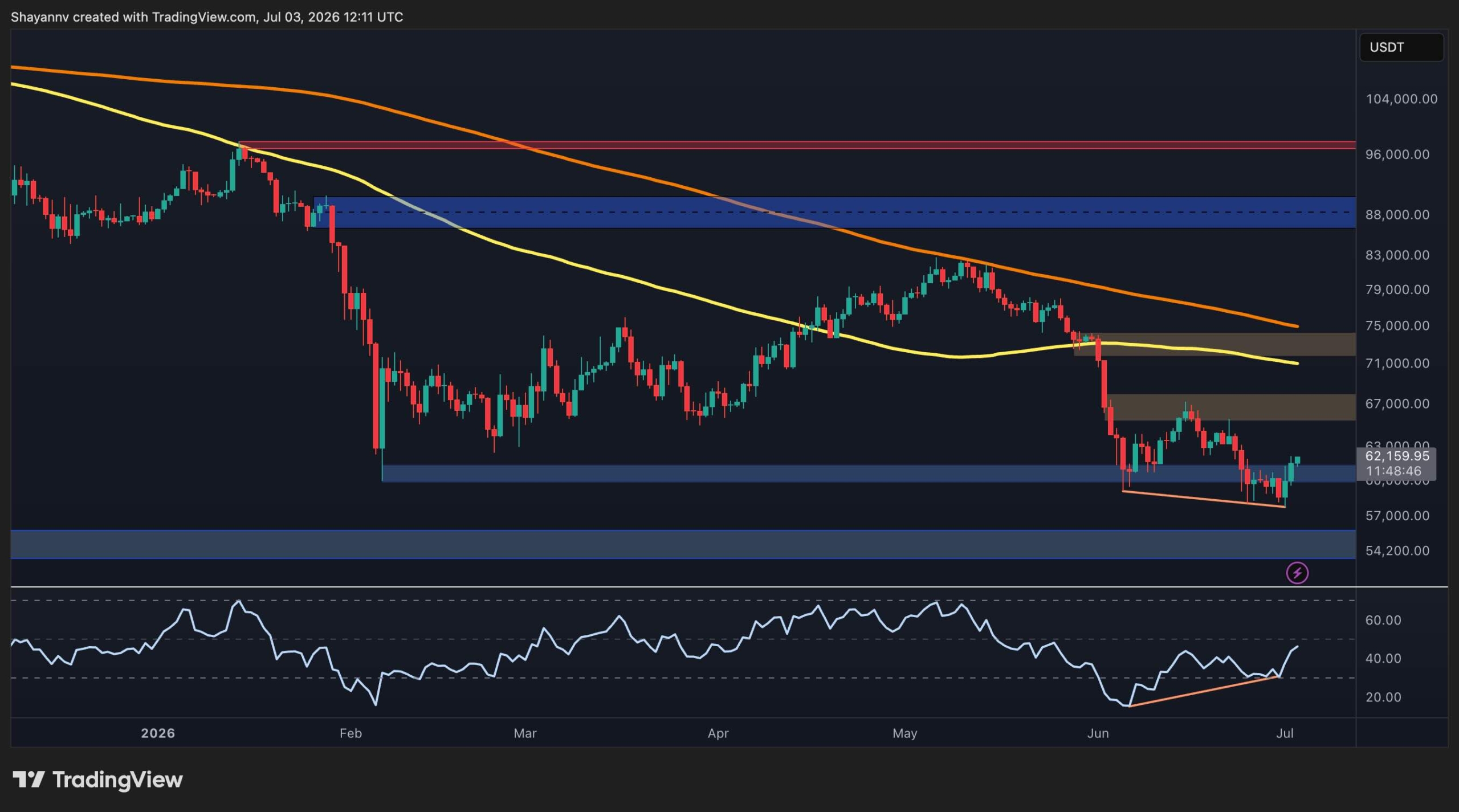
The daily chart continues to reflect a bearish market structure, with BTC trading around $62.1k. The price remains well below the 100- and 200-day moving averages, which are now acting as dynamic resistance around the $71,000-$75,000 region. As long as BTC remains below these averages, sellers will likely remain in control.
After the strong break below the 100-day moving average near $72,000 earlier this month, the market found demand at the $60,000 support zone. This area has once again avoided a deeper decline and is currently fueling a modest rebound. The RSI also formed a bullish divergence, with higher lows while prices made lower lows, indicating that the bearish momentum is fading and a near-term recovery is possible.
However, the general trend remains bearish. Even if buyers extend the current rebound, the first major hurdle lies between $72,000 and $75,000, where previous support has turned into resistance alongside the two moving averages. A successful recovery above this region would improve the medium-term outlook, while a rejection could expose the $60,000 support once again. Losing this zone would likely open the door to the next major demand zone around $55,000.
BTC/USDT 4-hour chart
The 4 hour time frame presents a more constructive picture. Bitcoin traded in a wide bearish wedge following June’s strong sell-off, a trend that often precedes bullish reversals when confirmed by a breakout.
The price recently rebounded from the lower wedge boundary and the $60,000 support zone. At the same time, the RSI produced another bullish divergence, reinforcing the idea that selling pressure is gradually weakening.
The next significant hurdle lies near the wedge’s descending upper trendline, which currently aligns with the $62,000 level. A break above this resistance could trigger a stronger rally towards the $66,000-$68,000 supply zone. Beyond that, the much broader resistance zone between $72,000 and $74,000 remains the main obstacle to any significant trend reversal.
Failure to break the wedge would keep the broader bearish structure intact and increase the likelihood of a fall below the $60,000 support.
Sentiment analysis
The SOPR (Spent Output Profit Ratio) of long-term holders continues to trend below the critical threshold of 1.0, indicating that long-term holders are, on average, making losses when they spend their coins. Historically, sustained values below 1.0 reflect periods of market stress, during which even experienced investors begin to distribute coins at a loss rather than making a profit.
The measure’s 30-day EMA has continued to weaken and is now below the neutral level, suggesting that this behavior has become persistent rather than temporary. This demonstrates moderate investor confidence and confirms that long-term holders have not yet returned to significant profit-taking.
Although this reflects persistent bearish sentiment, prolonged periods of LTH SOPR below 1.0 have often coincided with the latter stages of market corrections, as lower convictions gradually become exhausted. A return of the metric above 1.0 would indicate that long-term holders are once again spending coins to realize profits, a change that has historically aligned with improving market conditions and a healthier uptrend. Until then, on-chain data suggests that the market as a whole remains in a capitulation and recovery phase rather than a confirmed bullish reversal.
LIMITED OFFER for CryptoPotato readers at Bybit: Use this link to sign up and open a FREE $500 position on any coin!
Disclaimer: Information found on CryptoPotato is that of the cited authors. It does not represent the opinions of CryptoPotato on whether to buy, sell or hold any investments. You are advised to carry out your own research before making any investment decisions. Use the information provided at your own risk. See Disclaimer for more information.


