



Key takeaways
- Bitcoin’s short-term holder’s cost basis has fallen below the long-term holder’s adjusted level, triggering an “end of bear market” signal.
- The short-term holder’s cost basis fell from $112,500 to $69,000, consistent with recently acquired bitcoins changing hands at lower prices.
- The signal indicates an advanced bear market, not a confirmed bottom or a new bull cycle.
Bitcoin Bear Market May Enter Endgame
Blockchain analytics platform Cryptoquant shared analysis on July 18 suggesting bitcoinIt is bear market perhaps approaching its final phase. The signal compares the average acquisition prices of short- and long-term holders.
The analyst said:
“The end of bear market approach. »
Cost basis refers to the average price at which investors acquired bitcoin. Short-term holders, or STHs, have held bitcoin for less than six months, while long-term holders, or LTH, hold the crypto for more than six months.
The signal appeared when the STH cost base fell below the adjusted LTH cost base. The crossover indicates that the average cost basis of the short-term holders’ supply has fallen below that of the long-term holders’ adjusted supply.
The analyst explained:
“The end of bear market signal has just flashed. This signal is defined by the downward crossover of the STH/LTH cost basis (with a 3 day confirmation window to validate the signal).”
The crossover marks a change in the holder’s positioning rather than an exact market bottom. Bitcoin could stay volatile or trade lower before a sustainable recovery develops.
Chart shows crossover sequence through Bitcoin cycles
The chart included in the analysis plots bitcoinalongside the short-term holder’s cost basis (STH) and the adjusted long-term holder’s cost basis (LTH). This also marks “end of downtrend” signals and subsequent upward crossovers that the analysis associates with confirmed bull market phases.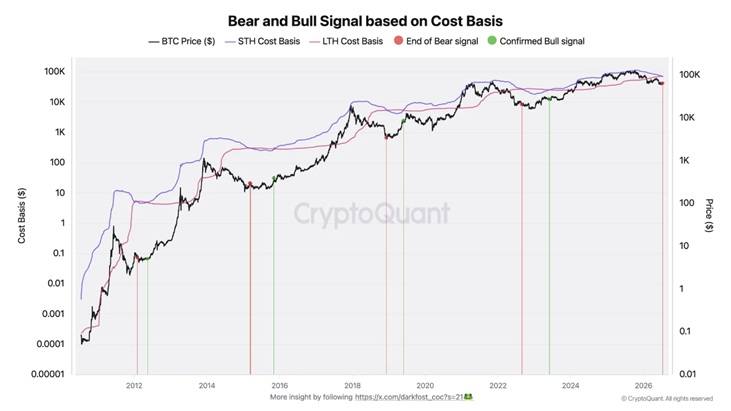
The final “end of decline” marker appears when the STH cost base falls below the adjusted LTH cost base. Previous cycles show the same sequence: a downward crossover, later followed by an upward crossover and bull market confirmation.
The interval between the “end of downtrend” and bull market confirmation markers shows that bitcoin may remain in a transient phase after the initial signal. The first crossing points towards the bear marketwhile the subsequent reversal suggests that the average cost base of new buyers is gradually increasing.
Lower cost base reflects purchasing at lower prices
According to the analysis, the short-term holder’s cost basis fell from $112,500 to $69,000. The decrease is consistent with bitcoin acquired over the past six months, changing hands at lower prices.
This activity reduced the average acquisition price of STH. The LTH cost base evolves more gradually because it reflects bitcoin accumulated over a longer period. The adjusted LTH calculation excludes bitcoin detained for more than seven years. The exclusion limits the influence of dormant supply and focuses the measurement on long-term assets considered economically active.
The analysis presents crossover as a recurring characteristic of bitcoin cycles: short-term holders accumulate bitcoin during prolonged declines until their average cost basis falls below that of long-term active holders. He also argues that institutional participation has not fundamentally changed this trend.
Signal Supports DCA Ahead of Bull Market Confirmation
The analysis describes the crossover as the start of a period of late accumulation rather than confirmation of an immediate price recovery.
The analyst noted:
“This does not mean that bear market ends at the moment the signal goes off and the bottom is in, but it indicates that we are entering its final phase, a period during which the establishment of a DCA makes sense. »
Dollar Cost ScheduleOr DCAinvolves investing fixed amounts over time rather than committing all capital at a single price. The strategy reduces the reliance on identifying the exact market bottom.
According to the analyst’s framework, a bull market would require the short-term holding cost to rise back above the long-term adjusted level for the holder. This upward crossover would match the confirmation seen in previous cycles and suggest that recently acquired bitcoin is changing hands at increasingly higher average prices. By then, the signal suggests that the Bitcoin bear market may be coming to an end without confirming that a new bull cycle has begun.


