




Key takeaways
- The Central Bank of Brazil banned Banco Topazio for 2 years and fined it $3.2 million for uncontrolled crypto transactions.
- Uncontrolled crypto transactions totaled $1.7 billion, representing 63% of Banco Topazio’s foreign exchange volume.
- Ailton Aiquino warned that similar violations could result in bans for other Brazilian banks.
The Central Bank of Brazil prohibits Banco Topazio from carrying out activities Cryptocurrency Business Operations
As banks enter the cryptocurrency businesses, regulators are becoming more vigilant about the compliance processes they must follow to conduct these operations safely.
The Decision Committee on the Administrative Sanctions Process (Copas) of the Central Bank of Brazil has imposed a two-year ban on the foreign operations of Banco Topazios. cryptocurrency commercial operations due to irregularities in transactions worth billions of dollars.
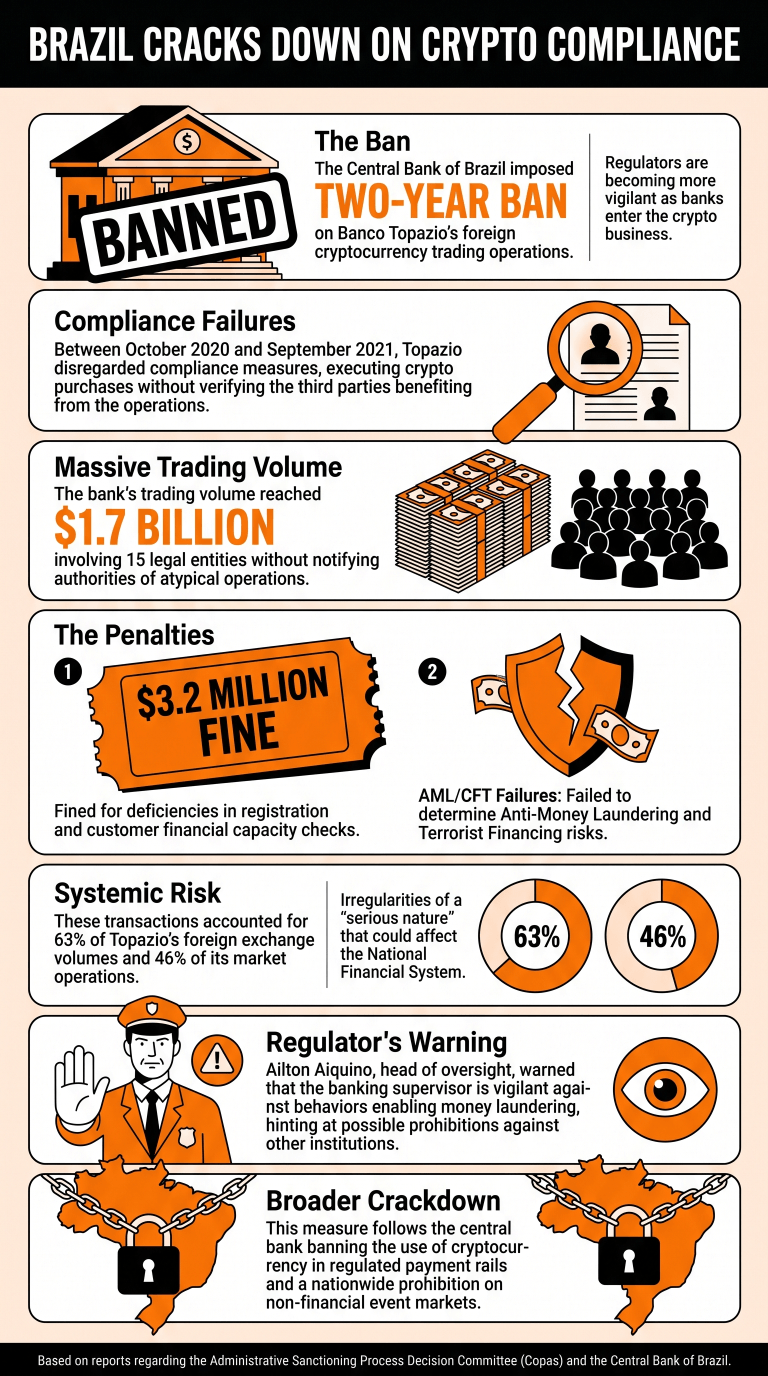
The commission determined that Banco Topazio failed to comply with compliance measures between October 2020 and September 2021, when it made purchases of cryptocurrencies without carrying out procedures to determine the qualification of third parties benefiting from these operations.
Banco Topazio’s transaction volume during this period reached $1.7 billion, involving 15 legal entities without notification of atypical operations. Topazio was fined $3.2 million for irregularities in determining clients’ financial capabilities, deficiencies in its registration procedures and failure to determine AML/CFT (anti-money laundering and counter-terrorism financing) risks.
These operations represented 63% of Topazio’s foreign exchange volumes over the period, and 46% of the institution’s market operations. This led the review committee to determine that the irregularities were of a “serious nature,” which, according to the law, could “severely affect the purpose and continuity of activities or operations within the national financial system, the consortium system or the Brazilian payment system.”
Ailton Aiquino, head of supervision at the central bank, suggested that these same bans could be applied to other institutions as a precaution if the bank considers them to be in violation of regulations.
He concluded that given the growing popularity of crypto assets in the Brazilian economy, it was important to “warn and make it clear to all agents operating in this market that the banking supervisor is attentive and vigilant in the face of deviant behavior that could lead to economic models capable of enabling money laundering operations. »
The announcement of the measure comes after the central bank banned the use of cryptocurrency in regulated payment channels and imposed a nationwide ban on non-financial event markets.


