



In Cardano news today, the Charles Hoskinson-led network’s main NFT marketplace, JPG Store, entered “restriction mode” on April 23 and is set to shut down completely on May 23, the same week Cardano voters decide to invest $12 million in a Bitcoin DeFi infrastructure project.
The timing is uncomfortable, beyond coincidence. The real question isn’t whether JPG Store failed; This is what its failure reveals about where Cardano user activity is really taking place.
After serving the Cardano ecosystem since 2021 and sharing an incredible journey with thousands of people along the way, we have reached a point where the JPG Store and Comet platforms must cease.
While we deeply appreciate the people who have supported us, the platforms have reached a…
– jpg.store (@jpgstoreNFT) April 23, 2026
ADA is trading at nearly $0.25 with a market cap of around $9 billion, according to current market data. This is a network carrying real asset value, but on-chain activity metrics tell a more complicated story in Cardano news today.
According to DefiLlama, Cardano’s DeFi TVL is around $130 million, stablecoin TVL is $48 million, 24-hour DEX volume is $780,000, and 24-hour NFT volume is $3,575. It’s the latter figure that we’re looking at here, as JPG Store was, until now, the platform that generated most of it.
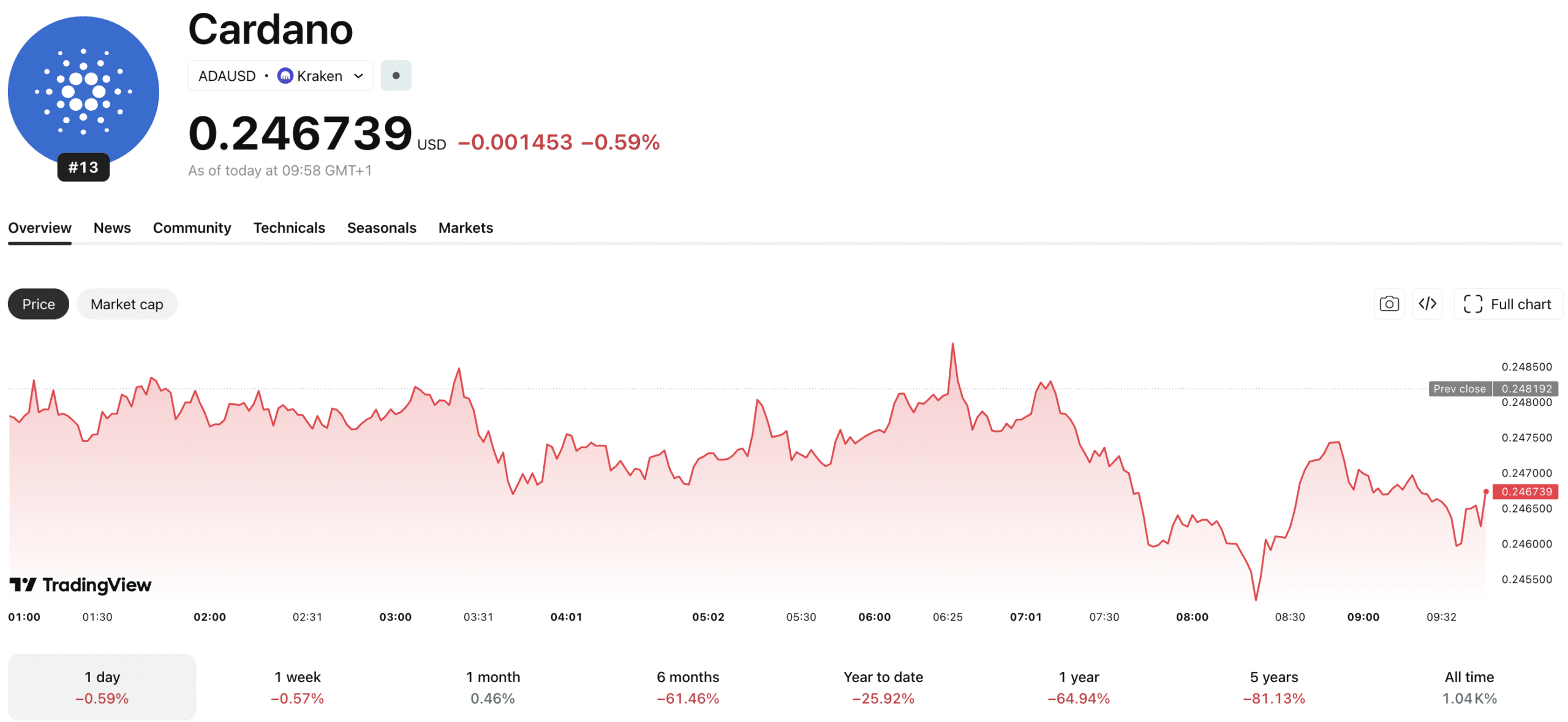
(SOURCE: TradingView)
Cardano News: Can the ADA NFT Ecosystem Survive Without the JPG Store?
Here’s the uncomfortable truth about market shutdowns: They are one of the clearest signals about the health of the chain available to ordinary observers. The price may be supported by speculation. TVL can be inflated by a handful of large wallets. But closing a marketplace because it couldn’t maintain operations reflects real user demand, or lack thereof.
Think of it like a local coffee shop closing its doors in a neighborhood. The neighborhood may still look good on a map, but the foot traffic tells a different story. JPG Store cited operational sustainability as the reason for the shutdown – not a hack, not a regulatory order, just the calculus of operating a product that couldn’t cover its costs.
Alternative Cardano NFT platforms like CNFT.io exist, but none have the market position of JPG Store. With $3,575 in 24-hour NFT volume across the entire Cardano ecosystem, the migration math for displaced users is not encouraging. Compare this to Ethereum’s NFT landscape, where warning signs of ecosystem health are visible in user activity data long before they appear in price, a framework that applies directly here.
The closure also creates an immediate practical problem. The JPG Store FAQ asks users to remove listings, cancel offers, settle or cancel loans, and transfer NFTs, tokens, and ADA to self-custodial wallets by May 23.
- Case of the bull: The JPG Store release consolidates remaining NFT activity on surviving platforms, and Cardano’s Bitcoin DeFi push – anchored by the Orion Fund’s $80 million target and Pogun’s liquidity infrastructure – attracts new capital and users that replace what was lost at the consumer level.
- Base case: NFT volume on Cardano remains depressed through 2025, the Pogun proposal crosses its 67% DRep threshold and makes infrastructure improvements, but the gap between consumer products takes 12-18 months to close as new developers assess whether the ecosystem has enough user demand to justify building on it.
- Bear/invalidation: The shutdown accelerates a narrative of application layer fragility that deters new builders, the Pogun proposal stagnates – it had just 1.04% DRep support as of April 24 compared to a threshold of 67% – and Bitcoin DeFi infrastructure is funded without a consumer layer to enable it, producing liquidity with nowhere to go.
In my opinion, $ADA is positioned for a strong performance this year.
This is a high priority asset to monitor closely.
NFA!. pic.twitter.com/7qBT1T62rK
— MANDOCT


 (@XMaximist)
 Upcoming proposals that could give the Cardano community a boost
Input Output’s 2026 Treasury List, which includes nine proposals and seeks nearly $50 million in Bitcoin DeFi and Vision 2030 initiatives, is a coherent long-term strategy. Furthermore, the network has already approved a first tranche of the Orion Fund of 50 million ADA, with an initial deployment of $15 million and a target of $80 million.
Pogun is part of this architecture. But a liquidity engine is only as valuable as the applications built on it, and right now one of those applications has just planned its own funeral. Ecosystem observers who observe how other altcoin ecosystems handle sustainability pressure will recognize the pattern: infrastructure investments without consumer demand are a recurring trap.
The Pogun vote expiring on May 24, a day after JPG Store’s demise, creates an inevitable juxtaposition. Voters now have a clear benchmark: fund this and show us what will be built before the next market release.
Watch if the Pogun proposal closes its gap at 67% DRep approval and if a Cardano NFT platform reports a measurable increase in volume as JPG Store users migrate. These two data points will tell you more about Cardano’s near-term trajectory than ADA’s price chart.
EXPLORE: Best Crypto Presales of 2025
Follow 99Bitcoins on XYouTube and Telegram for more crypto news and analysis.
The article Cardano News: NFT Market Shutdown Raises Big Questions About Ecosystem Growth appeared first on 99Bitcoins.


