




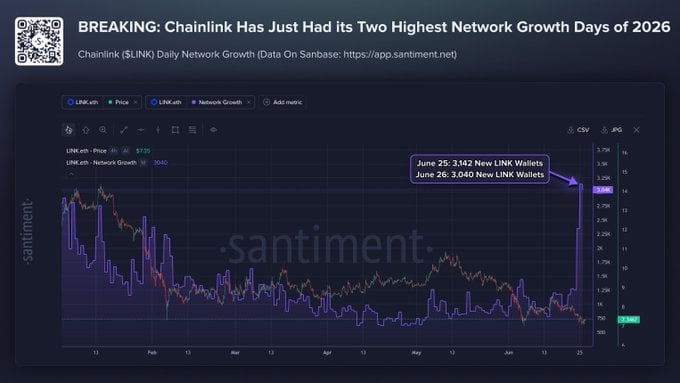
Chainlink recorded its two strongest days of network growth in 2026, as new user participation accelerated despite moderate price action.
According to Santimentthe network added 3,142 new wallets on June 25, followed by 3,040 new wallets on June 26, marking the largest daily expansion this year.
This increase reflects growing adoption rather than recycled business activity, as new addresses historically indicated the entry of new capital into the ecosystem.
Interest also remained buoyed by Chainlink’s growing institutional use cases, including real-world tokenized assets and data infrastructure. However, Chainlink continued to trade near local lows despite the remarkable on-chain activity.
This divergence suggests that market participants have not fully priced in the increase in network usage, leaving room for prices to respond if overall market conditions continue to improve.
Why have the best traders remained confident for a long time?
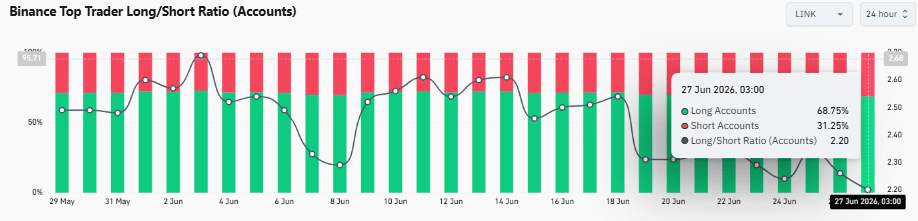
Professional traders continued to favor bullish exposure even as LINK traded near its recent lows.
Binance Top Trader’s long/short ratio showed that 68.75% of accounts remained long, while only 31.25% held short positions, producing a long/short ratio of 2.20. These numbers indicate that experienced participants retained their confidence despite the recent weakness.
Rather than reducing their exposure during the decline, many traders appeared willing to position themselves for a recovery from current levels.
Their positioning aligned with improving channel fundamentals, even if the price had not yet reflected stronger adoption. However, bullish positioning alone does not guarantee a rally.
Buyers still needed additional demand before LINK could regain higher resistance levels and confirm that sentiment had translated into sustained market strength.
Double bottom keeps recovery hopes alive for Chainlink
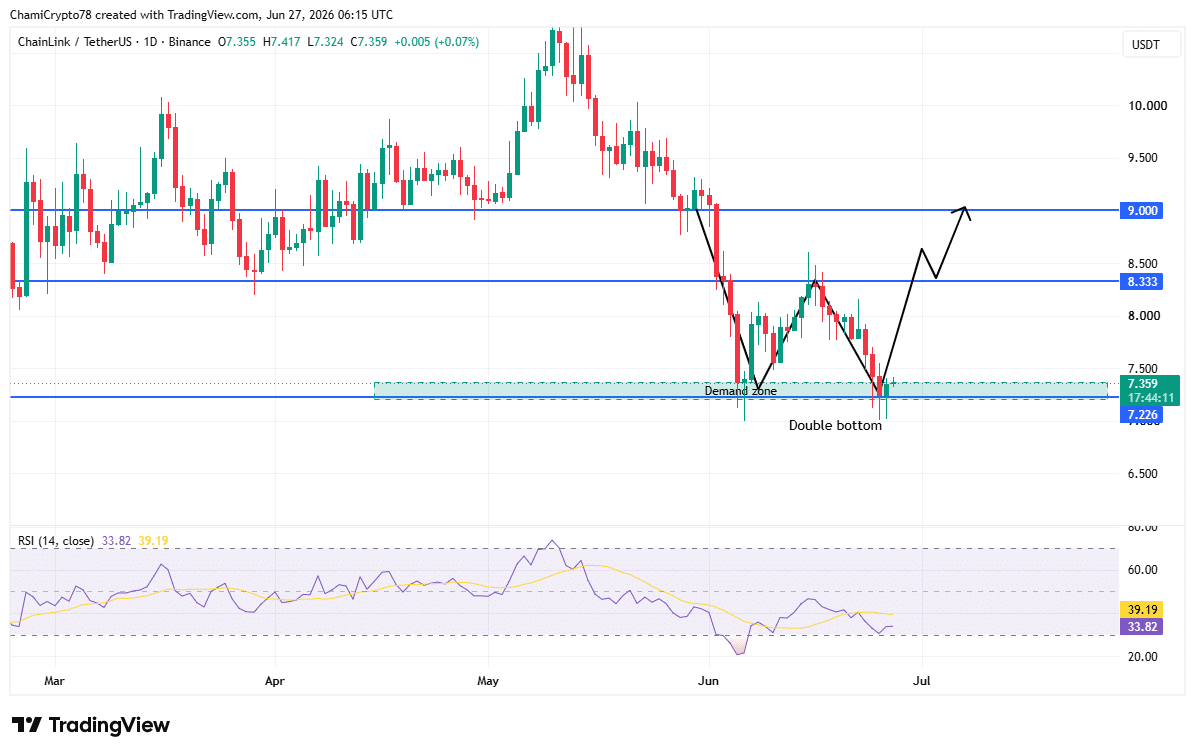
Chain link (LINK) defended its main demand zone near $7.23 after buyers repeatedly absorbed selling pressure around that level.
Repeated defense has created a developing double bottom structure, which often signals seller exhaustion before a trend reversal appears.
Buyers also kept the price above the demand zone despite several pushback attempts, demonstrating that demand remained active at lower prices.
If this structure continues to hold, the first upside target would likely remain near $8.33, where previous resistance had limited previous advances.
The relative strength index (RSI) stands at 33.82, remaining below the neutral level of 50 despite recovering from oversold territory. A successful breakout of this barrier would then focus on $9.00.
However, losing the current demand zone would invalidate the bullish setup and could expose LINK to another round of downward pressure.
Final Summary
- The portfolio’s record growth suggests adoption has strengthened even as LINK traded near recent lows.
- Double bottom support and bullish trader positioning could guide LINK towards higher resistance levels.


