




Circle struck $ 1.25 billion in USD (USDC) parts on the Solana blockchain in the last seven days, which has increased its total emission on the network to $ 24 billion in 2025.
The overvoltage underlines the growing role of Solana as a layer of regulation for the stabbed and highlights the domination of Circle as a choice of choice in one of the fastest sectors of cryptography.
DATA: @Circle struck 1.25 billion $ USDC on @Solana In the last 7 days, bringing the total from 2025 to 24 billion dollars. pic.twitter.com/pijwbsgguw
– Solanafloor (@Solanafloor) August 18, 2025
 DATA:
According to Defilma data, Stablecoin’s market capitalization on Solana has climbed $ 11.6 billion, with USDC, commanding a share of 72.2%, or about $ 8.38 billion.
This domination not only demonstrates the early bet of Circle sur Solana, where the USDC was natively integrated rather than developed, but also reflects the broad use of the token through decentralized exchanges such as Orca and Raydium, loan platforms such as Solend and payment applications.
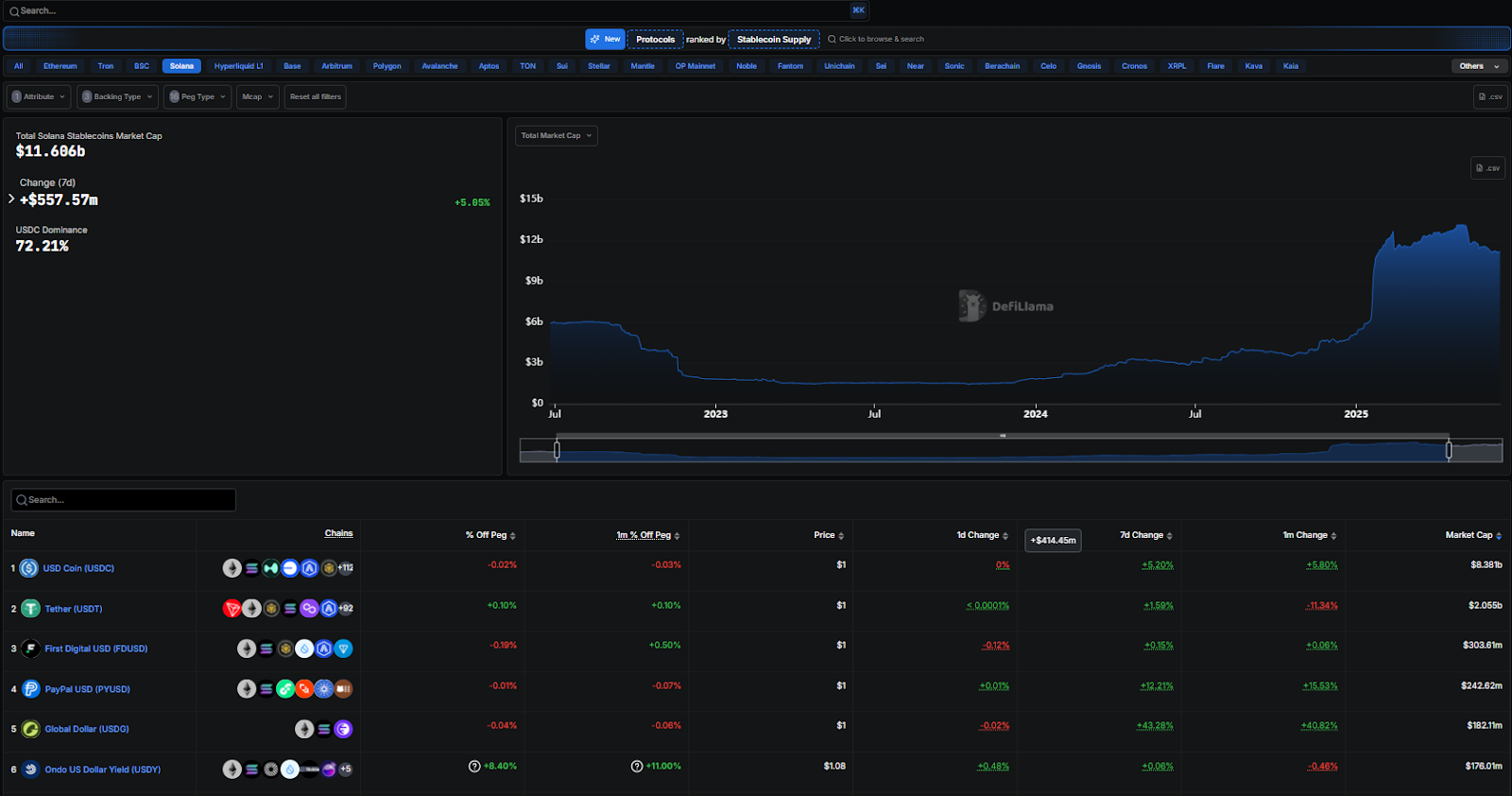
During last week alone, the Solana Stablecoin offer increased by more than $ 550 million, an increase of 5% which indicates new capital and trust entries.
The PEG of the USDC also remained remarkably tight, deviating only 0.02% compared to its $ 1 value, strengthening its reputation as one of the most reliable stable assets in crypto. This stability is particularly important in an ecosystem where rivals have more mixed performance.
TETHER, still the largest stablecoin on a global scale, maintains a share of 18% of the Solana market with around $ 2.05 billion in traffic, but its supply on the network decreased, down more than 11% in the last month.
On the other hand, the Pyusd of Paypal, the first digital USD (FDUSD) and the new entrants like Global Dollar (USDG) and USDA of Ondo yield began to carve out niches, in particular in payments and real assets in token.
The broader context reveals why the series of Circle strikes is important. Artemis data show that the use of the stables on Solana has new heights, with 1.4 billion of dollars in volume of transactions adjusted in the last 30 days, an increase of 23% which signals an increase in economic activity.
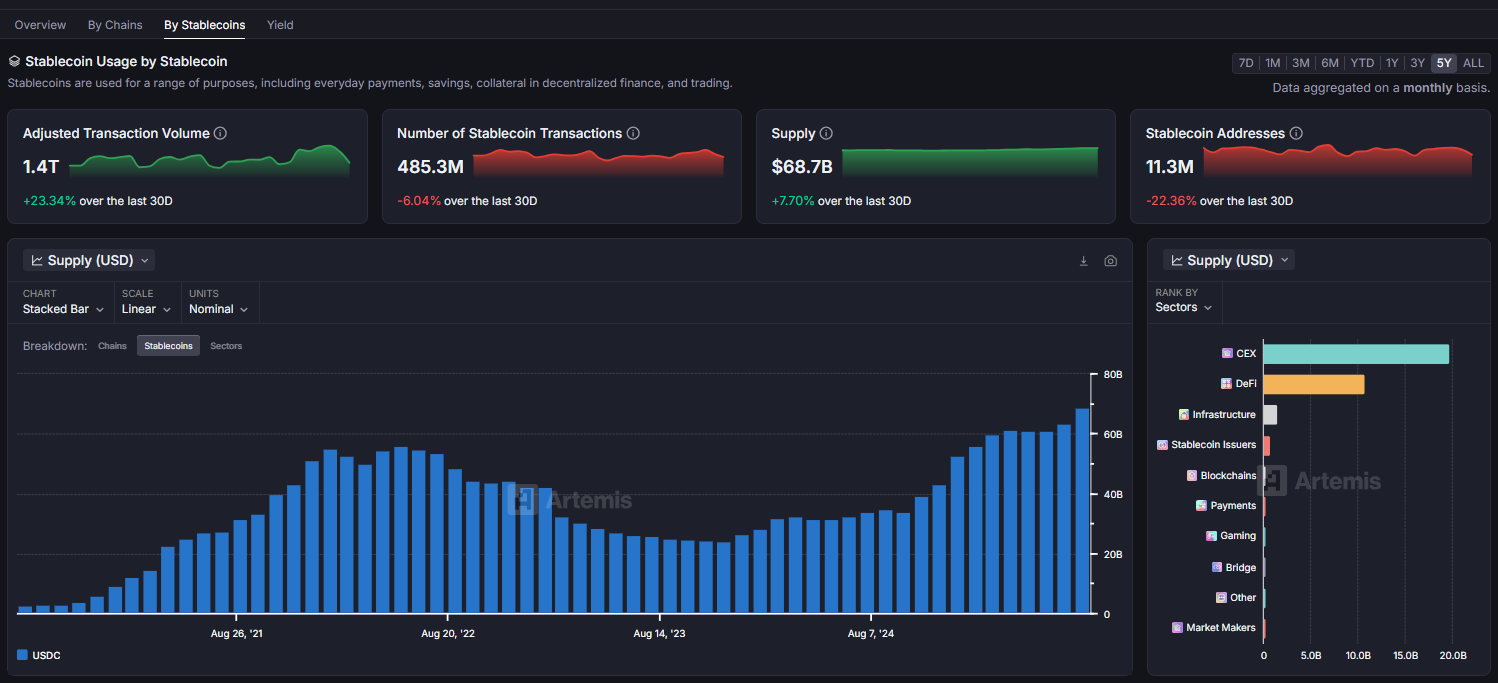
Interestingly, while the number of transactions has dropped by 6%, the average size of transactions has increased sharply, suggesting that institutional actors are increasingly leading to Solana’s stable flows.
This institutionalization is also visible in the drop in unique active stablecoin addresses, down 22% to 11.3 million, while funds are consolidated in less but larger wallets, including centralized exchanges and DEFI protocols.
The Circle USDC offer is currently $ 67.93 billion, Ethereum holding the largest share at 62.15% (42.21 billion dollars), followed by Solana at 12.34% (8.38 billion dollars) and Hyperliquid L1 at 7.49% ($ 5.09 billion).
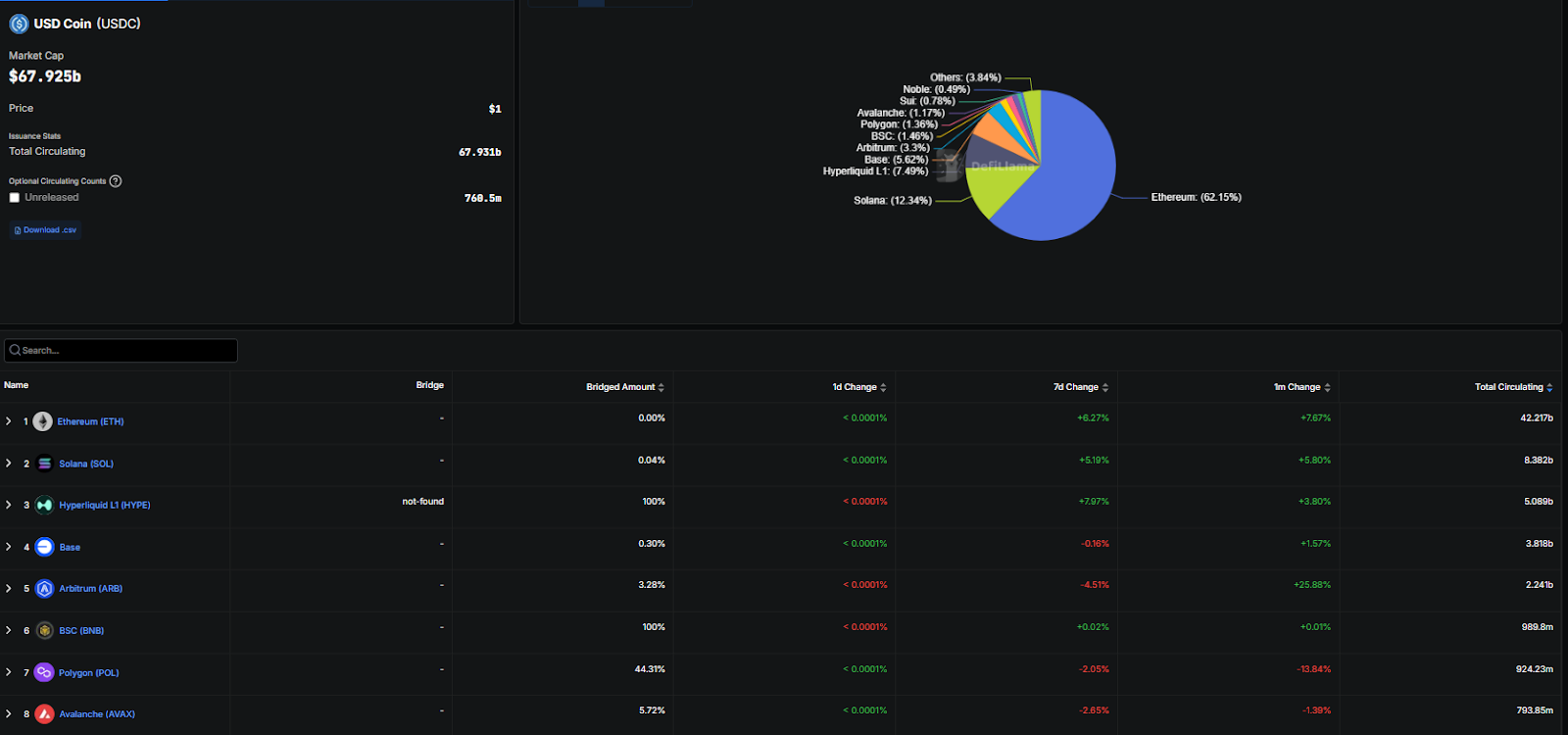
In particular, the base (5.62%), the arbitrum (3.3%), the BNB chain (1.46%), the polygon (1.36%) and the avalanche (1.17%) represent smaller circulation portions, while other networks collectively represent 3.84%.
Expansion is part of a broader trend in the Stablecoin sector. In July, the global market capitalization of Stablecoin reached a summit of $ 261 billion, marking 22 months of consecutive growth. Negotiation volumes on centralized scholarships have also skyrocketed to 1.6 billion of dollars, as the floors cement their role as skeleton of liquidity in the digital asset markets.
While Tether remains the giant in the sector with $ 164 billion in traffic, its domination has slightly slipped, an opening room for competitors like the USDC in Circle, which increased to 63.6 billion dollars in total and more recent competitors such as the USDE of Ethena.
For Solana, the figures tell a convincing story. With the USDC representing almost three -quarters of any stablecoin liquidity on the network, Circle has become the backbone of the DEFI economy and Solana payment.
Binance sees $ 1.82 billion stablecoin inputs while Solana hits 107K TPS in the stress test
Binance has experienced a massive influx of $ 1.82 billion in stablescoins in recent days, one of the largest deposits of a day in recent months.
Analysts note that these movements often precede market activity in cash, which suggests that large investors could prepare for accumulation or short -term transactions.
At the same time, Solana’s developers reported an important new step over the weekend, the network briefly managing 107,540 transactions per second on Mainnet during a stress test. The test, which used light “noop” calls, highlighted Solana’s theoretical capacity from 80,000 to 100,000 TP in living environments.
Despite the record, the real use of Solana remains much lower. The current flow is on average 3,600 TPS, most activities related to the validator’s vote. Real user transactions are generally between 900 and 1,050 TPS, widely driven by trading same on platforms such as Pump.fun and Let’sBonk.
The circle develops with OKX, hyperliquid and new arc blockchain in the middle of $ 482 million
In July, Circle deepened its global push with a partnership with OKX, introducing direct conversions 1: 1 USD-USDC for the 60 million exchange users. This decision aims to improve ramps on and outdoor in regions where banking access to stablecoins remains limited, while improving liquidity in the continuation of OKX financial services.
Around the same time, Circle deployed USDC and its improved cross-transfer protocol (CCTP V2) on the hyperliquid, allowing transparent transfers between the platform and other blockchains.
Hyperliquidal assets under management passing $ 5.5 billion, Circle stressed that the USDC issued, it will remain fully reserved and exchangeable 1: 1 for US dollars.
The momentum took place in August when Circle unveiled the arc, its own layer 1 blockchain designed for the finance of the Stablescoin. Positioned as the most ambitious infrastructure project of the company, ARC will use USDC as a gas token and has a native gas token and a cup of subsecond, an integrated FX engine and opt-in confidentiality tools.
Scheduled for the launch of Public Testnet this fall, Arc marks the circle offer to anchor the use of ignition between payments, currencies and capital markets. These announcements coincided with the first report on Circle’s results as a public company after its IPO of June, which raised $ 1.2 billion.
– cryptonews.com (@cryptonews) July 1, 2025

Despite the publication of a net loss of $ 482 million caused by costs related to the IPO, Circle declared solid operating results: the USDC in circulation increased from 90% from one year to the next for $ 65.2 billion, income increased by $ 53% to $ 658 million and adjusted the EBITDA increased by 52% to 126 million Dollars.
The USDC now controlling 28% of the Stablescoin market and the portfolio is 68% in annual sliding, Circle underlines its ambition to make stable -co -to be a central layer of global finance.
The Post Circle strikes $ 1.25 billion USDC on Solana in 7 days, reached $ 24 billion in 2025 – This is why it appeared first on Cryptonews.


