



Stand With Crypto delivered a petition signed by more than 28,000 Americans to the Senate Banking Committee on April 30, 2026, demanding that lawmakers plan an overhaul of the Digital Asset Market Clarity Act, known as the CLARITY Act.
The petition grew from about 15,924 signatures on April 28 to more than 28,000 the day it was delivered, a pace of mobilization that speaks to organized electoral pressure rather than casual sentiment online. The bill itself has already gained bipartisan support in the House in 2025.
The detail missing from most headlines is that this petition isn’t just political noise, it’s a pressure campaign aimed at a specific procedural bottleneck. The Senate Banking Committee must plan for a markup before the bill can move to a full Senate vote.
Without this step, the CLARITY Act remains in legislative limbo, regardless of the momentum it has created. For crypto investors, this limbo has real costs right now, not just in a hypothetical future.
What the CLARITY Act Would Really Change for Crypto Markets
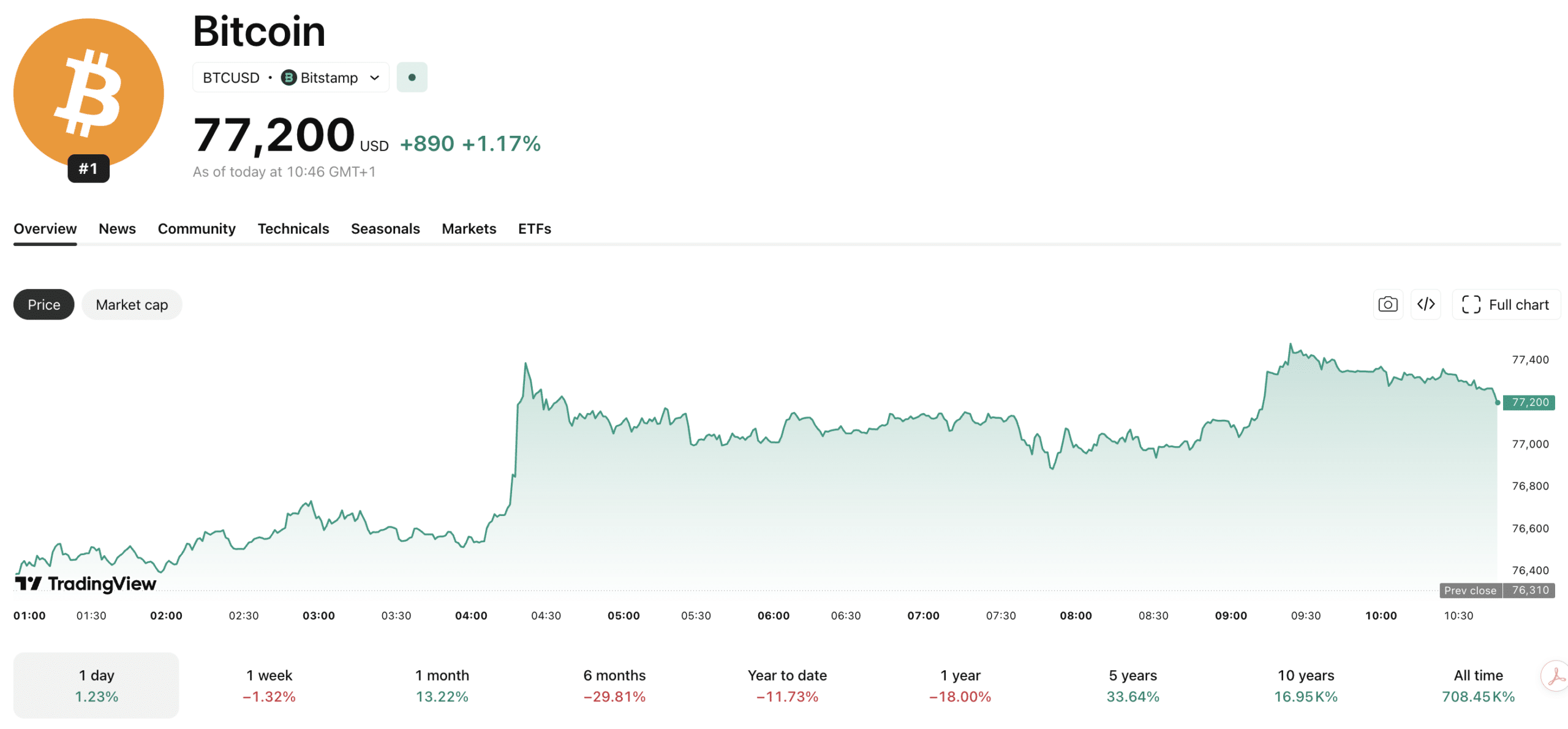
(SOURCE: TradingView)
Think of it like a zoning law for a city that operates without a law. Businesses were built anyway – some to reasonable standards, others on the cheap – because no one could say for sure what the rules were. The CLARITY Act is essentially a federal zoning map for digital assets, determining which agency owns which parts of the land.
The bill proposes a framework for classifying digital assets as securities, regulated by the US SEC, or commodities, regulated by the Commodity Futures Trading Commission. The dividing line is decentralization.
Assets operating on sufficiently decentralized networks could be considered commodities, potentially reclassifying tokens like Bitcoin and Ethereum outside of the SEC’s jurisdiction. A joint SEC-CFTC advisory committee would be mandated within 180 days of enactment to coordinate oversight.
The legislation also addresses consumer fraud protection, secondary market listing rules, and provisions relating to stablecoins and decentralized finance. Sponsors include Rep. French Hill and Rep. Jim Himes in the House, with Sen. Cynthia Lummis and Sen. Kirsten Gillibrand leading the Senate companion bill, the same pair behind the previous Lummis-Gillibrand Responsible Financial Innovation Act that stalled in 2022.
Related market structure legislation was submitted to the Senate Agriculture Committee in January 2026, demonstrating progressive momentum even before the petition push. This kind of regulatory clarity about who oversees what is precisely what exchanges and self-custody app developers say they need to operate with confidence in the U.S. market.
EXCLUSIVE: 99Bitcoin Readers – Earn $10 USDC when you sign up for Binance
Why this legislative push is more complicated than it seems
Great to welcome @iampaulgrewal And @faryarshirzad Since @coinbase at the Stand With Crypto booth at @TheBitcoinConf 2026 in Las Vegas.
Grateful for their continued support of the SWC community and the fight for clear, common-sense crypto policy. pic.twitter.com/Dbr060JCFQ
– Support crypto
(@standwithcrypto) April 29, 2026
 (@standwithcrypto)
 The optimistic view is that the CLARITY Act represents the most viable path to ending years of regulatory whiplash that has driven crypto development overseas. Analysts at Galaxy Digital estimated that the bill could increase token listings on U.S. exchanges by 30% to 50% by resolving secondary market rules that currently prevent many projects from launching domestically.
Mason Lynaugh, executive director of Stand With Crypto, made it clear when presenting the petition: the group is bringing the community’s voice directly to Washington, with 28,000 signatories demanding specific action from a specific committee.
Coinbase CEO Brian Armstrong called the bill critical to unlocking innovation while protecting consumers, and Stand With Crypto, which Coinbase introduced as an advocacy organization in August 2023, has raised about $5 million in lobbying since its launch. Advocacy groups like Coin Center have long argued that unclear rules stifle development and expose builders to arbitrary enforcement rather than protecting consumers.
Conversely, skeptics have substantive objections that go beyond partisan opposition. Former SEC Chairman Gary Gensler argued that changing asset classification based on decentralization criteria created loopholes that were easy to exploit. A project could restructure its governance to be considered a commodity and circumvent the investor protections offered by securities law.
Senators Elizabeth Warren and Tim Scott are both expected to offer amendments before any full Senate vote scheduled for June 2026, with Warren’s camp focusing on anti-money laundering provisions and consumer safeguards. The 68% community support in the Reddit poll seems strong until you notice that 32% of crypto-engaged users, people already in the space, still have reservations about what the bill actually offers.
EXPLORE: Best Crypto Presales with Staking Rewards
Follow 99Bitcoins on XYouTube and Telegram for more crypto news and analysis.
Post-CLARITY Act Petition Grows: What Does It Mean? appeared first on 99Bitcoins.


