



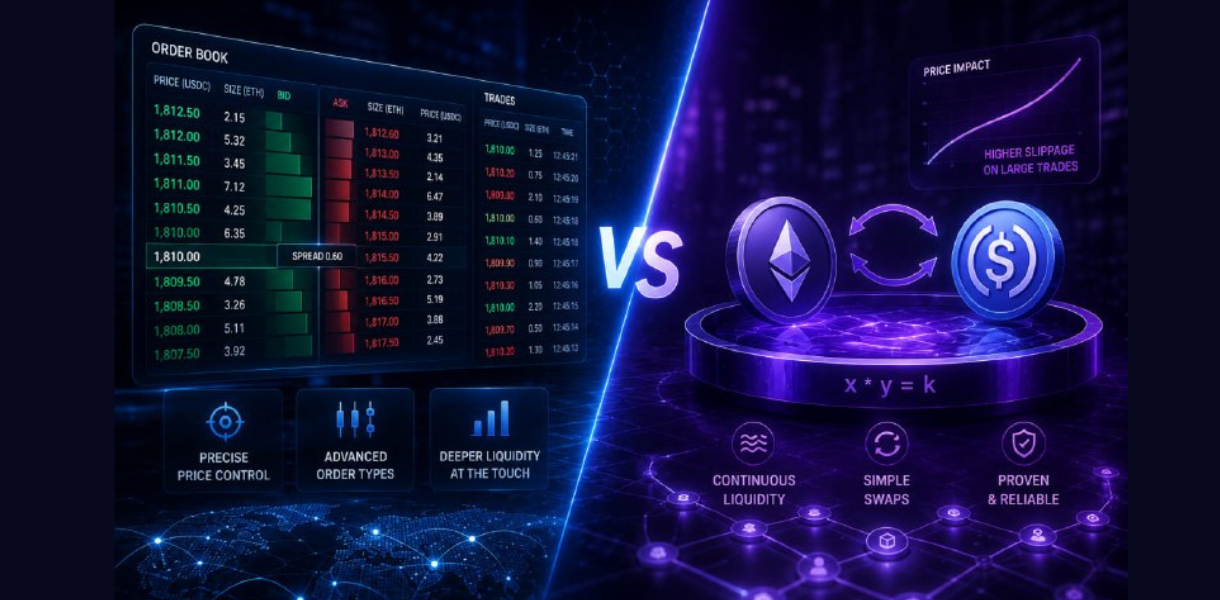

After five years of dominance by automated market makers, central limit order book DEXs are bringing sophisticated traders back on-chain. Here’s what really changes.
For most of the last five years, decentralized commerce meant one thing. The automated market maker. Uniswap defined the model in 2020. Curve refined it for stablecoins. PancakeSwap ported it to BNB Chain. By the end of 2023, AMM-based pools held the majority of on-chain liquidity, and AMM was seen as the natural endpoint of DEX design.
This assumption is falling apart. In 2026, a new generation of DEXs built on the Central Limit Order Book model will move sophisticated traders away from centralized platforms and remove liquidity from the AMM-only platforms that defined the first cycle. KalqiX, which launched mainnet in May 2026, is the most recent and aggressive example. It’s not the only one.
This is what’s really changing under the hood, and why traders and protocols paying attention should care.
How AMMs took over and what they left behind
The AMM model solved a problem that no one had solved before: how to provide deep, continuous liquidity for thousands of token pairs without the need for a central market maker. The calculation is elegant. A constant product formula (x times y equals k) sets the price based solely on the ratio of tokens in a pool. Liquidity providers deposit capital. Traders trade against the pool. The fees add up. No backlog required.
This elegance was accompanied by structural costs. AMMs are quietly ineffective by design. Large transactions experience slippage proportional to pool depth. Liquidity providers absorb fleeting losses each time prices move. Traders cannot place limit orders, enter times accurately, or execute strategies that depend on partial executions. And the public, deterministic nature of each transaction has created an entire MEV mining industry that taxes both retail and institutional flows.
For occasional exchanges, the AMMs were sufficient. For anything resembling professional trading, this was a compromise.
What a central limit order book actually does differently
The Central Limit Order Book is the template that runs all major stock exchanges, all major futures markets, and all major centralized crypto exchanges. Buyers and sellers post limit orders at the chosen prices. The book sorts these orders by price and time priority. Trades are executed when a market order or limit order meets a pending order.
This structure gives traders three things that AMMs cannot do. Precise price control. Complex order types. The ability to provide liquidity by posting prices instead of locking capital into a passive curve. It also gives the market greater liquidity because liquidity providers can compete on spreads rather than being trapped in a formula.
The reason CLOBs have not historically lived on-chain is performance. Order matching requires a fast, tidy engine that updates the book thousands of times per second. Settle every match on a public blockchain is the opposite of speed. For most of DeFi’s history, the constraint was intractable and AMM was the workaround.
What has changed in the last 18 months
Two pieces of infrastructure made on-chain order books viable for the first time. Off-chain matching engines have moved high-frequency, latency-sensitive work away from the chain itself. Zero-knowledge proofs allowed these matches to be cryptographically verified off-chain before final settlement arrived on-chain.
The result is a hybrid. The matching engine operates in the millisecond range. Traders can place and cancel orders at near CEX speed. The on-chain settlement layer preserves the trustless self-custody guarantees that DeFi was built for in the first place. Users no longer have to choose between speed and ownership.
This is the design pattern used by KalqiX. Off-chain matching for performance. Zero-knowledge proofs for verification. Chain settlement for custody. The platform reports testnet results from over 198 million transactions across 100 million orders and over 7,300 users ahead of mainnet going live in May 2026. Whether these numbers translate into sustainable mainnet activity is a question that only the next two quarters will answer. But architecture is no longer theoretical.
Where AMMs are still winning and CLOBs are progressing
It pays to be honest about the trade-offs that still need to be made. AMMs are even better for long-tail token launches where no liquidity yet exists, because the pool model bootstraps a market without requiring two-way interest. They are simpler for casual users who want to trade and move on. And they have a five-year head start on integrations into the broader DeFi stack.
The CLOBs are making progress in three places. Professional traders who need limit orders, stop-losses, and partial fills have historically been underserved on-chain. Institutional flows that require significant liquidity on contact without slippage have been forced by default to centralized sites. And projects that want to offer their communities a professional-grade trading experience haven’t had the infrastructure to offer one without launching their own exchange.
The third category is where the angle of the white mark is important. Platforms like KalqiX don’t just build a single front-end. They expose the matching engine and shared liquidity layer to other projects, who can deploy their own CLOB-based exchange and share the fee savings. This model multiplies the number of CLOB sites without increasing operational costs.
The big picture
The DEX category spent five years optimizing the wrong constraint. AMMs solved cold start liquidity, which was important when on-chain trading was a curiosity. The constraint that counts now is the quality of execution. This is what determines whether sophisticated capital stays on-chain rather than being routed by default through Binance or Coinbase.
Order book DEXs are not new. The technology to operate them at a usable speed without giving up their own guard is. Whether KalqiX or another CLOB platform will capture most of this change remains an open question. Change itself is no longer change.


