




The fourth quarter started strong for crypto and DeFi after an overall bullish third quarter, but markets quickly descended into uncertainty. as hopes for macroeconomic easing have faded and Fears of overvaluation of artificial intelligence (AI) have increased.
Overleveraged positions in Bitcoin and DeFi collapsed, triggering forced sales and a painful reset.
“The fourth quarter was defined by a major reset in leverage, with Bitcoin’s sharp pullback forcing a broader reassessment of risk,” wrote Jamie Elkaleh, Bitget’s chief marketing officer, in correspondence with Investing News Network (INN).
Risk aversion caused Bitcoin to fall from an all-time high near US$126,000 in October to a late November low below US$86,000. It had stabilized between $92,500 and $93,000 in early December.
The fourth quarter marked Bitcoin’s second-worst quarterly performance following the 2022 post-peak capitulation.
“But despite the volatility, the market has shown increasing maturity: capital and developer attention has shifted to utility-focused sectors. This quarter has reinforced that the next phase of crypto growth is based on fundamentals and not leverage,” Elkaleh said, also noting a decisive shift in Q4 from short-term trading to long-term portfolio integration.
“Compared to Q3, Q4 showed a clear pivot towards tokenized assets, with stablecoins and on-chain yield instruments becoming core allocations,” he continued. According to him, this change reflects confidence in the key role of crypto in global finance.
Keep reading to learn more about the trends driving the crypto market in 2025.
Bitcoin price in the fourth quarter
During the fourth quarter, cryptocurrencies traded in line with broader volatility in the tech and AI market – as high-growth AI stocks sold off, risk appetite faded for Bitcoin, DeFi and AI-themed tokens.
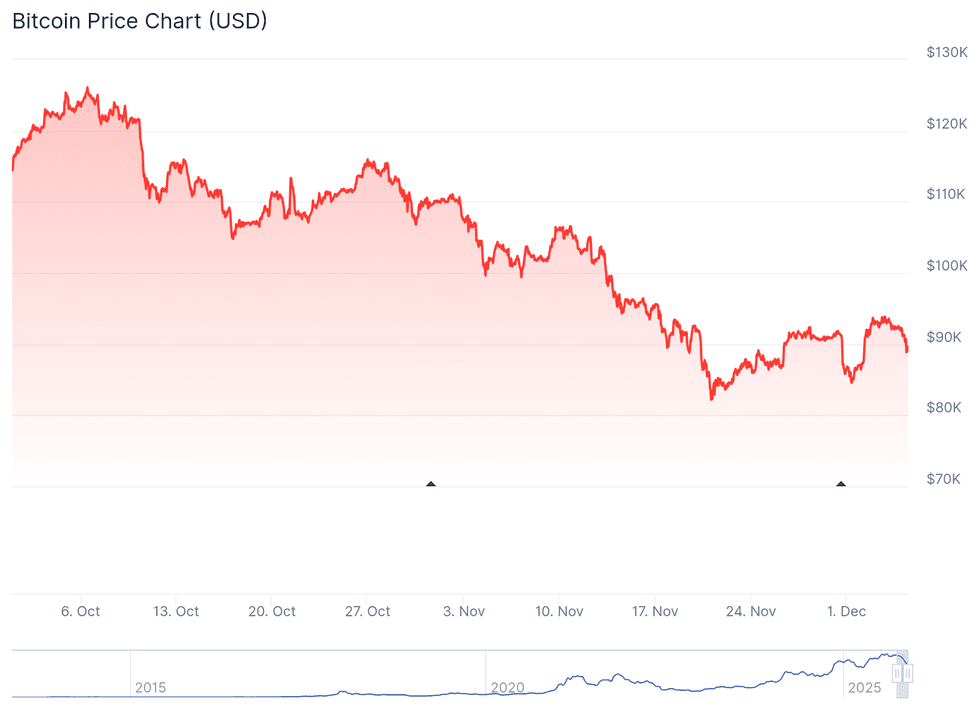
Chart via CoinGecko.
Bitcoin price, from October 1 to December 5, 2025.
At the infrastructure level, Bitcoin miners have been aggressively moving toward high-performance computing (HPC) and AI workloads. Companies like Hive Digital Technologies (TSXV: HIVE, NASDAQ: HIVE) have repurposed their data centers to lease GPU capacity to AI companies, using the same power infrastructure for more stable HPC revenue alongside mining.
This convergence has deepened the connections between crypto energy assets and AI development.
Privacy tokens showed relative strength amid the downturn, led by Zcash’s roughly 700% rally from September lows in terms of technical upgrades and accumulation, although most were still correcting with the market after hitting a high.
Growing Crypto Utility and Infrastructure
Despite the liquidity outflows, the infrastructure has gradually expanded with new tokenized assets, cross-chain tools, and exchange-traded funds (ETFs). Spot Bitcoin ETFs in the United States now hold 1.36 million BTC, or about 6.9% of the circulating supply, with total assets under management of $168 billion, according to data cited by analysts at Coinglass and Fasanara.
In mid-September, the U.S. Securities and Exchange Commission (SEC) approved generic listing standards for commodity-based trust stocks, reducing the maximum exchange approval times for listing eligible crypto spot ETFs to approximately 75 days. The move paved the way for a wave of new altcoin and staking ETFs in the fourth quarter.
At the same time, new rolling, long-term futures contracts have given institutions better tools to hold or hedge their exposure. Cross-chain liquidity routers and higher quality Oracle data have also reduced the risk of fragmentation and pricing across chains.
“The underlying strength of the market lies in the accelerated adoption of tokenization, stablecoins and DeFi infrastructure, supported by constant institutional flows and scalable technical advancements,” said Elkaleh.
The growing utility was evident in product adoption.
Tokenized cash and bonds helped increase the on-chain liquidity pool, and the launch of SPXA, the first licensed token of the S&P 500 (INDEXSP: .INX), quickly attracted more than $500 million from institutions during Bitcoin’s fourth-quarter crash.
“These areas anchor crypto in the real economy and continue to grow even in times of volatility, providing the most sustainable foundation for future growth,” Elkaleh explained to INN.
Parallel EVM chains aimed to add scalable block space compatible with Ethereum tools, while regulated prediction markets like Kalshi and Polymarket emerged as a new channel for event-driven trading and liquidity.
Finally, the decentralized perpetual sector saw explosive and sustained growth during the fourth quarter, capturing 16% of global perpetual trading volume.
Hyperliquid, the leading exchange, has become one of the leading crypto assets in terms of fee revenue, demonstrating a structural migration from centralized trading to on-chain systems designed for performance and transparency.
US regulatory clarity paves way for TradFi integration
The fourth-quarter U.S. government shutdown blocked passage of a bipartisan market structure bill in Congress, delaying a split over spot trading oversight between the Commodity Futures Trading Commission (CFTC) and the SEC.
In mid-November, a Senate committee released a bipartisan discussion draft, giving the CFTC clearer authority over digital cash products; however, it will not be voted on until at least 2026.
Despite this speed bump, the joint guidance from the SEC and CFTC makes clear that regulated exchanges and banks can list and hold certain crypto assets under current rules.
The SEC’s Crypto Project speeches in mid-November also laid out a framework for classifying and exempting tokens: digital assets, including network tokens, collectibles, and utility tools, are classified as commodities, while tokenized securities, such as on-chain stocks and bonds, must remain subject to normal SEC rules.
This regulatory clarity has enabled progress in the integration of TradFi for the crypto market.
The fourth quarter saw major banks start using blockchains for payments and settlements.
JPMorgan Chase (NYSE:JPM) has launched a US dollar deposit token on Base, with clients like Mastercard (NYSE:MA) and B2C2 successfully testing transactions for near-instant settlement 24/7. Ant International has partnered with UBS Group (NYSE:UBS) for cross-border token deposit payments.
Meanwhile, on-chain collateral networks for traditional assets have moved closer to production.
These networks trade tokenized securities, such as tokenized bonds and credit, allowing these macro assets to be used as effective collateral in the decentralized ecosystem.
“Institutional money is finally treating tokenization as a real use case, not a scientific project,” said Nicolas Mersch, portfolio manager at Purpose Investments. “Tokenized Treasuries and money market funds are leading the way, closely followed by tokenized real estate and private credit. The appeal is simple: faster settlement, better collateral mobility, and lower operational friction for banks and asset managers.”
SEC Chairman Paul Atkins also teased future crypto regulation with tailored disclosures and exemptions, giving tokens a regulated path from the fundraising phase to regular trading.
Regulatory clarity has led to an increase in the market capitalization of stablecoins. The stablecoin market hit an all-time high of more than $290 billion in the fourth quarter, accelerated by clearer U.S. regulations.
“Segments such as privacy assets, decentralized AI, and stablecoin ecosystems have weathered the downturn more effectively because they are tied to practical use cases and diversification strategies,” Elkaleh explained. “These areas rely less on speculative leverage and more on real demand, creating a buffer against the volatility that disproportionately affects Bitcoin as a high-beta macro asset.”
What investors should remember
The painful leverage reset seen in the fourth quarter of 2025 has laid a much sounder foundation for the crypto market, confirming the shift from speculation to fundamental utility. Dominant trends in real-world institutional asset integration and regulatory clarity set the stage for dramatic acceleration in 2026.
Don’t forget to follow us @INN_Technology for real-time updates!
Securities Disclosure: I, Meagen Seatter, hold no direct investment interest in any company mentioned in this article.
Editorial Disclosure: Investing News Network does not guarantee the accuracy or completeness of the information reported in the interviews it conducts. The views expressed in these interviews do not reflect the opinions of Investing News Network and do not constitute investment advice. All readers are encouraged to do their due diligence.
The views and opinions expressed herein are the views and opinions of the author and do not necessarily reflect those of Nasdaq, Inc.


