



Key takeaways
- The National Assembly adopted 176 reforms on Thursday, opening Cuba to private investment.
- Under new rules, Cuba allows private companies with more than 100 employees and private investments in the real estate market.
- Trump’s sanctions have forced Diaz-Canel to undertake reforms to save the island’s crumbling economy.
Cuba backtracks on socialism with new economic reforms
Cuba, one of the bastions of communism still present in the world, is currently making changes to boost its economy, which has been damaged by recent American pressure.
On Thursday, Cuba’s National Assembly adopted a series of 176 reforms aimed at decentralizing Cuba’s traditionally state-run economy and opening several sectors, including the financial sector, to private capital.
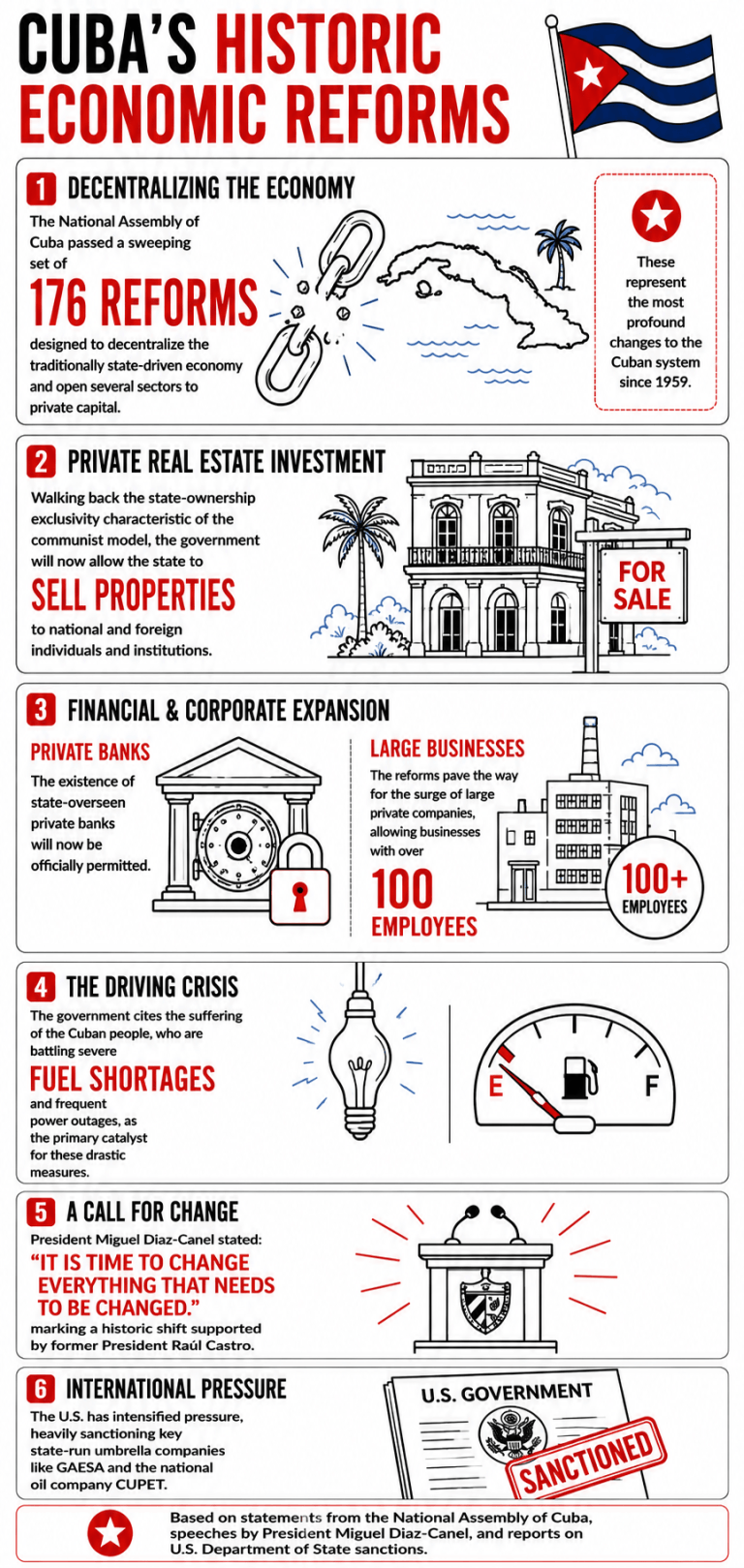
The changes would allow private investment to enter real estate development on the island, allowing the state to sell part of its properties to domestic and foreign individuals and institutions, thus returning to the exclusivity of state ownership characteristic of the communist model.
The existence of private banks, supervised by the state, would also be authorized under these new rules, as would the rise of companies with more than 100 employees in Cuba. This would pave the way for the rise of large private companies.
The reforms represent one of the most profound changes to the island’s system since the late Fidel Castro came to power after overthrowing dictator Fulgencio Batista in 1959.
The changes were supported by Fidel Castro’s living brother and former President of Cuba, Raúl Castro, recently indicted by the U.S. Department of Justice for shooting down two unarmed U.S. civilian aircraft operated by Brothers to the Rescue in international airspace in February 1996.
The government cited as the source of these measures the suffering of the Cuban people, faced with fuel shortages and frequent power cuts.
In a speech before the Assembly, Cuban President Miguel Díaz-Canel stressed that Cuba was experiencing its most difficult hour and that the government had the historic responsibility to save it.
“When people’s lives become so difficult, the primary duty of the Communist Party and the revolutionary government is not to better explain the crisis, but to change whatever is necessary to overcome it. » he assessed.
“It’s time to change everything that needs to be changed” he concluded.
The changes come after the Trump administration put pressure on the Cuban government to change its system, with President Donald Trump frequently referring to Cuba as his government’s next target.
The U.S. State Department has sanctioned several key Cuban government companies, including Grupo de Administración Empresarial SA (GAESA), which operated as an umbrella company for the Cuban military, and Unión Cuba-Petróleo (CUPET), which is the subject of allegations of selling oil in secondary markets while the Cuban people face frequent energy outages.


