



Former Ripple CTO David Schwartz pushed back against new claims that XRP could hit $10,000, arguing that the market itself already provides a reality check on such extreme price targets. In an exchange on
Schwartz pushes back against XRP Moonshot claims
The discussion began after an Schwartz responded with a simple market-based objection.
“If there were a few very wealthy, very rational people who truly believed that there was a 1% chance that XRP would hit $10,000 in 10 years, they would bid XRP up to at least $20 today,” Schwartz wrote. “Why aren’t they? Conspiracy?”
The problem wasn’t just that $10,000 is a high number. Schwartz’s argument was that if the expected value of such a target were credible to rational, well-capitalized investors, they would not wait passively. Even assigning just a small probability to a massive future price would, by his reasoning, be enough to justify aggressive buying at levels much higher than the current market has supported.
Related reading
This response speaks directly to one of the recurring assumptions behind XRP’s ultra-bullish predictions: that the market has not priced in Ripple’s future institutional utility, settlement demand, or latent strategy. Schwartz’s response suggests that markets may be imperfect, but they are not so inert that major capital pools would ignore an asymmetric opportunity of this magnitude if they believed it vaguely plausible.
The debate then moved to another familiar claim in XRP circles: that Ripple itself could use its own products, including Ripple Prime or treasury-linked flows, to significantly drive the asset higher. One user asked why Ripple wouldn’t use its own assets through these channels and suggested it could push XRP above $100.
Schwartz rejected the idea that Ripple still has an unused mechanism capable of massively revaluing XRP on command.
“Perhaps there was a time when one could semi-plausibly argue that Ripple had an easy way to massively and permanently increase the price of XRP, but was just waiting for the right moment to maximize something or other,” he wrote. “But my goodness, it’s hard to argue with that today. On the one hand, circumstances have changed so much that it’s hard to imagine that we’ve held on to this magic switch for so long and it’s still waiting to go.”
Related reading
He added that Ripple has already explained its strategy, although the company does not disclose all internal details. “We explained what we do, why we do it, and what we hope to achieve,” Schwartz wrote. “While we are not transparent about everything, we are not hiding a grand conspiracy. At least not to my knowledge.”
Another user argued that wealthy investors often focus on preserving their wealth rather than making high-risk bets. Schwartz countered that this fails to understand how large pools of capital often behave. “The rich preserve their wealth by taking greater risks than other people can bear,” he replied.
The exchange continued when another user suggested that very wealthy buyers would accumulate XRP over-the-counter rather than on centralized exchanges, limiting the visible impact on prices. Schwartz admitted that this might be true initially, but argued that it would not change the broader conclusion. “At the beginning,” he wrote. “But they wouldn’t stop until they changed prices or ran out of money.”
At press time, XRP was trading at $1.3749.
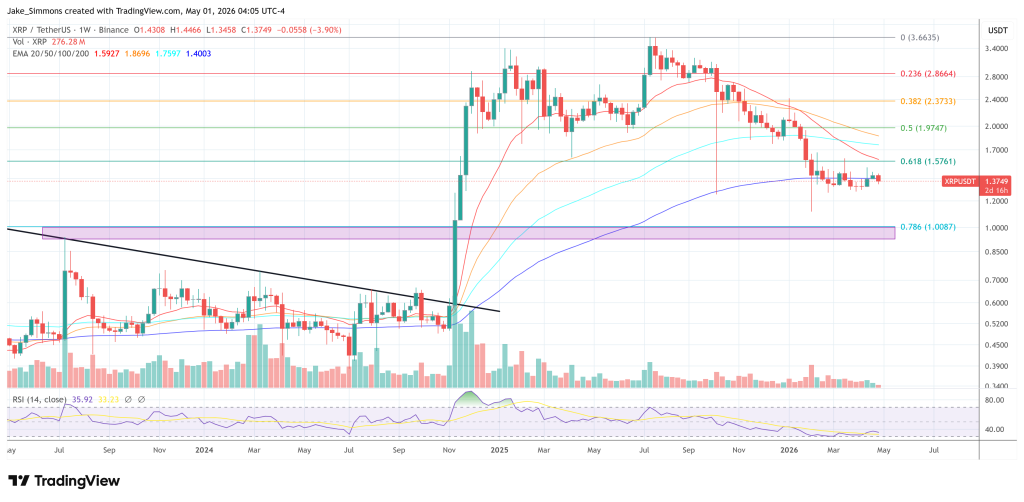
Featured image created with DALL.E, chart from TradingView.com


