




New blockchain analysis raises questions about the long-promoted “fair launch” of the PEPE meme coin, after new data suggests nearly a third of the token’s initial supply may have been controlled by a single entity.
The findings come from blockchain visualization platform Bubblemaps, which released its latest analysis on Wednesday, alleging that the project’s early messaging may have misled investors.
Bubblemaps reports concentrated PEPE holdings at launch
According to the data, approximately 30% of PEPE’s Genesis offering was consolidated into a group of wallets connected to a single entity at the time of the token’s April 2023 launch.
Bubblemaps said this focus contradicts PEPE’s brand as a token created “for the people” and its stated stealth launch approach without pre-sale allocations.

The company added that the same cluster sold around $2 million worth of tokens just one day after its launch. The move, he believes, added enough early selling pressure to prevent the meme coin from crossing the $12 billion market cap threshold in its first major push.
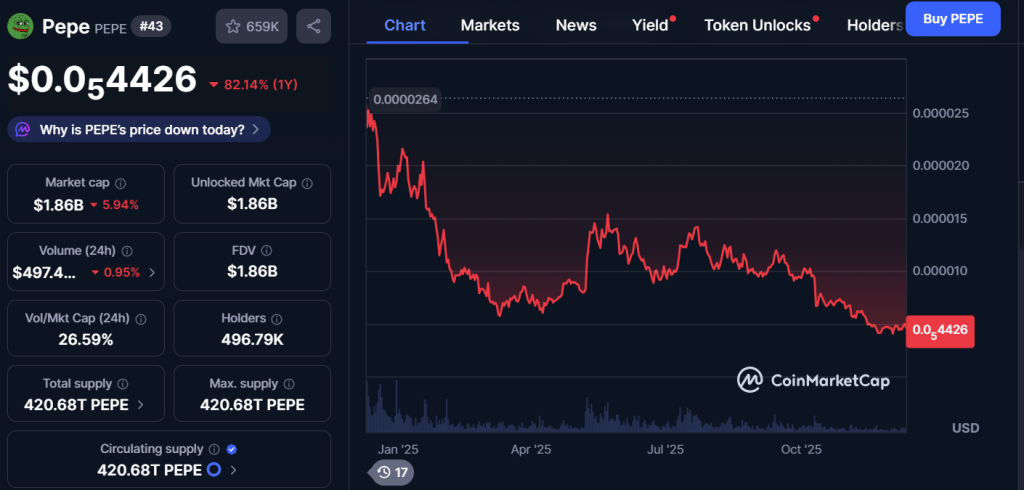
The claims surfaced during a difficult time for the token. The price of PEPE has fallen 5.7% in the last 24 hours and more than 81% in the past year, according to CoinMarketCap.
The project also faced an unrelated security alert last December, when its website was briefly compromised and redirected users to a malicious “hell drainer,” a tool associated with wallet theft, phishing, and other social engineering scams.
However, PEPE’s performance has not been uniformly negative. The token has seen dramatic rebounds at different times over the past couple of months.
On October 8, PEPE also outperformed the broader meme coin market amid a wave of accumulation by large holders.
Data from Nansen showed that the top 100 wallets increased their collective holdings by 4.18% month-on-month, bringing their total to over 307 trillion tokens.
Analysts at the time pointed to the formation of a bull pennant and noted that PEPE was testing a historically strong demand zone, fueling speculation of an imminent breakout.
On October 25, it rebounded 156% from its weekly low, attracting dip buyers and putting short sellers under pressure as trading volumes reached $1 billion.
Bubblemaps Identifies Large-Scale Wallet Coordination Across Major Meme Tokens
Bubblemaps’ new findings are part of a broader series of investigations by the firm into hidden accumulation patterns, insider launches, and potential manipulation in the coin industry.
Its “Time Travel” analytics tool, introduced in May, reconstructs historical token distributions to highlight wallets that may have coordinated their holdings before launch.
The goal, according to the company, is to help traders spot risks such as rug pulls, supply concentration and rapid liquidity removal.
Bubblemaps has already been involved in uncovering questionable activity behind several high-profile meme tokens this year.
@Bubblemaps has presented new on-chain evidence suggesting that the team behind the Libra coin is responsible for the launch of Melania.#Bubblemaps #Balancehttps://t.co/lV88r49B5P
– Cryptonews.com (@cryptonews) February 17, 2025

In February, the company linked MELANIA and LIBRA tokens to the same wallet, alleging that the entity behind the launches used internal tactics to grab early liquidity and extract millions in profits before both tokens collapsed.
LIBRA’s implosion sparked political fallout in Argentina after insiders allegedly withdrew more than $100 million, causing the token to lose almost all of its value in a matter of hours.
Similar patterns emerged in other cases. Investigators reported that more than 70% of Kanye West’s YZY token holders suffered losses shortly after its launch, while 11 wallets captured nearly a third of all profits.
– Cryptonews.com (@cryptonews) August 28, 2025
 More than 70% of traders who bought Kanye West’s Solana-based YZY memecoin ended up in the red, according to
 Bubblemaps also raised the alarm in September over what it described as one of the largest Sybil attacks on record, linking around 100 wallets in a coordinated effort that claimed $170 million in MYX airdrop tokens.
– Cryptonews.com (@cryptonews) September 10, 2025

And in early December, the company linked more than 1,000 wallets to a single actor who allegedly captured most of the WET token presale on Solana in seconds.
The post Did an entity kill the launch of the PEPE fair? Bubblemaps Reports 30% Genesis Hoard and $2 Million Dump appeared first on Cryptonews.


