



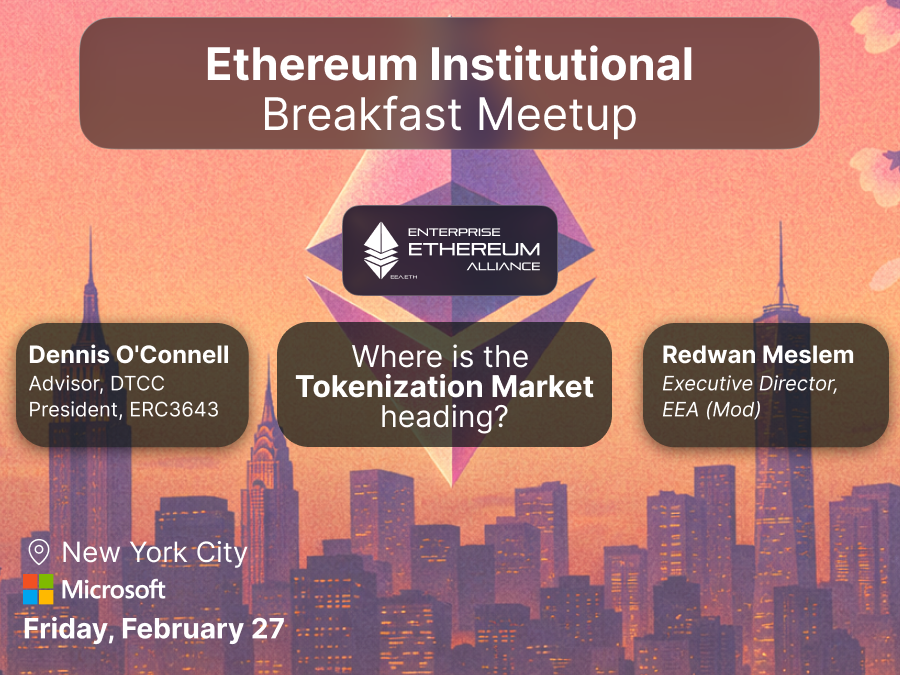
Inside the first Ethereum institutional breakfast
On February 27, the Enterprise Ethereum Alliance brought together financial institutions, infrastructure providers, and protocol engineering teams for the first Ethereum Institutional Breakfast Series at the Microsoft Garage in New York.
Clarity of market structure is the final frontier for institutional adoption of DeFi.
Last week, the AEE brought together high-level institutional practitioners for a closed-door discussion on the tokenization of real-world assets. The conversation focused on a deceptively simple question: What happens when regulated securities follow protocols without permission?
Three essential ideas emerged
1. The issue is resolved; the market structure is not.
The technical and regulatory frameworks for tokenizing private credit, funds and other securities now exist in more than 23 jurisdictions. Standards like ERC-3643 provide pathways to compliance. The bottleneck has changed: where does permissioned infrastructure stop and permissionless DeFi begin?
2. KYC creates structural fragmentation.
Each institution maintains proprietary KYC processes, both as a compliance requirement and as a competitive arbitrage. This creates cascading verification requests: KYC to own the asset, KYC to collateralize it, KYC to use it in DeFi protocols. The question is not technical, it is regulatory. Who sets the limit?
3. Secondary liquidity is the cause of institutional emergency.
Without composable DeFi rails, tokenized securities remain siled. The real value proposition comes when compliant assets can access on-chain lending, liquidity pools, and yield mechanisms. Institutions are now actively testing these limits: the Aave, Morpho and Uniswap partnerships point the way.
What are the issues
Citadel’s Market Structure Letter exposed the fundamental tension: If accredited investors deposit ERC-3643 securities into DeFi protocols, does the protocol become a broker? Current regulatory frameworks were not designed to answer this question. The Clarity Act and similar laws attempt to answer, but their implementation remains contested.
Unlike previous regulatory debates around issuance or custody, this one determines whether institutional capital can take advantage of Ethereum’s composability at scale or whether it remains confined to closed systems.
The EEE advantage
These conversations don’t happen at conferences. They require antitrust protection, neutral ground, and participants who have already deployed capital on-chain. The AEE provides exactly that: a forum where competitors can identify their shared infrastructure needs without exposing their proprietary strategies.
When the SEC Crypto Working Group needed feedback on Ethereum’s institutional framework, relationships with the EEA made those connections possible. When Latin American regulators adopted compliant tokenization standards a few months after the US regulatory changes, cross-border EEA networks accelerated alignment.
The playbook for tokenization exists. The question now is one of execution, and execution requires coordination between institutions that traditionally do not collaborate. This is what the EEA allows.
The Enterprise Ethereum Alliance regularly hosts technical and strategic dialogues for institutional members. Conversations follow the Chatham House Rule to enable frank exchange while protecting the interests of participants.


