





Ethereum is pushing against the $2,400 level but has been unable to close above that level, caught in a market heating up around it, while price action remains tepid. The broader environment is increasingly constructive, but ETH continues to suffer the lingering effects of the correction that defined the first quarter of 2026. And according to an analysis of the Arab channel, the data below the price is starting to change – quietly, gradually, but in a direction that matters.
The Sharpe ratio for Ethereum on Binance has moved into positive territory, recording around 0.07. This is a modest figure, and the report does not exaggerate. But the importance lies less in the current situation of the ratio than in its current situation. For much of the past few months – especially during the difficult February period – the indicator was in negative territory, meaning that ETH holders were absorbing risk without being adequately compensated by returns. This situation has changed.
The 30-day average yield now stands at around 0.0027, a low but positive number that reflects a market that is beginning to regain its footing. Volatility remains high enough to limit how quickly the ratio can improve, but the direction has changed.
From punishment to healing
To appreciate where Ethereum’s risk-adjusted returns are today, it’s helpful to look at where they’ve been. For much of the past few months – and particularly in February, when the market was at its strongest – the Sharpe ratio remained in deeply negative territory. This meant that holders were taking significant risks without being compensated. Every session of volatility was working against them, and the indicator’s calculations clearly reflected this.

The gradual evolution towards positive values since then is not spectacular, but it is significant. The Arabic channel analysis describes it as an improvement in market efficiency – a phrase that reflects something real. As Ethereum stabilized around the $2,300 level, the relationship between risk and return began to normalize. Prices are no longer moving violently enough to wipe out the modest gains that have begun to accumulate. This type of equilibrium, in which returns improve without being immediately wiped out by volatility, generally provides the basis for a lasting trend rather than a short-lived rebound.
The honest caveat is that 0.07 is far from the high values associated with strong bullish momentum. Ethereum has not entered an aggressive upward phase – the data does not yet support this conclusion. What it reinforces is the idea that the worst lies behind the risk-adjusted picture and that the conditions for a real recovery are slowly coming together.
If the Sharpe index continues to rise in the coming weeks, it would mean that investor confidence is returning on a lasting basis. For now, it’s early, but the direction has changed and, in the markets, direction usually matters more than level.
Ethereum’s daily structure shows a market attempting to move from a corrective phase to an early recovery, but still facing general resistance. After the sharp sell-off in early February, marked by a sharp rise in capitulation volume that pushed the price towards the $1,800 region, ETH established a base and began to form higher lows. This change indicates that the selling pressure has reduced and buyers are gradually returning.
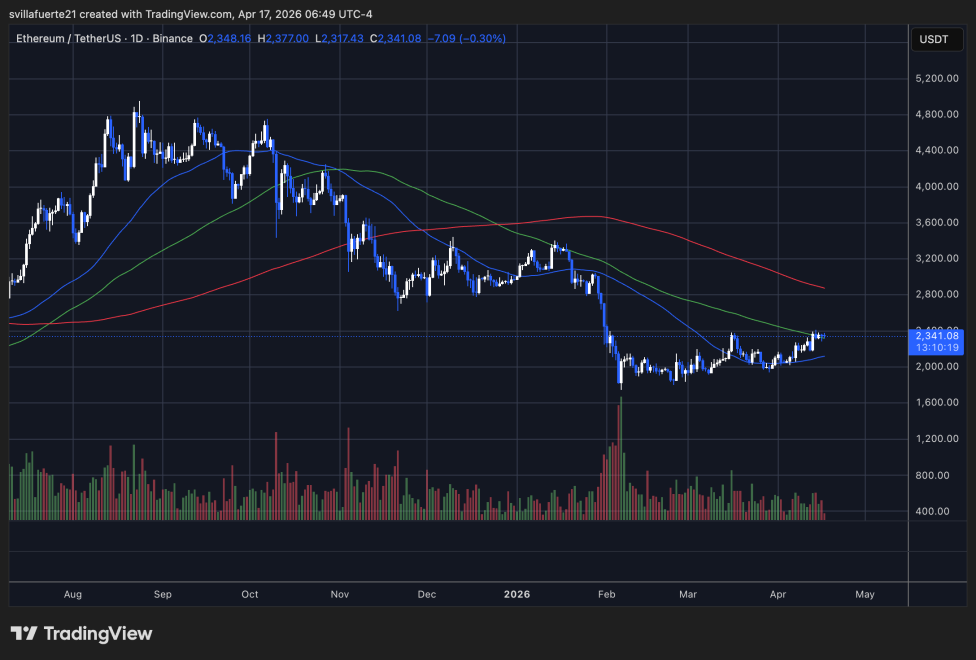
The price is now trading around the $2,300-$2,400 area, which is technically important. This area aligns with the 100-day moving average, currently acting as dynamic resistance. ETH has tested this level several times but has yet to reach a decisive breakout, suggesting that supply remains present at these levels. Meanwhile, the 50-day moving average has turned below the price, supporting the short-term recovery trend, while the 200-day moving average remains above it, reinforcing the broader bearish backdrop.
Volume normalized after February’s peak, indicating that the current move is not driven by panic but by more measured accumulation. The structure is constructive but incomplete.
A confirmed breakout and holding above $2,400 would likely open the way to higher levels, potentially targeting the $2,700 region. Failure to break this resistance would keep ETH range-bound, with support near $2,100 remaining critical.
Featured image from ChatGPT, chart from TradingView.com
Editorial process as Bitcoinist focuses on providing thoroughly researched, accurate and unbiased content. We follow strict sourcing standards and every page undergoes careful review by our team of top technology experts and seasoned editors. This process ensures the integrity, relevance and value of our content to our readers.


