





Vitalik Buterin said the Ethereum Foundation (EF) is moving toward a smaller, more focused and more opinionated role, with fewer ETH sales and a clearer mandate around Ethereum’s long-term resilience, privacy, security and capture resistance.
In a lengthy post via He also stressed that these remarks reflected his own views and not a unilateral official directive.
“First of all, this is just my own view. The board is not just me, and I do not have any additional special powers on the board that other board members do not have,” Buterin wrote. He added that the board is growing and his own influence within the organization “will continue to diminish,” which he said is “honestly what I want.”
A smaller Ethereum foundation with a narrower mandate
Buterin said changes to the FE in 2025 had improved execution, efficiency and focus on concrete goals. But with those issues partially resolved, he argued that another criticism became harder to ignore: Ethereum’s public values of decentralization, privacy, and “sanctuary technology” were not always reflected strongly enough in the foundation’s actions.
The result, according to Buterin, is a transition to a foundation that does less, but does it with more conviction. He described the FE as “a node, with a defined purpose, alongside other nodes,” rather than the central coordinating body of Ethereum.
This distinction is important both financially and culturally. Buterin noted that EF only holds about 0.16% of all ETH, which he said is “less than many other individual ETH holders,” while central foundations in other blockchain ecosystems often hold much larger shares. He also argued that the FE’s initial financial role was limited: funding the development of the on-chain software through the steps outlined in Ethereum’s pre-launch documents, a goal he said was “fully completed in 2022.”
“And so today, the FE chooses to use its remaining resources to pursue longevity on a grand scale,” Buterin wrote. “Yes, this means we are selling less ETH.”
The foundation, he said, will focus specifically on work “critical to the success of Ethereum as a censorship/capture-resistant, open, private and secure system” that would not otherwise occur. This means that some respected people and projects can sit outside of the FE, even if they are aligned with Ethereum’s broader mission.
Ethereum Should Not Pursue Speed Alone
Buterin’s technical argument centered on what he called the CROPS dimension: censorship resistance, openness, confidentiality and security. He compared this to the idea that Ethereum should define its ambition primarily by ultra-low latency and extreme throughput.
“To some, ‘impressive’ means: 250ms latency and 1M TPS. I think Ethereum trying to go this route is a mistake,” he wrote. “Being as fast and scalable as possible, and only a small epsilon more decentralized than the rest, is a path to mediocrity, and if we try it, we will lose.”
Buterin said Ethereum still has to evolve, but argued its most defensible advantage should be deeper. He highlighted AI-assisted formal verification as a potential path to a “provably bug-free Ethereum,” a goal that he said would have seemed absurd to many cybersecurity researchers until recently. He also highlighted “on-chain consensus,” arguing that Ethereum’s orientation with lean consensus preserves properties he sees as distinct from Bitcoin-style and traditional BFT-style systems.
A third priority is intermediate minimization. Buterin called it “honestly embarrassing” that smart contract wallets and privacy protocols often rely on intermediaries to include on-chain transactions. He cited FOCIL, EIP-8141, EIP-7701 and Kohaku as part of efforts to strengthen inclusion properties, public memory pool access and user-layer infrastructure that does not disclose private data between multiple third-party services.
ETH Asset Still Matters
Buterin also linked technical focus to the economic role of ETH, calling ETH the most valuable “product” of the Ethereum blockchain, from a financial perspective. » He said that Ethereum had obtained $250 billion worth of ETH and argued that the properties he described were beneficial to the asset.
He added that almost 90% of his net worth is in ETH, with most of the rest made up of around $40 million in on-chain fiat already allocated to open source biotech, software or hardware initiatives. Nonetheless, he said some work needed to support ETH as an asset is outside the scope of the FE and will require intervention from other organizations and major ETH holders.
The foundation’s new long-term structure, Buterin said, should stabilize over the coming months. His final description was straightforward: EF will be “a smaller ship than in previous years,” more opinionated, more sustainable, and more closely tailored to ensure that Ethereum “brings something meaningful to the world.”
At press time, ETH was trading at $2,108.
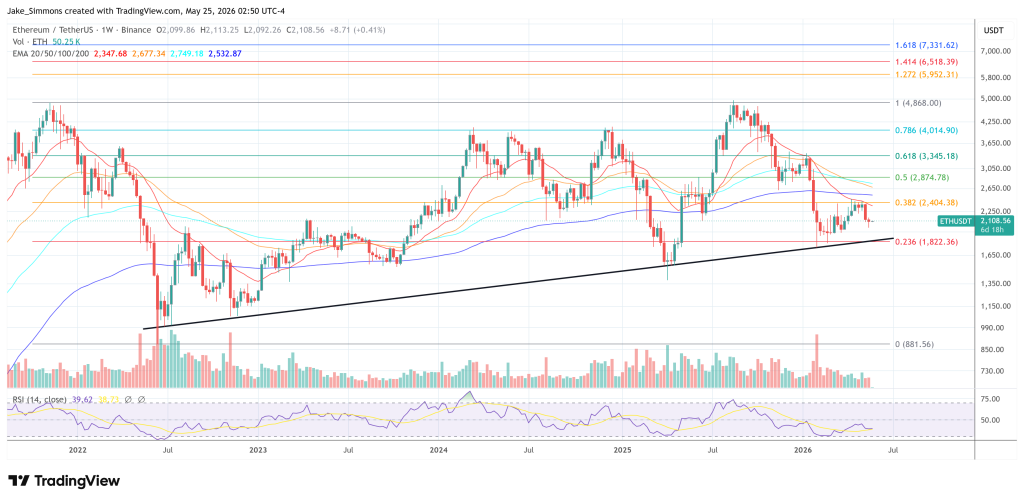
Featured image created with DALL.E, chart from TradingView.com
Editorial process as Bitcoinist focuses on providing thoroughly researched, accurate and unbiased content. We follow strict sourcing standards and every page undergoes careful review by our team of top technology experts and seasoned editors. This process ensures the integrity, relevance and value of our content to our readers.


