




Ethereum held above $2,250 as the market heads towards what appears to be a decisive move in either direction. The recovery from the February lows has been real and sustained – but according to lead analyst Darkfost, the participants who should be most convinced of this are doing the opposite of what conviction looks like.
Related reading
The context behind this observation begins with the severity of the previous correction. ETH has fallen around 65% from its last high – a decline that has placed it among the hardest-hit assets in a downturn that has damaged the entire altcoin market. TOTAL2, which measures the combined market capitalization of altcoins excluding Bitcoin and stablecoins, lost more than 51% of its value over the same period. The sale was broad, deep and extensive enough to leave lasting marks on the psychology of the participants.
Since then, the recovery has been significant. Ethereum is now trading more than 30% above the February 6 low – a rally that, in any normal market environment, would attract new buyers and establish a bullish consensus.
This consensus was not formed. Darkfost data shows that despite the 30% rally, most investors are still not convinced. They do not sit idly by waiting for confirmation. They are actively taking aggressive short positions against a market that has already moved significantly higher – a posture that sets up a specific dynamic that the data now makes visible.
The last time funding looked like this, the bear market was coming to an end
Darkfost’s funding rate data is where the pattern becomes historically significant. Throughout Ethereum’s 30% rally from February lows, funding rates on Binance have remained consistently negative – not briefly, not as a daily fluctuation, but as a month-long sustained condition that reflects the collective positioning of participants who refuse to believe the rebound is real.

The average monthly funding rate currently sits at -0.0018. The last time funding remained this negative for this long was in November 2022 – during the FTX collapse, at the end of the previous bear market. Darkfost is careful to note that today’s environment is fundamentally not comparable to that of the time. What is comparable is the behavioral imprint: a market in recovery while the majority of derivatives players position themselves aggressively against it, constantly paying to maintain short exposure even as the price rises.
This bet already generates a cost. Short liquidation volumes have increased as Ethereum’s bullish momentum forces overleveraged positions out of the market. Each forced liquidation removes a short position and adds buying pressure, creating the possibility that the rally will feed on itself as more short positions are captured and closed.
Markets rarely reward the type of consensus that currently surrounds the short side of Ethereum. The parallel with the FTX era is not a prediction. This reminds us that the strongest movements tend to start precisely when the greatest number of people position themselves against them.
Related reading
Ethereum Tests Structure as Momentum Remains Below Resistance
Ethereum is trading around $2,280 after a steady recovery from its February capitulation low near $1,800, but the chart shows the market losing momentum as it approaches a key resistance group. Price is now compressing between the short-term uptrend (around the 50-day moving average) and the descending 100- and 200-day moving averages, which continue to move lower and cap attempts higher.
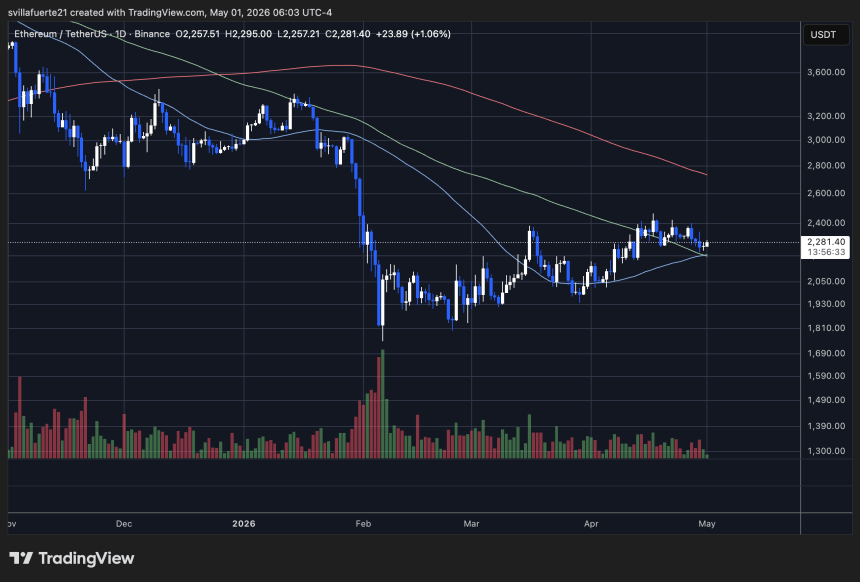
The recent structure is constructive but not yet bullish. Higher lows since mid-March indicate accumulation, but each push towards the $2,350-$2,450 region has been rejected, forming a clear supply zone. This repeated failure suggests that sellers remain active at higher levels, likely using the rallies to distribute.
Related reading
The volume reinforces the hesitation. The recovery phase has not matched the intensity seen during the February sell-off, implying that the current move lacks conviction. Buyers are present, but not aggressive enough to absorb supply decisively.
From a structural perspective, Ethereum is rolling up. A clear break above $2,450 would shift the momentum and pave the way for reclaiming the $2,700 region. Conversely, losing the $2,200-$2,250 support zone would invalidate the upper-lower structure and expose the market to a deeper retracement towards $2,000 or lower.
Featured image from ChatGPT, chart from TradingView.com


