




Stablecoin activity is becoming a competition over which blockchains move the most token dollars.
Visa Onchain Analytics showed that adjusted stablecoin transaction volume reached approximately $1.79 trillion in June, surpassing its February peak and increasing sharply from May. The network’s key breakdown was tight: Base ranked first with around $565 billion in adjusted volume, just ahead of Ethereum with around $562 billion.
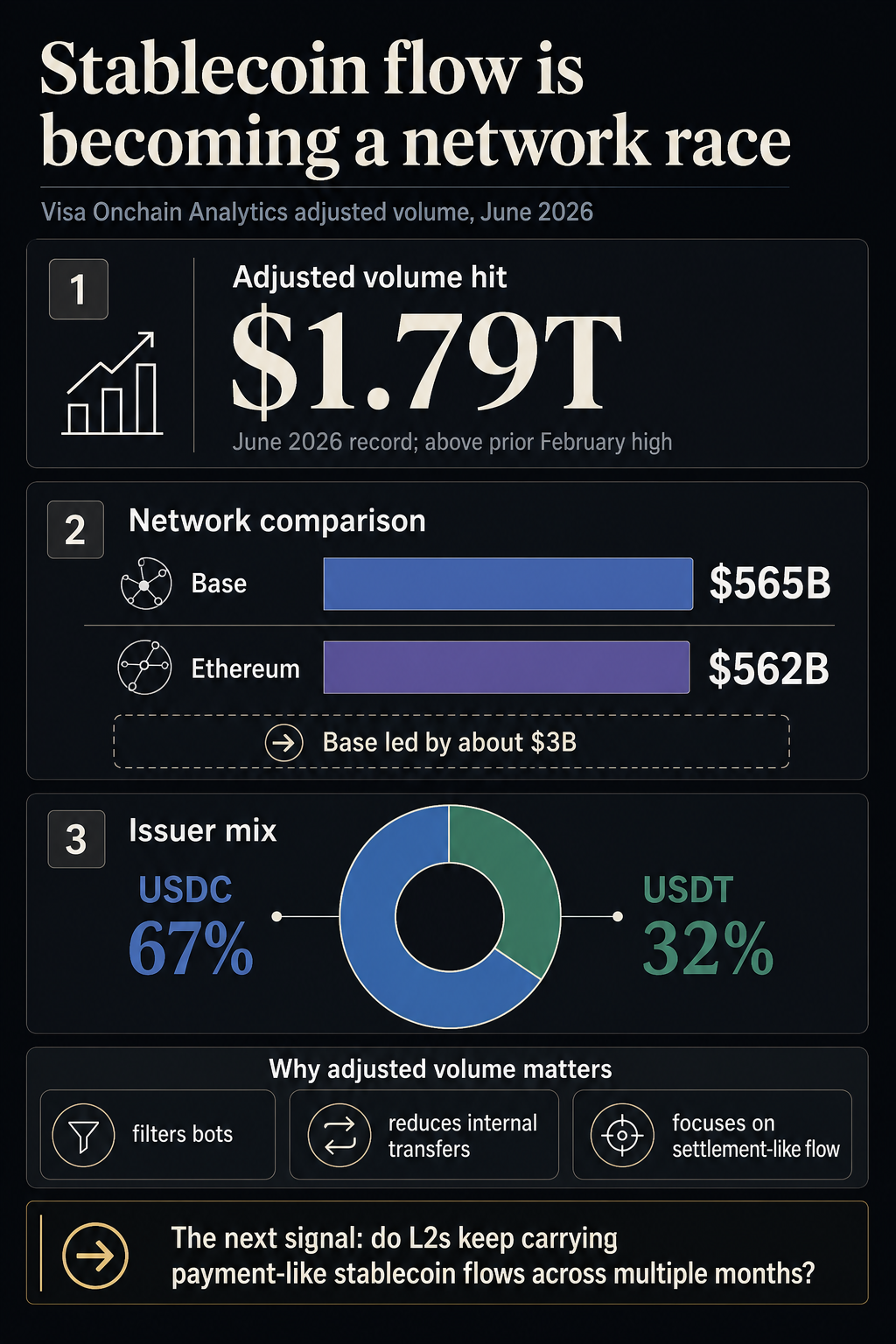
Although the advantage Base may have over Ethereum is small, it is nonetheless a significant achievement. Base is a layer 2 network built around cheaper and faster Ethereum activity. When it reaches the top of an adjusted stablecoin flow chart, it shifts the focus from token supply to payment distribution: wallets, fees, app integrations, and settlement availability.
Visa’s dashboard separates adjusted and unadjusted activity, as raw blockchain volume can include bots, high-frequency wallets, internal smart contract movements, and intra-exchange transfers. Its adjusted methodology, developed with Allium and other partners, attempts to eliminate this noise and move closer to an activity that resembles real settlement.
Filters remain a best-guess approach, and Visa says it will continue to improve its methodology as labeling coverage expands. Even with this limitation, adjusted volume is more useful for the Base-Ethereum comparison than raw transfer volume alone, because it shows where significant movement in the stablecoin is occurring.
The issuer split strengthened the role of USDC in stablecoin settlement. USDC accounted for approximately 67% of June’s adjusted volume, while USDT accounted for approximately 32%. This keeps USDC at the center of stablecoin flows, especially on Base, but the biggest change remains how volume is distributed across networks.
Visa’s broader stablecoin explanation describes stablecoins as a payment infrastructure for cross-border transfers, stablecoin-linked cards, business payments, and seven-day settlements. In this world, the chain that carries the dollars becomes the essential part of the product. Fees, wallet distribution, app integrations, and settlement availability determine whether stablecoins appear usable outside of trading platforms.
Visa’s news page had previously highlighted a much longer L2 trend, noting that L2 networks collectively surpassed Ethereum in monthly number of stablecoin transactions in August 2024 and that Base saw rapid growth in USDC after its launch in 2023. June volume data shows the same trend starting to appear in adjusted dollar flows.
However, the lead remains narrow. The base only surpassed Ethereum by about $3 billion, with both networks clearing over half a trillion dollars in adjusted volume. The next signal is whether L2s continue to capture stable payment-like activity over multiple months and market conditions.


