





Ethereum is once again under pressure, struggling to find the strength to reclaim the $4,000 level amid growing uncertainty in the crypto market. Investor sentiment has become increasingly cautious, with mixed opinions among analysts – some warning that a bear market could be brewing, while others believe this correction could precede a massive rally in the coming weeks.
According to information from CryptoQuant, the latest on-chain data reveals a notable change in Ethereum exchange activity that could shape near-term price dynamics. Despite the recent decline in ETH price, the 7-day moving average of (total) net exchange flow has shifted from strong outflows to inflows, from around -57,000 ETH on October 16 to +7,000 ETH recently.
This change suggests that more ETH is now moving on exchanges, potentially signaling increasing selling pressure as traders prepare to dump assets amid volatility. Historically, such surges in inflows have often preceded short-term pullbacks, especially when accompanied by negative market sentiment. However, some analysts caution that this could also reflect whale repositioning or liquidity management, not an outright distribution.
Ethereum Exchange Flows Rise as Binance Activity Signals Caution
According to CryptoOnchain’s latest analysis on CryptoQuant, Binance appears to be playing a major role in Ethereum’s recent exchange flow dynamics. Data shows that Binance’s 7-day net flow has changed dramatically, from around -31,000 ETH on October 15 to +3,000 ETH in recent days. This single exchange accounts for almost 50% of the total change seen across all major trading platforms, highlighting its significant influence on Ethereum’s short-term liquidity landscape.

This sudden and pronounced increase in ETH deposits on exchanges – especially during a period of price weakness – is generally considered a short-term bearish signal. When traders or institutional holders move coins from private wallets to exchanges, it often suggests that they are willing to sell or reposition in anticipation of further decline. As a result, increased supply on exchanges could increase selling liquidity, making it easier for large sell orders to have a greater impact on price action.
However, analysts also warn against interpreting this decision too narrowly. While foreign exchange flows often precede selling pressure, they may also reflect strategic hedging, margin deposits for derivatives trading, or liquidity management during periods of market stress.
Nonetheless, combined with broader macroeconomic uncertainty and Ethereum’s struggle to stay above key technical levels, this data reinforces the cautious tone prevailing in the market. If inflows persist and Ethereum fails to defend support near $3,800-$3,700, downside risk could intensify. Conversely, a rapid return to capital outflows would signal renewed investor confidence and potentially pave the way for a stronger recovery.
ETH Holds Key Support Amid Uncertainty
Ethereum is currently trading around $3,880, holding slightly above a key near-term support zone near $3,700 to $3,750 as seen in the 3-day chart. The recent retracement took ETH back towards the 50-day moving average, which now serves as an important line of defense for the bulls.
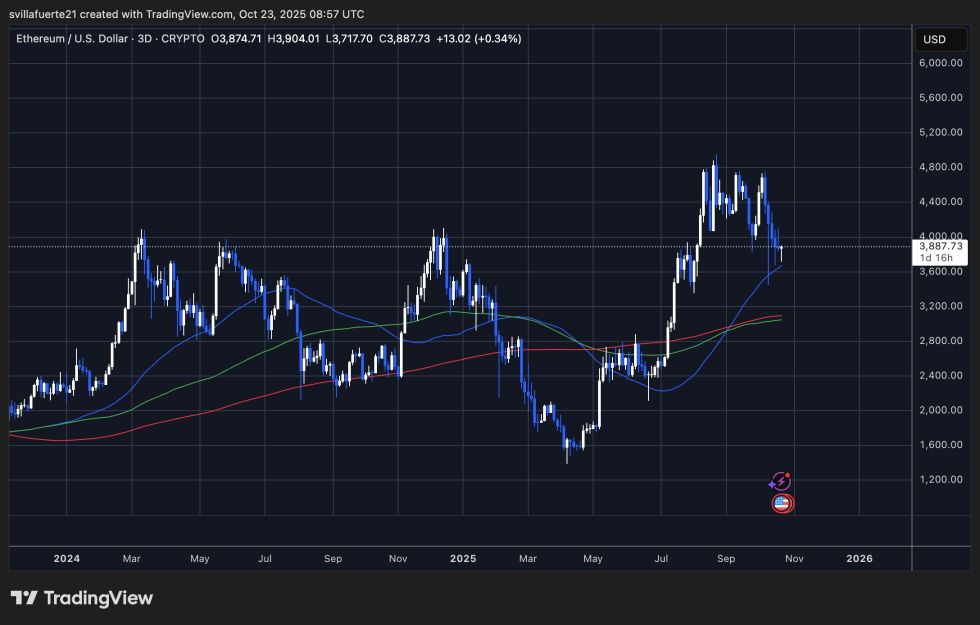
After failing to breach the $4,400 level earlier this month, Ethereum has entered a corrective phase that reflects broader weakness in the altcoin market. The price structure shows lower highs forming from the local top, indicating a fading momentum. However, as long as ETH remains above the 100-day moving average near $3,400, the broader uptrend remains technically intact.
If current support holds, Ethereum could attempt another rally towards $4,000 – $4,200, where strong resistance and previous liquidity clusters lie. A confirmed close above this area would signal renewed strength and potentially mark the end of this correction phase.
On the other hand, a decisive break below $3,700 could expose ETH to greater losses, targeting $3,400 and possibly $3,000, where the strongest historical demand is located. For now, Ethereum’s price action remains at a pivotal point: balancing short-term weakness with medium-term recovery potential.
Featured image from ChatGPT, chart from TradingView.com
Editorial process as Bitcoinist focuses on providing thoroughly researched, accurate and unbiased content. We follow strict sourcing standards and every page undergoes careful review by our team of top technology experts and seasoned editors. This process ensures the integrity, relevance and value of our content to our readers.


