



Ethereum fell below $2,800 after a sharp and sudden drop, deepening market panic and reinforcing the feeling that the bulls have lost control. The recent decline has pushed investors into defensive mode, with some analysts now openly discussing the possibility of a broader bear market. Selling pressure has intensified across cash and derivatives markets, and volatility continues to rise as traders struggle to identify a reliable support zone.
Related reading
A new CryptoQuant report from Darkfost highlights one of the most alarming developments: Ethereum open interest on Binance has been steadily collapsing for over three months. After hitting an all-time high of $12.6 billion on August 22, open interest has now been cut in half. Nearly $6.4 billion in derivative positions evaporated, bringing ETH open interest down to $6.2 billion, a sharp drop of 51%.
While this seems like an extraordinary contraction, Darkfost notes that open interest has only just fallen below the previous all-time high of $7.7 billion. This highlights how speculative and overexploited the derivatives market in 2025 has become – and suggests that Ethereum could undergo a much deeper structural reset than expected.
Speculation Hides on Exchanges as Ethereum Enters Deep Reset Phase
Darkfost points out that 2025 was the most speculative phase in Ethereum’s history, fueled by aggressive leverage, rapid capital inflows, and a market structure that proved far less strong – and far less sustainable – than it was during the rally. The collapse of open interest on Binance is only part of the story.
The same pattern is emerging across major derivatives platforms, revealing a broader structural unwinding rather than an exchange-specific phenomenon.
On Gate.io, ETH open interest increased from $5.2 billion to $3.5 billion. On Bybit, the drop is even more severe, going from $6.1 billion to $2.3 billion. This synchronized contraction shows how aggressively speculative positions were eliminated. Meanwhile, the ongoing correction took Ethereum price from $4,830 to $2,800, marking a sharp 43% decline from the highs.

This widespread reduction in leverage suggests that the market is undergoing a deeper reset than typical corrections. Investors are not rushing to re-enter their positions, especially as liquidations continue to pile up on the stock exchanges.
While decreasing open interest weighs on near-term momentum and sentiment, Darkfost notes that such aggressive deleveraging could ultimately help rebuild a healthier market base – capable of supporting a sustainable floor for ETH.
Related reading
ETH Loses Key Trend Support as 3-Day Structure Turns Fully Bearish
Ethereum’s 3-day chart shows a decisive break in structure, with price now firmly below the 50 SMA, 100 SMA, and 200 SMA for the first time since late 2024. The rejection from the $3,600-$3,800 region triggered a strong downward impulse, sending ETH straight through all major moving averages and confirming a move towards a longer-term downtrend. The current trading zone around $2,800 reflects a critical test of prior support, but momentum remains weak.
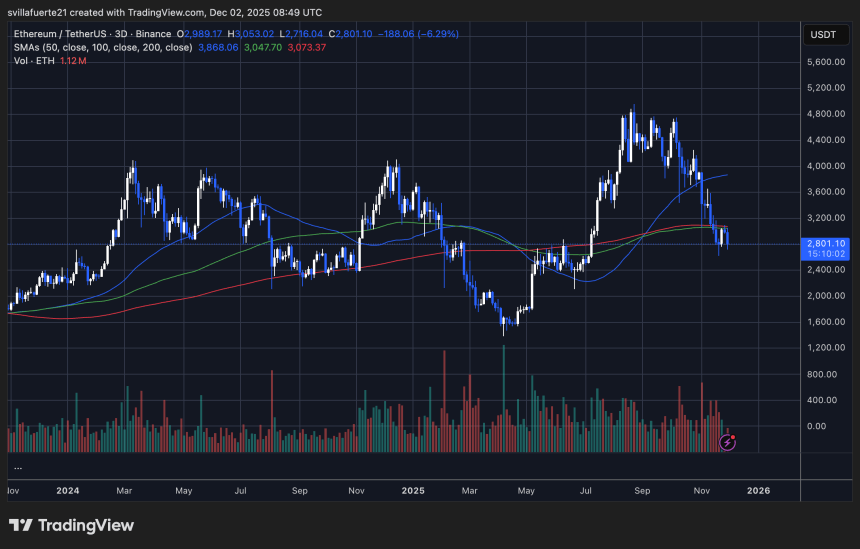
The 50 SMA has now moved below the 100 SMA, while both are beginning to converge lower towards the 200 SMA – a pattern that typically precedes sustained corrections. Volume has increased on the red candles, showing that sellers remain dominant and there is little evidence of aggressive buying on the dips. The most recent candle wick near $2,700 highlights vulnerability rather than strength, suggesting buyers are hesitant to defend this level with conviction.
Related reading
ETH also forms a series of lower highs and lower lows, confirming the bearish market structure. If $2,750 breaks sharply, the next significant liquidity areas are around $2,550 and $2,300, where prior consolidations developed earlier in the cycle.
Featured image from ChatGPT, chart from TradingView.com


