



Fidelity Digital Assets says Bitcoin’s latest pullback has pushed the market into an area that has historically aligned with accumulation phases, even as its momentum signal remains negative and the broader appetite for crypto risk remains narrow.
In its Q2 2026 Signals report, the Fidelity research team described a market that is still going through a correction phase rather than entering a full-scale expansion. Bitcoin remains the dominant source of unrealized profitability across the entire digital asset complex, while other major assets continue to stabilize after a sharp reset in the first quarter.
Fidelity says Bitcoin appears undervalued
The report’s clearest Bitcoin price signal comes from the asset’s “Yardstick,” a valuation framework that compares Bitcoin’s market cap to hash rate. Fidelity rated this indicator as positive, noting that the price decline and hash rate decline have pushed the indicator into what it calls an “undervalued” zone.
Related reading
“Historically, this undervalued area has aligned with accumulation phases and relative troughs,” the report states.
According to Fidelity, Bitcoin spent 71 of the previous 91 days, or 78% of the period, below one negative standard deviation of the Yardstick average. This condition first emerged in October 2025 and was amplified by two cold weather episodes in the United States that temporarily reduced mining activity as operators reduced their electricity consumption to support local grid stability.
This nuance is important. Fidelity does not view the drop in hash rate solely as a sign of deteriorating miner confidence. The report says some analysts have linked the decline to miners shifting to AI-based workloads, but says the move could also reflect demand response programs, particularly in regions like Texas, where miners regularly shut down during peak network demands.
The pricing environment remains difficult. Fidelity’s momentum signal for Bitcoin turned negative on October 18, 2025, when BTC traded near $107,000. Since then, Bitcoin has fallen approximately 36%, with most of the first quarter of 2026 spent in a defined range between $62,500 and $76,022. The company said this trend is more consistent with a consolidation than a trend renewal.
“This signal is not designed to identify specific highs or lows,” Fidelity wrote, adding that the current reading indicates stabilization rather than new bullish momentum.
Bitcoin’s NUPL score also reflects a cautious market. Fidelity said BTC’s net unrealized profit/loss stood at 0.21 at the end of Q1 2026, putting investors in the “Hope-Fear” zone. This reading suggests that some holders remain profitable, but the market has not yet established a broad belief that a sustainable floor is in place.
The historical configuration is more constructive. Fidelity found that previous periods where Bitcoin’s NUPL hovered around 0.21, plus or minus 0.01, coincided with a median one-year return of 63% and a three-year compound annual growth rate of 74%. The company stressed, however, that these historical relationships may weaken or not persist, particularly when macroeconomic conditions dominate digital asset flows.
Related reading
Separately, Fidelity’s Jurrien Timmer highlighted a more tactical Bitcoin setup, sharing a chart that shows BTC testing the upper limit of what he described as a potential bear flag. The chart places Bitcoin near $79,486 after its rebound from the February low around $60,033, with momentum indicators returning to overbought territory.
Timmer presented the current setup as an important technical test. “Technical analysis 101 says that when bear market rallies are overbought, it is usually the kiss of death and it is time to sell,” he wrote. “However, during bull markets, overbought dynamics mean the market is strong and likely to stay that way.”
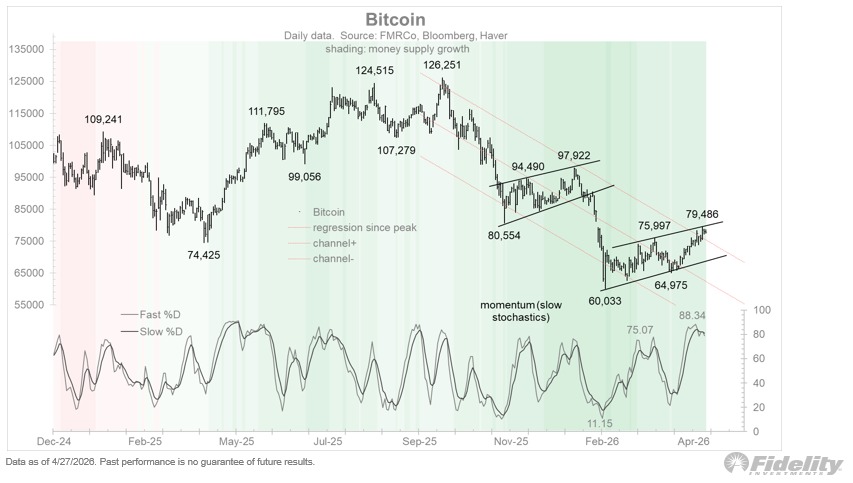
Its conclusion sharpened the pricing question raised by Fidelity’s broader report: whether Bitcoin is still trapped in a corrective structure or whether it is starting to move into a new bullish phase. “If Bitcoin cannot be pulled down by this current combination of overbought momentum and trendline resistance, then this is an emerging bull market and not a bear market rally,” Timmer said, adding that this was his “hunch all along” and “maybe about to be confirmed.”
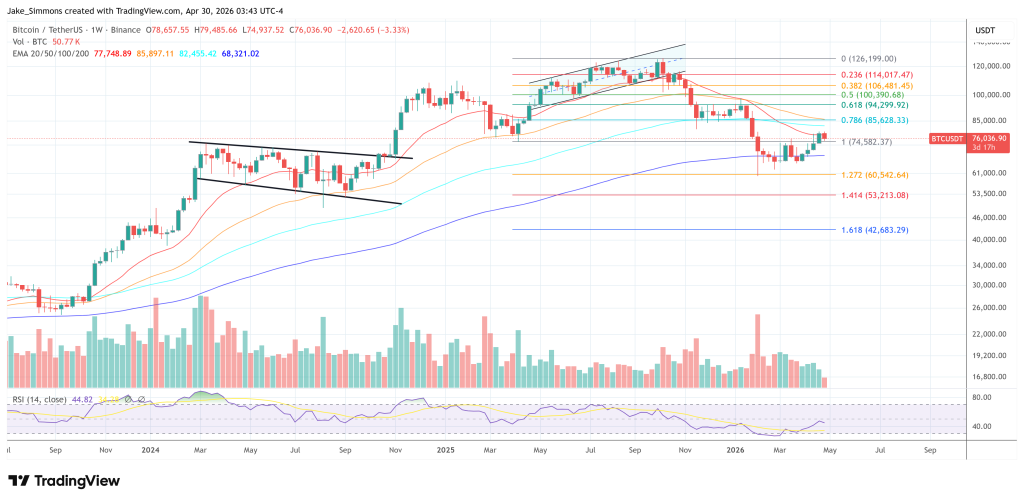
At press time, BTC was trading at $76,036.
Featured image created with DALL.E, chart from TradingView.com


