



Key points to remember:
- Gomining launched GoBTC at Consensus Miami in May 2026, targeting 12 hours BTC settlement for a fee of 0.2%.
- The 0.2% merchant fee reduces fees for card processors who charge 1.5-3.5%, with fees split between wallets and miners.
- Any wallet provider can integrate GoBTC; Gomining dedicates a mining pool to confirm its transactions.
What is GoBTC
When paying, GoBTC gives traders instant authorization, meaning transactions are recorded in real time. Chain settlement on the Bitcoin the network finalizes within 12 hours, using Bitcointhe base coat directly rather than going through a side chainpayment channel or intermediary depository.
The protocol is non-custodial and free for users, and traders pay a flat fee of 0.2%, split evenly between wallet providers and bitcoin minors. As a reminder, traditional card processors charge between 1.5% and 3.5% per transaction.
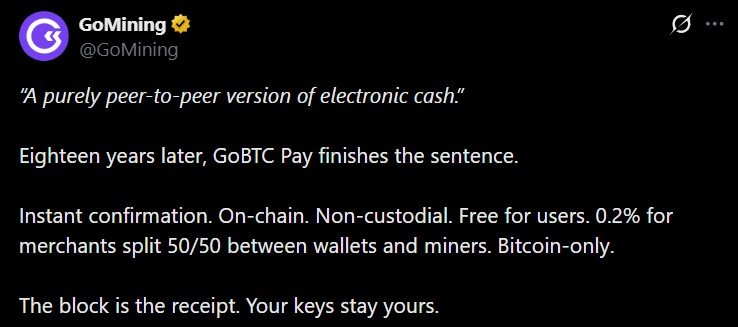
GoBTC is an open infrastructure, meaning any wallet provider can integrate the protocol, and Gomining dedicates a specific mining pool to confirming GoBTC transactions, giving the payment layer dedicated block space without competing with the standard. bitcoin traffic. The company is targeting full 12-hour on-chain settlement across the system by the end of 2026.
Why now?
Bitcoin‘s white paper, published 17 years ago, described the network as a “peer-to-peer electronic payment system.” By most measures, this vision has remained elusive in everyday commerce because in the United States only about 2,300 companies accept bitcoin directly, even though 22% of American adults own them.
THE Lightning NetworkBitcoin’s main payment layer, introduced in 2018 to solve this problem, took seven years to reach $1 billion in monthly volume. And, although Lightning has since made real progress, processing $1.17 billion in volume in November 2025 and more than 12 million monthly transactions in 2026, its routing complexity and limited merchant adoption have prevented widespread use.
GoBTC takes a different architectural gamble in which it settles directly on-chain using Bitcoin’s block confirmation mechanism, with Gomining’s mining infrastructure absorbing settlement latency. The model’s ability to scale beyond initial integrations will depend on wallet provider adoption and how merchants respond to the pre-settlement authorization timeline.
For Gomining, this launch marks an expansion beyond its roots of mining as a service in the payment infrastructure layer, there is a bet that the company best placed to confirm Bitcoin transactions is also best placed to settle them.


