



Key takeaways
- Coinbase’s Faryar Shirzad called the Clarity Act “a dramatic step forward in consumer protection.”
- The Senate is targeting floor action the week of July 20, with the August 7 recess leaving a narrow window.
- Coinbase plans tokenized shares and an “everything exchange” if the bill clears the 60-vote hurdle.
More support pours in
Shirzad defended the Digital Asset Market Clarity Act in an interview with Fox Business on Wednesday, describing the legislation as “a dramatic step forward in consumer protection and market integrity.” The appearance, which comes as the bill nears its decisive phase, is part of an intensifying industry effort ahead of an expected vote in the Senate.
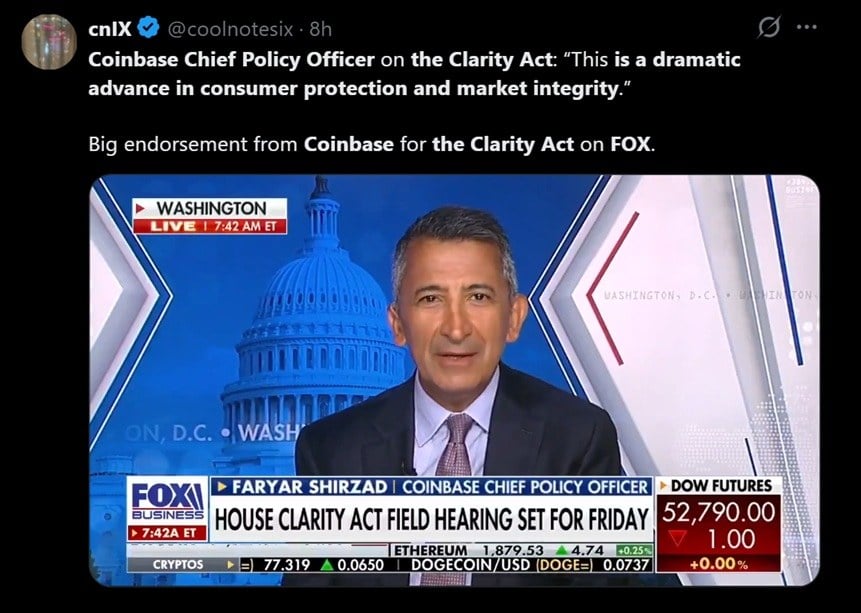
The Coinbase executive called the bill a way to unlock the exchange’s next act, adding:
CLARITY is the law that gives us the regulatory certainty needed to offer these products to our customers. There is a huge movement across the financial system to move financial assets on-chain.
The Clarity Act would create the first comprehensive federal framework for digital assets, dividing regulatory responsibilities between the Securities and Exchange Commission (SEC) and the Commodity Futures Trading Commission (CFTC). It addresses how assets are classified, what issuers must disclose and how trading platforms register, issues that have been debated piecemeal for a decade.
The measure has been debated in Congress for nearly a year. The House approved its version in July 2025, and the Senate Banking Committee advanced its plan by a 15-9 vote in May 2026. Negotiators released a consolidated text this week after about 10 months of negotiations, and the measure was added to the Senate calendar, with floor action targeted for the week of July 20.
Passage requires 60 votes, and the Senate’s Aug. 7 recess leaves a narrow window because the bill has already missed the White House’s July 4 signature goal.
The push and pull back
Momentum has been building in unusual directions, with President Donald Trump recently urging the Senate on July 13 to pass the bill, warning that China could take the lead in crypto innovation, and the Federal Law Enforcement Officers Association this week becoming the second approval from law enforcement of the measurement.
Opposition remains concentrated among a group of Democrats led by Sen. Elizabeth Warren, who has said the bill is a way to circumvent sanctions because of exemptions for some non-custody services. Shirzad rejected such posturing, arguing that the bill would place crypto platforms under the obligations of the Bank Secrecy Act, including anti-money laundering programs and customer verification. “This is not a free pass to crypto,” he said earlier this month, calling the measure a “strict security mandate.”
Ethics rules, stable rewards and developer protections were the last remaining disputes as staff finalized the proposed merger, according to reports last week. The next step is the floor vote itself, where the bipartisan committee’s support for the bill faces a broader test. Shirzad predicted the votes would be there, pointing to the roughly 80 House Democrats who supported the previous version. With only three work weeks left before the holidays and mid-term politics drawing closer, the clarity law is finally down to the only countdown that counts, namely 60.


