




Pi Network price soared nearly 20% to around $0.086 on July 15 after an oversold rebound, with improving U.S. inflation data and renewed buying interest combining to push the token off new record lows.
Summary
- Pi Network price surged nearly 20% after an oversold rebound and weaker U.S. inflation data boosted cryptocurrency sentiment.
- A bullish MACD crossover and higher trading volume supported the recovery, although the IP remains below key moving averages.
- July’s massive token unlocks continue to pressure the market despite new Pi2Day products and ecosystem upgrades.
According to data from crypto.news, Pi Network (PI) rebounded from the $0.070 to $0.072 area before hitting an intraday high near $0.086, while the latest US inflation figures helped fuel a relief rally in the cryptocurrency market.
The move follows several weeks of relentless selling that erased about 40% of the token’s value and pushed momentum indicators into deeply oversold territory, encouraging bargain hunters and short-term traders to return to the market.
Oversold conditions and macroeconomic relief supported the rebound
The rally accelerated after Pi’s daily Relative Strength Index fell to around 15, a level that typically signals the exhaustion of selling pressure.
At the same time, weaker-than-expected U.S. consumer price data improved confidence in digital assets, attracting new liquidity to high-risk cryptocurrencies that had suffered some of the steepest declines during the recent market correction.
Trading activity also accelerated during the rally, with daily volume surpassing $27 million as speculative buyers returned. On the 4-hour chart, Pi also produced a bullish crossover in the MACD, while the histogram turned positive for the first time in days, suggesting that bearish momentum has weakened in the near term.
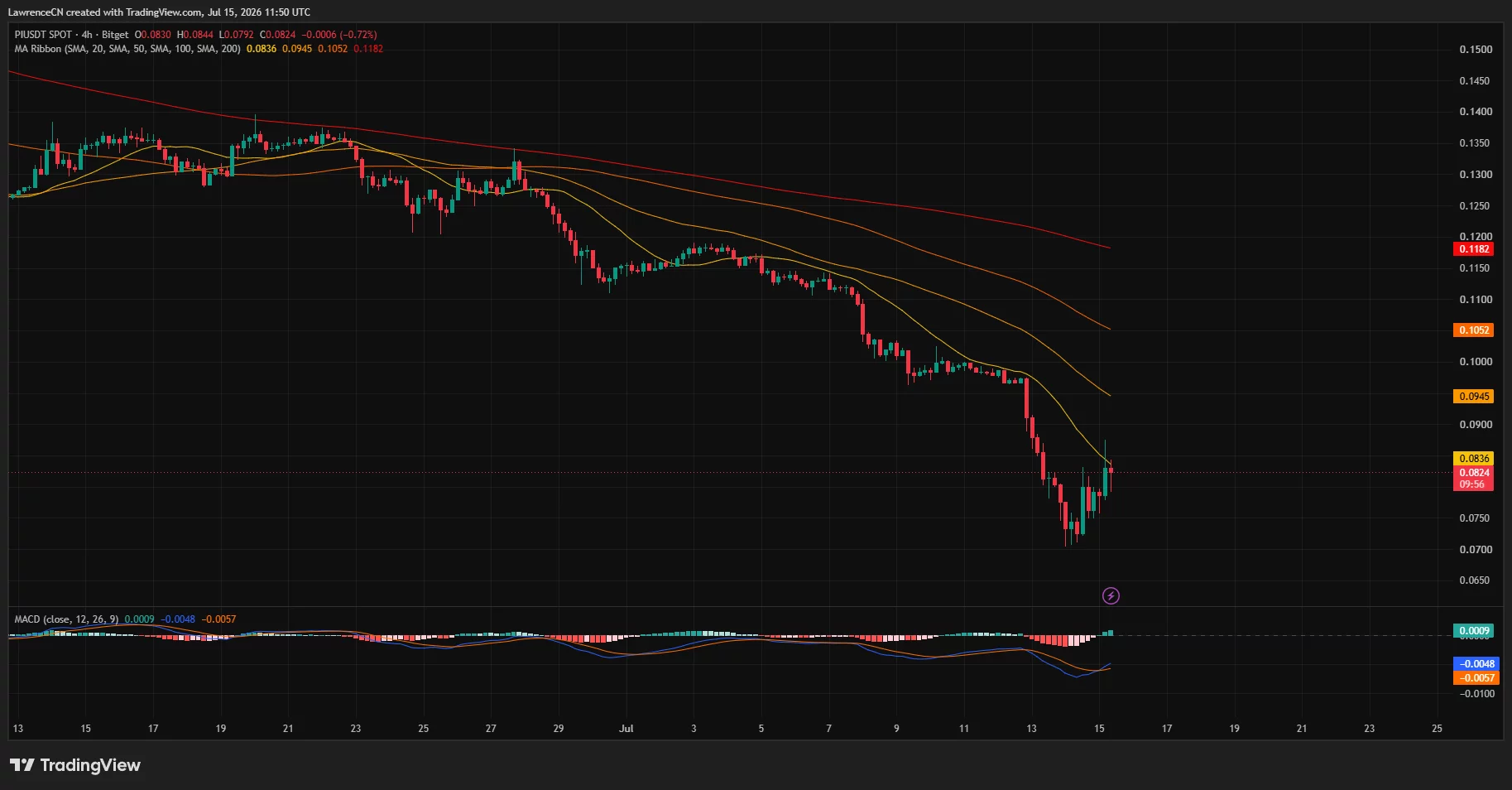
Despite this, the technical situation has not yet completely recovered. Data from TradingView shows that PI remains below all of its key moving averages, including the 50, 100 and 200 period simple moving averages, leaving the dominant downtrend intact despite the latest bounce.
The token briefly recovered its 20-period moving average near $0.084 before encountering resistance, indicating that buyers still face selling pressure as prices attempt to recover.
From a price structure perspective, the recent rebound has helped make the $0.070 area an important near-term support area. However, stronger resistance now lies near the 50-period moving average around $0.094, followed by around $0.105 and $0.118, levels that would need to be reclaimed before the market can begin to reverse the broader downtrend.
Massive token unlocks continue to weigh on sentiment
Although macroeconomic conditions helped spark today’s rally, the factors behind Pi’s prolonged decline remain largely unchanged. Throughout July, the network absorbed significant scheduled token unlocks, with approximately 103.7-127 million PI entering circulation. The steady increase in available supply has repeatedly exceeded organic demand, contributing to sharp breaks below the $0.12 and $0.10 support levels.
At the same time, capital continued to flow into AI-related stocks in the United States and East Asia, reducing investor appetite for smaller, thinly traded crypto assets such as Pi. The combination of a growing token supply and weaker speculative demand limited sustained buying pressure despite occasional relief rallies.
Developers nevertheless continued to introduce new products intended to build long-term utility within the ecosystem. Recent versions of Pi2Day have added decentralized application hosting, developer SDKs, and an automated Know Your Customer verification service that requires payments in PI.
Alongside these launches, ongoing core upgrades based on newer versions of the Stellar protocol and continued community speculation regarding potential listings on major exchanges such as Kraken remain among the key narratives that advocates believe could improve demand over time, although no such listing has been officially confirmed.


